Names
Forsterite
Intro
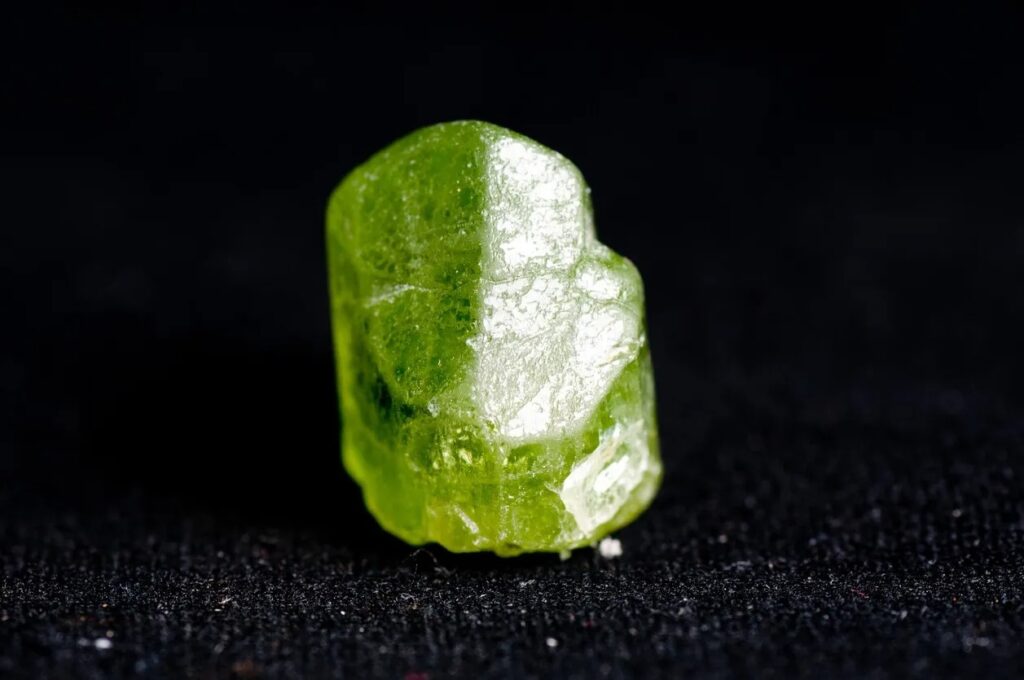
Forsterite is the magnesium-rich endmember of the olivine solid-solution series (Mg₂SiO₄ - Fe₂SiO₄), crystallizing in the orthorhombic crystal system. As an essential rock-forming orthosilicate (nesosilicate) mineral, it constitutes the dominant volumetric phase of Earth's upper mantle (peridotite/dunite) and is widespread in ultramafic igneous rocks, contact-metamorphosed dolomitic limestones, and primitive chondritic meteorites. Gem-quality intermediate varieties rich in the forsterite component are celebrated worldwide as Peridot.
Basic Information Show Hide
Mineral ID
forsterite
Common Synonyms / Aliases
Magnesium olivine, Peridot (gem variety), Chrysolite (archaic), Bolitas, White olivine
Chemistry Show Hide
Chemical Formula
Mg₂SiO₄
Elements
Mg, Si, O
Minor Elements / Impurities
Fe, Mn, Ni, Ca, Cr
Empirical Formula
Mg₂.₀₀Si₁.₀₀O₄.₀₀
Molecular Weight (g/mol)
140.69
Solubility
Insoluble in water; slowly dissolves in cold dilute acids, decomposes in hot concentrated HCl.
Reaction to Acid
Moderate (Dissolves relatively rapidly in weak or dilute acids with silica gel formation).
Classification Show Hide
Mineral Type
Mineral Species
IMA Status
Approved
IMA Symbol
Fo
Strunz Classification
09.AC.05
Dana Classification
51.03.01.01
Mineral Group
Olivine Group
Crystal Structure Show Hide
Crystal System
Orthorhombic
Crystal Habit
Prismatic to tabular crystals flattened on {100} or {010}, equant to rounded grains, granular and massive aggregates (dunites/peridotites), disseminated xenocrysts, and embedded nodules.
Crystal Class
2/m 2/m 2/m (Dipyramidal)
Space Group
Pbnm
Cell Parameter A (Angstrom)
4.754
Cell Parameter B (Angstrom)
10.197
Cell Parameter C (Angstrom)
5.981
Cell Angle Alpha (Degrees)
90
Cell Angle Beta (Degrees)
90
Cell Angle Gamma (Degrees)
90
Unit Cell Z
4
Crystal Twinning
Rare on {011}, {012}, or {100}
Common Crystal Faces
{010}, {100}, {021}, {110}, {120}, {111}
Physical Properties Show Hide
Primary Color
ColorlessYellow (Y)greenish Yellow (gY)Yellow-Green or Green-Yellow (YG/GY)yellowish Green (yG)Green (G)WhiteGray
Common Colors
Pale green, yellowish green, olive green, white, gray, pale yellow
Streak
White
Luster
Vitreous
Transparency / Diaphaneity
Transparent to translucent.
Hardness (Mohs)
6.5 - 7.0
Cleavage
Poor
Cleavage Direction
{010} imperfect, {100} very poor
Cleavage Angle / Parting Quality
Cleavage on {010} is distinct/imperfect; parting rarely observed along {100}.
Fracture
Conchoidal to uneven.
Tenacity
Brittle
Specific Gravity
3.22 - 3.27
Magnetism
Non-magnetic (diamagnetic for pure endmember; weakly paramagnetic with increasing Fe content).
Melting Point
1890 °C (3434 °F) (pure endmember at 1 atm, melts congruently).
Thermal Stability
Highly refractory; stable at ambient pressure up to its melting point. Under high mantle pressure regimes (>13-14 GPa), transforms to wadsleyite (beta-spinel phase) and subsequently to ringwoodite (gamma-spinel phase) in the mantle transition zone.
Optical Properties Show Hide
Refractive Index
1.635 - 1.670
Refractive Index Alpha
1.635
Refractive Index Beta
1.651
Refractive Index Gamma
1.670
Optical Axial Angle (2V)
82° - 90°
Optical Sign / Extinction
Positive (+) (pure endmember and compositions Fo₁₀₀ to ~Fo₈₈ are Biaxial (+); crosses over to Biaxial (-) as Fe increases above ~12 mol%)
Birefringence
0.035
Dispersion
Weak (r > v)
Optical Character
Biaxial+
Pleochroism
Weak to None
Pleochroism Details
Very weak in Fe-bearing varieties: X = pale yellow-green to brownish-yellow, Y = pale green, Z = pale green to colorless; non-pleochroic in pure colorless forsterite.
Optical Phenomena
Rarely exhibits chatoyancy (cat's-eye effect) or asterism (star peridot) due to oriented needle-like inclusions of chromite or ludwigite.
Fluorescence
Inert under UV light.
Luminescence / Phosphorescence / Thermoluminescence
Non-fluorescent under shortwave (254 nm) and longwave (365 nm) ultraviolet radiation.
Absorption Spectrum
Typical Fe²⁺ absorption bands around 453 nm, 473 nm, 493 nm, and broad NIR bands.
Occurrence and Formation Show Hide
Formation Process
Early magmatic crystallization in mafic-ultramafic rocks; metamorphism of siliceous dolomites; condensation in early solar nebula (chondrites).
Geological Environment
Dunites, peridotites, kimberlites, skarns, metamorphosed limestones, and stony meteorites.
Associated Minerals
Diopside, Calcite, Dolomite, Spinel, Phlogopite, Enstatite, Magnetite, Chromite
Type Locality
Mount Somma, Somma-Vesuvius Complex, Naples, Campania, Italy
Major Producing Countries / Localities
AustraliaBrazilCanadaChinaEgyptFinlandGermanyItalyMyanmarNorwayPakistanRussiaSouth AfricaSri LankaUnited States
Economic Deposit Type
Magmatic cumulates, contact metasomatic skarns, and pallasite meteorites.
History and Naming Show Hide
Discovery Year
1824 (Described and named by Armand Lévy).
Name Origin
Named in honor of the prominent English mineral collector and dealer Adolarius Jacob Forster (1739–1806).
Type Specimen Repository
Natural History Museum, London, UK / Harvard University Mineralogical Museum, Cambridge, MA, USA
Safety and Related Information Show Hide
Wearability
Good
Health Hazards
Completely non-toxic and skin-safe in solid mineral and jewelry form; standard wet-cutting and respiratory dust protections apply when cutting, crushing, or grinding bulk rock matrices.
Handling Precautions
Never clean using ultrasonic or steam cleaners due to thermal and mechanical shock vulnerability; avoid contact with acids (including citrus juices, vinegar, and pickling solutions) which etch and degrade the polished surface.
Varieties
Peridot (gem-quality green variety), Dunite (ultramafic rock primarily composed of forsterite), Chrysolite (traditional yellow-green variety name), Extraterrestrial Peridot (pallasitic olivine).
Polytypes
None (High-pressure polymorphs include Wadsleyite and Ringwoodite).
Related Minerals
Fayalite (Fe₂SiO₄), Tephroite (Mn₂SiO₄), Monticellite (CaMgSiO₄), Kirschsteinite (CaFeSiO₄), Liebenbergite (Ni₂SiO₄), Laihunite (Fe³⁺-bearing defect olivine).
Commercial and Gemology Show Hide
Common Treatments
Generally untreated (natural unenhanced); rarely fracture-filled with epoxy/resins or metal foil-backed in antique settings.
Enhancements
None standard
Common Cuts
Brilliant cutoval mixed cutcushion cutemerald/step cutround brilliantpear cutcabochon (for included or star stones)faceted beadscarving.
Rarity / Market Grade
Common (as a primary rock-forming mineral and small gemstone grains; flawless gem-quality crystals over 10 carats from Zabargad, Pakistan, or Myanmar are Rare to Museum-grade).