Names
Halite
Intro
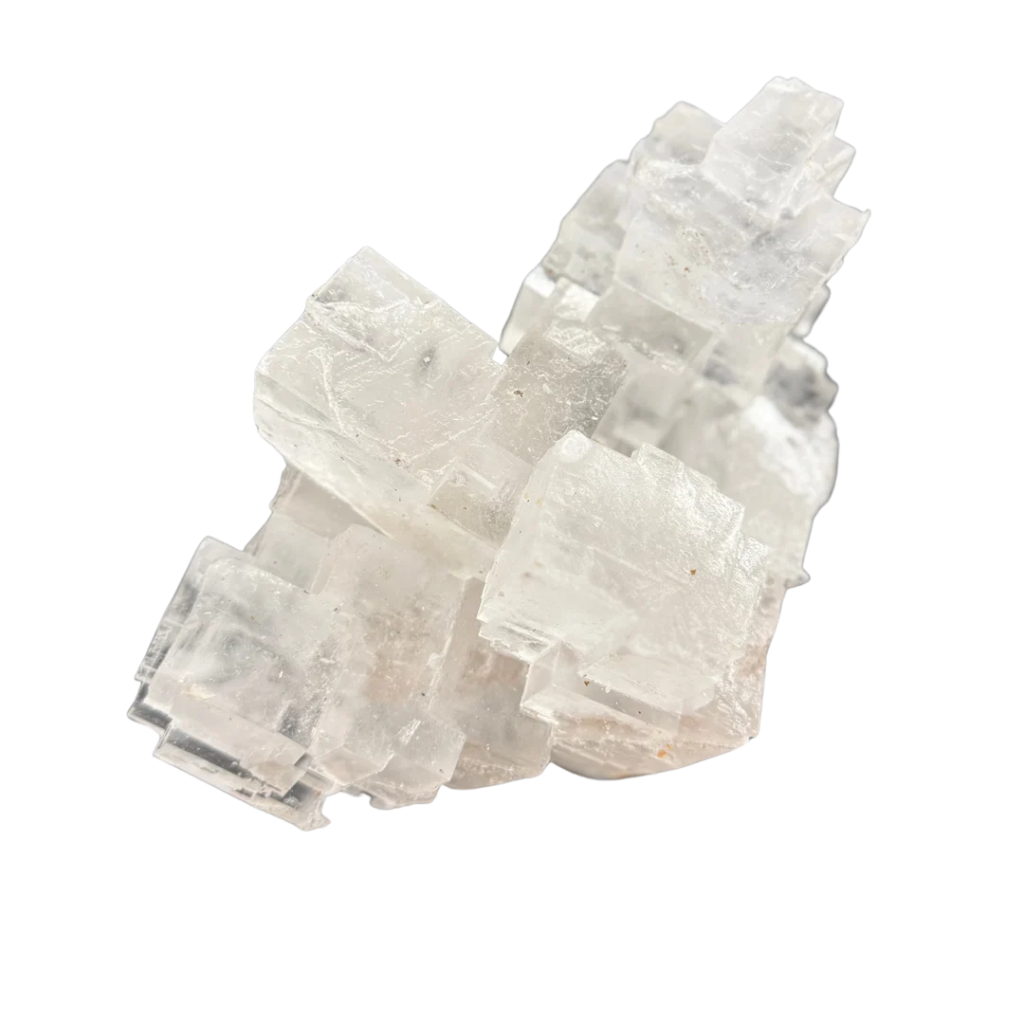
Halite is the mineral form of sodium chloride (NaCl), commonly known as rock salt. It forms isometric crystals in evaporite deposits and is essential to human life, industry, and chemical production.
Basic Information Show Hide
Mineral ID
halite
Common Synonyms / Aliases
Rock salt, Table salt, Common salt
Chemistry Show Hide
Chemical Formula
NaCl
Elements
Sodium (Na), Chlorine (Cl)
Minor Elements / Impurities
Fe, S, Br, Ca, Mg, K, clay, organic matter
Empirical Formula
NaCl
Molecular Weight (g/mol)
58.44
Solubility
Highly soluble in water (~357 g/L at 20°C)
Reaction to Acid
None (Dissolves readily in aqueous acids without effervescence; releases hydrogen chloride (HCl) gas when reacted with concentrated sulfuric acid (H₂SO₄)).
Classification Show Hide
Mineral Type
Mineral Species
IMA Status
Approved
IMA Symbol
Hlt
Strunz Classification
03.AA.20
Dana Classification
09.01.01.01
Mineral Group
Halides (Halite Group)
Crystal Structure Show Hide
Crystal System
Isometric (Cubic)
Crystal Habit
Cubic crystals, hopper crystals, granular, massive, fibrous
Crystal Class
Hexoctahedral (4/m -3 2/m)
Space Group
Fm-3m
Cell Parameter A (Angstrom)
5.640 Å
Cell Parameter B (Angstrom)
5.640 Å
Cell Parameter C (Angstrom)
5.640 Å
Cell Angle Alpha (Degrees)
90°
Cell Angle Beta (Degrees)
90°
Cell Angle Gamma (Degrees)
90°
Unit Cell Z
4
Crystal Twinning
Rare on {111} (spinel twin law)
Common Crystal Faces
{100}, rarely {111}, {110}
Physical Properties Show Hide
Primary Color
ColorlessWhite
Common Colors
Colorless, white, yellow, red, orange, pink, blue, purple
Streak
White
Luster
Vitreous (glassy) to greasy or slightly resinous on old exposed faces.
Transparency / Diaphaneity
Transparent to translucent (opaque in dense impure rock aggregates).
Hardness (Mohs)
2 - 2.5
Cleavage
Perfect
Cleavage Direction
{100} cubic in three directions at 90°
Cleavage Angle / Parting Quality
Perfect cubic cleavage; no parting
Fracture
Conchoidal to uneven (rarely observed due to prominent cleavage dominance).
Tenacity
Brittle; plastic under high confining pressure and elevated geological temperatures (salt tectonics).
Specific Gravity
2.16 - 2.17
Magnetism
Non-magnetic (diamagnetic).
Melting Point
801 °C
Thermal Stability
Stable under ambient conditions; hygroscopic in high humidity
Optical Properties Show Hide
Refractive Index
1.544
Refractive Index Alpha
1.544
Refractive Index Beta
1.544
Refractive Index Gamma
1.544
Optical Axial Angle (2V)
0°
Optical Sign / Extinction
None (Isotropic; may exhibit anomalous weak birefringence under internal structural strain).
Birefringence
0.000
Dispersion
Low (V = 0.013)
Optical Character
Isotropic
Pleochroism
None
Pleochroism Details
None in plane-polarized light.
Optical Phenomena
Structural color defects (f-centers) cause intense blue or violet coloration in some specimens.
Fluorescence
Shortwave/Longwave UV: orange, red, yellow (due to organic inclusions or impurities)
Luminescence / Phosphorescence / Thermoluminescence
Fluorescent (some specimens fluoresce orange, red, or yellow under UV)
Absorption Spectrum
Highly transparent across the infrared and ultraviolet spectrum; widely used for IR spectroscopy optical windows (NaCl transmission window: 0.25 µm to 16 µm).
Occurrence and Formation Show Hide
Formation Process
Precipitation from evaporating seawater or saline inland lake waters in arid regions.
Geological Environment
Sedimentary evaporite deposits, salt domes, dry lake beds (playas), fumarolic deposits.
Associated Minerals
Gypsum, Anhydrite, Sylvite, Carnallite, Polyhalite, Dolomite, Calcite
Type Locality
Known since antiquity; no formal modern type locality.
Major Producing Countries / Localities
AlgeriaArgentinaAustraliaAustriaBoliviaCanadaChileChinaEgyptEthiopiaGermanyIranIsraelKazakhstanMexicoPakistanPolandRomaniaRussiaSpainTunisiaUkraineUnited KingdomUnited States
Economic Deposit Type
Bedded evaporite, salt dome, playa lake deposit
History and Naming Show Hide
Discovery Year
Known since antiquity
Name Origin
From the Greek word "hals" (salt) and "lithos" (stone).
Type Specimen Repository
None preserved (Prehistoric recognition).
Safety and Related Information Show Hide
Wearability
Poor
Health Hazards
Generally non-toxic. High ingestion levels can cause hypernatremia; dust inhalation may irritate lungs and eyes.
Handling Precautions
Store in hermetically sealed containers with desiccants at low relative humidity (
Varieties
Blue Halite (irradiated), Hopper Halite (skeletal crystallization), Rock Salt (massive impure bedded deposit).
Polytypes
None
Related Minerals
Sylvite (KCl), Carobbiite (KF), Villiaumite (NaF), Chlorargyrite (AgCl).
Commercial and Gemology Show Hide
Common Treatments
Irradiation (can induce blue or violet color centers)
Enhancements
None common
Common Cuts
Collector cabochons or faceted stones (rare novelty collectors only)carved decorative lampsculinary slabsor raw structural crystal clusters.
Rarity / Market Grade
Extremely Common (as massive rock salt; well-crystallized aesthetic blue/hopper display specimens are Rare to Museum-grade).