Names
Hercynite
Intro
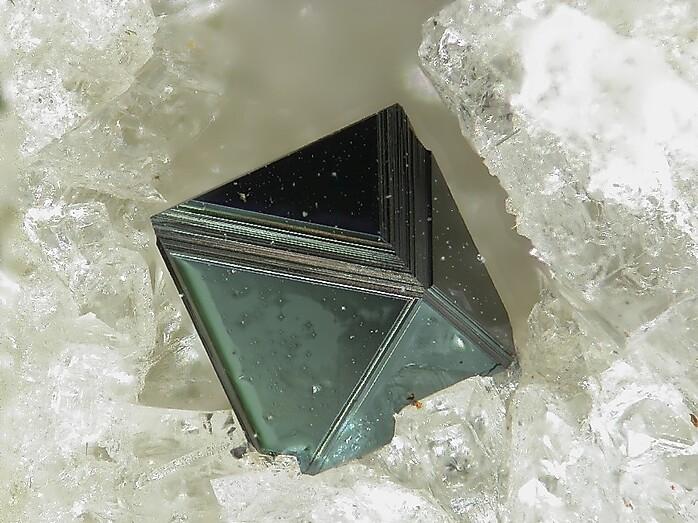
Hercynite is a dense, refractory iron-aluminum oxide mineral belonging to the spinel group, characterized by the ideal chemical formula Fe²⁺Al₂O₄. Crystallizing in the isometric system as sharp black octahedra or granular masses, it forms predominantly in high-grade aluminous metamorphic rocks and mafic-ultramafic igneous intrusions, serving as both a key petrogenetic indicator and a high-temperature refractory phase.
View article
Basic Information Show Hide
Mineral ID
hercynite
Common Synonyms / Aliases
Ferrospinel, Iron Spinel, Hercinite
Chemistry Show Hide
Chemical Formula
Fe²⁺Al₂O₄
Elements
Elements represented by the ideal formula: FeAl2O4. Trace-element content and substitutions depend on the specimen.
Minor Elements / Impurities
Mg, Zn, Mn, Ca (substituting at the divalent A-site); Cr, V, Ti, Fe³⁺ (substituting at the trivalent B-site). Forms extensive solid solutions with Spinel (MgAl₂O₄), Magnetite (Fe²⁺Fe³⁺₂O₄), and Chromite (Fe²⁺Cr₂O₄)
Empirical Formula
FeAl₂O₄
Molecular Weight (g/mol)
173.81
Solubility
Insoluble in water; requires high-temperature fusion with potassium bisulfate (KHSO₄) or sodium carbonate/borax fluxes for complete chemical decomposition
Reaction to Acid
Virtually insoluble and inert in hydrochloric acid (HCl), nitric acid (HNO₃), and dilute sulfuric acid at room temperature
Classification Show Hide
Mineral Type
Mineral Species
IMA Status
Grandfathered
IMA Symbol
Hc
Strunz Classification
4.BB.05
Dana Classification
07.02.01.03
Mineral Group
Spinel group
Crystal Structure Show Hide
Crystal System
Isometric (Cubic)
Crystal Habit
Sharp octahedral crystals (typically small, up to a few millimeters), massive, granular, disseminated rounded grains, and intergrowths with magnetite or corundum
Crystal Class
Hexoctahedral (m3̄m / 4/m 3̄ 2/m)
Space Group
Fd3̄m
Cell Parameter A (Angstrom)
8.153
Cell Parameter B (Angstrom)
8.153
Cell Parameter C (Angstrom)
8.153
Cell Angle Alpha (Degrees)
90
Cell Angle Beta (Degrees)
90
Cell Angle Gamma (Degrees)
90
Unit Cell Z
8
Crystal Twinning
Common contact and penetration twinning according to the Spinel Law with twin plane {111}
Common Crystal Faces
{111} (dominant octahedron), {110} (dodecahedron), {100} (cube)
Physical Properties Show Hide
Primary Color
Green (G)Black
Common Colors
Black, Dark Greenish-Black, Dark Gray; deep emerald green, olive green, or dark brownish-green in thin section under transmitted light
Streak
Dark Gray to Dark Greenish-Gray
Luster
Vitreous, Submetallic, Dull (in fine-grained massive aggregates)
Transparency / Diaphaneity
Opaque (translucent only on microscopic thin edges or in petrographic thin sections)
Hardness (Mohs)
7.5 - 8
Cleavage
None
Cleavage Direction
None (indistinct parting along {111})
Cleavage / Parting Description
Lacks true crystallographic cleavage; exhibits indistinct octahedral parting parallel to {111}
Fracture
Conchoidal to Uneven
Tenacity
Brittle
Specific Gravity
3.91 - 4.4
Magnetism
Non-magnetic to very weakly paramagnetic (increases slightly if significant Fe³⁺ substitution toward magnetite is present)
Melting Point
~1780 °C
Thermal Stability
Highly refractory and thermally stable up to its melting point in reducing or neutral atmospheres; oxidizes in air above 800–1000 °C to decompose into hematite (Fe₂O₃) and corundum (Al₂O₃) phases
Optical Properties Show Hide
Refractive Index
1.790 - 1.835
Optical Sign / Extinction
Isotropic; remains completely dark (extinct) upon 360° stage rotation under crossed polars
Birefringence
0
Dispersion
Moderate (normally masked by intense dark body color)
Optical Character
Isotropic
Pleochroism Details
None; displays uniform dark green to brownish-green transmitted color regardless of crystal orientation
Optical Phenomena
Rare asterism (4- or 6-rayed star effect when oriented exsolution needles of rutile or magnetite are present)
Fluorescence
Inert under both short-wave (SW) and long-wave (LW) UV light
Absorption Spectrum
Strong broad absorption below 500 nm and centered around 550–600 nm caused by tetrahedrally coordinated Fe²⁺ ions
Occurrence and Formation Show Hide
Formation Process
Crystallizes during high-grade regional metamorphism (granulite and upper amphibolite facies) and thermal contact metamorphism of iron- and aluminum-rich pelitic sediments, as well as early magmatic crystallization in silica-undersaturated mafic/ultramafic intrusions and corundum-magnetite emery deposits
Geological Environment
Granulite-facies metapelites, contact hornfels aureoles, mafic-ultramafic layered intrusions, and metamorphosed bauxite/emery deposits
Associated Minerals
Corundum, Magnetite, Sillimanite, Andalusite, Kyanite, Cordierite, Almandine Garnet, Biotite, Orthopyroxene, Ilmenite, Sapphirine, Plagioclase
Type Locality
Poběžovice (Ronsperg), Domažlice District, Plzeň Region, Czech Republic (Bohemian Massif / historical Hercynian Forest)
Major Producing Countries / Localities
ArgentinaAustraliaAustriaBrazilCanadaChinaCzechiaFinlandFranceGermanyIndiaItalyJapanMadagascarMexicoNamibiaNorwayPolandRussiaSouth AfricaSpainSri LankaSwedenTanzaniaUnited KingdomUnited StatesVietnam
Economic Deposit Type
Metamorphic emery deposits, magmatic oxide segregations, and high-alumina refractory mineral assemblages
History and Naming Show Hide
Discovery Year
1839 (Described and named by Austrian mineralogist Franz Xaver Maximilian Zippe)
Name Origin
Named after Silva Hercynia, the ancient Roman/Latin name for the Hercynian Forest (stretching across the Bohemian Forest and Harz Mountains of Central Europe) where the type specimens were collected
Type Specimen Repository
National Museum, Prague, Czech Republic; Natural History Museum, Vienna, Austria
Safety and Related Information Show Hide
Wearability
Very Good
Health Hazards
Non-toxic and non-radioactive; mechanical cutting, crushing, or dry grinding generates fine mineral dust that can irritate the respiratory tract
Handling Precautions
Use wet cutting techniques and wear a certified particulate respirator (N95/P2) during lapidary shaping or sample preparation; safe for routine handling and display
Varieties
Picotite (chromian hercynite, (Fe²⁺,Mg)(Al,Cr,Fe³⁺)₂O₄), Pleonaste / Ceylonite (intermediate Mg-Fe²⁺ solid solution, (Mg,Fe²⁺)Al₂O₄)
Polytypes
Consult crystallographic literature for confirmed polytypes, where applicable.
Related Minerals
Spinel (MgAl₂O₄), Gahnite (ZnAl₂O₄), Galaxite (MnAl₂O₄), Magnetite (Fe²⁺Fe³⁺₂O₄), Chromite (Fe²⁺Cr₂O₄), Magnesioferrite (MgFe³⁺₂O₄)
Commercial and Gemology Show Hide
Common Treatments
None (natural hercynite is rarely treated; synthetic iron-doped spinels may be produced via flame-fusion or flux methods for industrial/optical research)
Common Cuts
Faceted (rare collector gems), Cabochon (opaque black stones)
Rarity / Market Grade
Uncommon in sharp macroscopic euhedral crystals; transparent facet-grade material is exceedingly rare (most commercial "black spinel" gemstones belong to the Mg-rich pleonaste/ceylonite intermediate series rather than pure hercynite)