Names
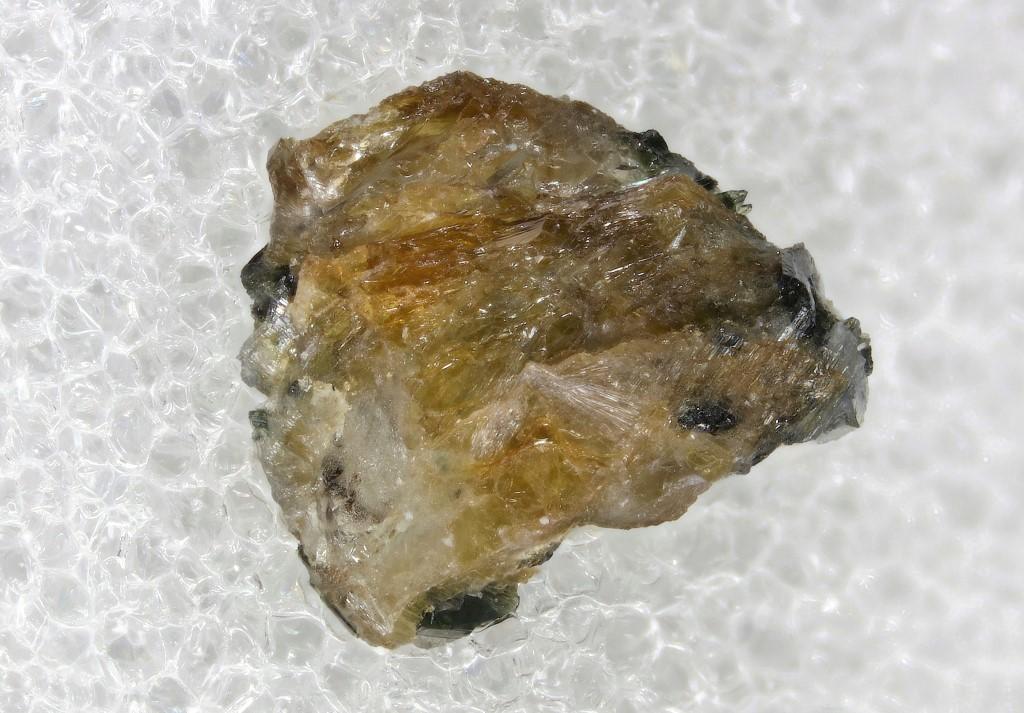
Bussenite
Intro
Bussenite is an extremely rare complex sorosilicate/carbonate mineral containing sodium, barium, iron, and titanium. It is found exclusively in highly differentiated, hyperagpaitic peralkaline pegmatites in the Khibiny Massif, Russia.
View article
Basic Information Show Hide
Mineral ID
bussenite
Common Synonyms / Aliases
IMA 2000-035
Chemistry Show Hide
Chemical Formula
Na₂Ba₂Fe²⁺Ti(Si₂O₇)(CO₃)O(OH)(H₂O)₂F
Elements
Barium (Ba), Sodium (Na), Iron (Fe), Titanium (Ti), Silicon (Si), Carbon (C), Oxygen (O), Hydrogen (H), Fluorine (F)
Minor Elements / Impurities
Strontium, calcium, manganese, potassium, and niobium reported in the type-material analysis.
Empirical Formula
(Na₁.₈₆K₀.₀₄Ca₀.₀₄)Σ₁.₉₄(Ba₁.₉₆Sr₀.₀₄)Σ₂.₀₀(Fe²⁺₀.₇₂Mn₀.₂₈)Σ₁.₀₀(Ti₀.₇₈Nb₀.₁₆Zr₀.₀₂Fe³⁺₀.₀₄)Σ₁.₀₀(Si₂O₇)(CO₃)O(OH)₀.₇₀F₁.₁₈·2H₂O
Molecular Weight (g/mol)
748.24
Solubility
Insoluble in water
Reaction to Acid
Effervesces moderately in dilute hydrochloric acid (HCl) due to the presence of carbonate groups (CO₃).
Classification Show Hide
Mineral Type
Mineral Species
IMA Status
Approved
IMA Symbol
Bus
Strunz Classification
09.BE.72 (9th Edition: Silicates (Germanates) - Sorosilicates - Si2O7 groups with additional anions; with cations in octahedral [6] and greater coordination)
Dana Classification
56.02.06.03 (56.02: Sorosilicate insular units with additional anions, containing complex carbonate or other radicals)
Mineral Group
Ba-Ti-sorosilicates / Bafertisite-Seidozerite related supergroup
Crystal Structure Show Hide
Crystal System
Triclinic
Crystal Habit
Tabular to platy crystals, micaceous foliated aggregates, thin lamellae, and flake-like intergrowths.
Crystal Class
Pinacoidal (1̄)
Space Group
P1̄
Cell Parameter A (Angstrom)
5.40 Å
Cell Parameter B (Angstrom)
7.06 Å
Cell Parameter C (Angstrom)
16.27 Å
Cell Angle Alpha (Degrees)
100.18°
Cell Angle Beta (Degrees)
93.88°
Cell Angle Gamma (Degrees)
89.96°
Unit Cell Z
2
Crystal Twinning
Polysynthetic lamellar twinning observed under cross-polarized light.
Common Crystal Faces
{001} prominent
Physical Properties Show Hide
Primary Color
Yellow-Orange or Orange-Yellow (YO/OY)orangy Yellow (oY)Yellow (Y)Brown
Common Colors
Yellow, brownish-yellow, reddish-orange to pale yellowish-brown
Streak
White to pale yellowish-white
Luster
Vitreous to pearly on cleavage faces
Transparency / Diaphaneity
Transparent to translucent
Hardness (Mohs)
3 - 3.5
Cleavage
Perfect
Cleavage Direction
Perfect on {001}
Cleavage / Parting Description
Easily splits into thin, flexible-to-brittle lamellae along {001}.
Fracture
Micaceous to uneven
Tenacity
Brittle to slightly flexible in thin sheets
Specific Gravity
3.51 - 3.55
Magnetism
Non-magnetic to very weakly paramagnetic
Melting Point
Not determined
Thermal Stability
Decomposes at elevated temperatures with release of H₂O, CO₂, and F.
Optical Properties Show Hide
Refractive Index
1.680 - 1.725
Refractive Index Alpha
1.680
Refractive Index Beta
1.708
Refractive Index Gamma
1.725
Optical Axial Angle (2V)
60° – 65° (Measured: ~62°)
Optical Sign / Extinction
Negative
Birefringence
0.045
Dispersion
Strong; r > v
Optical Character
Biaxial-
Pleochroism
Weak to moderate
Pleochroism Details
X = pale yellow, Y = brownish-yellow, Z = yellow-brown
Optical Phenomena
Pearly sheen on basal cleavage faces
Fluorescence
None under both SW and LW UV light
Luminescence / Phosphorescence / Thermoluminescence
Non-fluorescent
Absorption Spectrum
Not reported
Occurrence and Formation Show Hide
Formation Process
Late-stage hydrothermal crystallization in ultra-alkaline (hyperagpaitic) pegmatite veins within nepheline syenite complexes.
Geological Environment
Alkaline igneous intrusions; differentiated pegmatites of peralkaline nepheline syenite complexes.
Associated Minerals
Natrolite, aegirine, lorenzenite, lamprophyllite, fluorite, pectolite, villiaumite, barytolamprophyllite, microcline
Type Locality
Eveslogchorr Mountain, Khibiny Massif, Murmansk Oblast, Kola Peninsula, Russia
Major Producing Countries / Localities
CanadaRussia
Economic Deposit Type
Hyperagpaitic pegmatite
History and Naming Show Hide
Discovery Year
2000
Name Origin
Named in honor of Irina Vladislavovna Bussen (Ирина Владиславовна Буссен, 1915–2013), Russian mineralogist and prominent explorer of the alkaline rocks and minerals of the Lovozero and Khibiny Massifs.
Type Specimen Repository
Fersman Mineralogical Museum, Russian Academy of Sciences, Moscow, Russia (Catalogue No. 2577/1)
Safety and Related Information Show Hide
Wearability
Poor
Health Hazards
Contains barium, fluorine, and heavy elements. Avoid ingestion, prolonged skin contact, and dust inhalation.
Handling Precautions
Handle with gloves or wash hands after contact. Store in dry, sealed specimen containers away from acids.
Related Minerals
Bafertisite, hejtmanite, lamprophyllite, innelite, perraultite, epistolite
Commercial and Gemology Show Hide
Rarity / Market Grade
Extremely rare