Names
Violarite
Intro
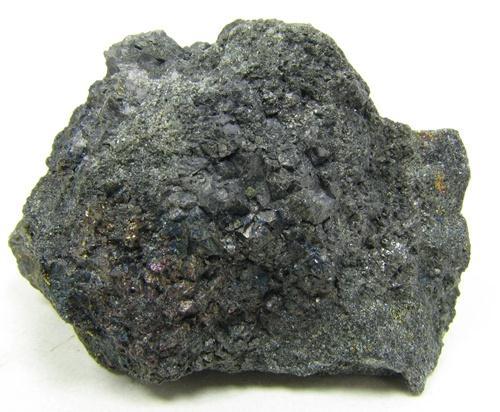
Violarite is a supergene iron-nickel sulfide mineral belonging to the linnaeite subgroup of the thiospinel group, with the ideal chemical formula Fe²⁺Ni³⁺₂S₄. Commonly formed through the low-temperature weathering and supergene alteration of primary pentlandite in magmatic nickel-copper sulfide deposits, it is characterized by its metallic luster, violet-gray tint on fresh surfaces, and rapid tarnishing to brownish-gray or copper-red upon exposure to air.
View article
Basic Information Show Hide
Mineral ID
violarite
Common Synonyms / Aliases
Nickel-linnaeite (obsolete); historically confused with polydymite prior to 1924
Chemistry Show Hide
Chemical Formula
Fe²⁺Ni³⁺₂S₄
Elements
Iron (Fe), Nickel (Ni), Sulfur (S)
Minor Elements / Impurities
Cobalt (Co) substituting for nickel and iron toward linnaeite and siegenite, minor Copper (Cu)
Empirical Formula
FeNi₂S₄
Molecular Weight (g/mol)
301.49
Solubility
Insoluble in water; decomposes and dissolves in concentrated nitric acid (HNO₃) and aqua regia with separation of elemental sulfur.
Reaction to Acid
Decomposes in nitric acid (HNO₃) without carbonate effervescence, yielding a greenish solution and releasing hydrogen sulfide or sulfur oxides depending on acid concentration.
Classification Show Hide
Mineral Type
Mineral Species
IMA Status
Approved
IMA Symbol
Vio
Strunz Classification
02.DA.05 (Nickel-Strunz 10th Edition: Metal Sulfides with M:S = 3:4 and 2:3)
Dana Classification
02.10.01.08 (Sulfides, Including Selenides and Tellurides, where AₘBₙXₚ with (m+n):p = 3:4, Linnaeite Group)
Mineral Group
Linnaeite Subgroup (Thiospinel Group, Spinel Supergroup)
Crystal Structure Show Hide
Crystal System
Isometric
Crystal Habit
Typically occurs as massive, granular, nodular, or finely disseminated aggregates replacing primary pentlandite along cleavages and fractures; rarely forms distinct octahedral or cubic crystals up to a few millimeters across.
Crystal Class
Hexoctahedral (4/m 3̄ 2/m)
Space Group
Fd3̄m
Cell Parameter A (Angstrom)
9.45
Cell Parameter B (Angstrom)
9.45
Cell Parameter C (Angstrom)
9.45
Cell Angle Alpha (Degrees)
90
Cell Angle Beta (Degrees)
90
Cell Angle Gamma (Degrees)
90
Unit Cell Z
8
Crystal Twinning
Spinel-law contact or penetration twinning on {111} may occur in rare well-formed crystals.
Common Crystal Faces
{111}, {100}, {110}
Physical Properties Show Hide
Primary Color
Violet (V)Gray
Common Colors
Violet-gray
Streak
Black
Luster
Metallic
Transparency / Diaphaneity
Opaque
Hardness (Mohs)
4.5 - 5.5
Cleavage
Perfect
Cleavage Direction
{001}
Cleavage / Parting Description
Displays perfect cleavage parallel to {001} (cubic cleavage), often accentuated by shrinkage cracks and alteration textures inherited from precursor pentlandite.
Fracture
Uneven to subconchoidal
Tenacity
Brittle
Specific Gravity
4.50 - 4.80
Magnetism
Non-magnetic (paramagnetic; noticeably less magnetic than associated pyrrhotite and magnetite)
Melting Point
Decomposes incongruently upon heating above approximately 460 °C to 480 °C, breaking down into monosulfide solid solution (pyrrhotite-type phase) and sulfur vapor prior to melting.
Thermal Stability
Stable only under low-temperature supergene and late hydrothermal conditions; thermally unstable above ~465 °C, converting into (Fe,Ni)₁₋ₓS + S₂.
Optical Properties Show Hide
Optical Sign / Extinction
Isotropic; completely extinct under crossed polars in reflected-light microscopy
Dispersion
Weak dispersion of reflectance in reflected light, increasing steadily toward longer red wavelengths
Optical Character
Isotropic
Pleochroism
Absent (no bireflectance)
Pleochroism Details
Exhibits a distinct pale violet to pinkish-cream tint in reflected plane-polarized light without directional color change upon stage rotation.
Optical Phenomena
Rapid surface tarnishing upon exposure to humid air, producing brownish or copper-red iridescent films.
Fluorescence
Inert under both shortwave (254 nm) and longwave (365 nm) ultraviolet light.
Occurrence and Formation Show Hide
Formation Process
Forms predominantly as a secondary supergene alteration mineral during the oxidative weathering of primary pentlandite-pyrrhotite nickel sulfide ores near the water table, where iron is selectively leached and remaining nickel is oxidized from Ni²⁺ to Ni³⁺; also occurs less commonly as a late-stage, low-temperature hydrothermal phase.
Geological Environment
Supergene enrichment zones and low-temperature hydrothermal veins within mafic to ultramafic intrusion-hosted and komatiite-hosted magmatic nickel-copper-PGE sulfide deposits.
Associated Minerals
Pentlandite, pyrrhotite, chalcopyrite, millerite, pyrite, marcasite, polydymite, siegenite, vaesite, cubanite, magnetite
Type Locality
Vermilion Mine, Denison Township, Sudbury District, Ontario, Canada
Major Producing Countries / Localities
AustraliaCanadaChinaFinlandItalyRussiaSouth AfricaUnited StatesZimbabwe
Economic Deposit Type
Magmatic Ni-Cu-PGE sulfide deposits (specifically supergene transition/violarite-pyrite zones, where it serves as a major ore mineral of nickel)
History and Naming Show Hide
Discovery Year
1924
Name Origin
Named by American geologists Waldemar Lindgren and W. Myron Davy in 1924 from the Latin word "viola" (violet), in reference to its characteristic violet-gray color observed in polished sections under reflected light.
Type Specimen Repository
Harvard Mineralogical Museum, Harvard University, Cambridge, Massachusetts, USA; National Museum of Natural History (Smithsonian Institution), Washington, D.C., USA
Safety and Related Information Show Hide
Wearability
Display only
Health Hazards
Contains Nickel (Ni) compounds, which are classified as skin sensitizers and potential carcinogens if inhaled as fine dust. Prolonged skin contact with tarnished or damp specimens may trigger allergic contact dermatitis.
Handling Precautions
Avoid inhaling dust generated during cutting, crushing, or grinding; wash hands after handling; store in dry, low-humidity conditions to prevent surface oxidation, tarnishing, and sulfuric acid-induced specimen degradation.
Varieties
Cobaltian violarite (intermediate compositions along the solid-solution series toward linnaeite and siegenite); Cuprian violarite
Related Minerals
Polydymite (Ni²⁺Ni³⁺₂S₄, nickel analogue), Greigite (Fe²⁺Fe³⁺₂S₄, iron analogue), Linnaeite (Co²⁺Co³⁺₂S₄, cobalt analogue), Siegenite (CoNi₂S₄), Pentlandite ((Fe,Ni)₉S₈, primary precursor)
Commercial and Gemology Show Hide
Rarity / Market Grade
Locally abundant in massive supergene nickel ore zones, though well-crystallized aesthetic display specimens are uncommon to rare.