Names
Kuksite
Intro
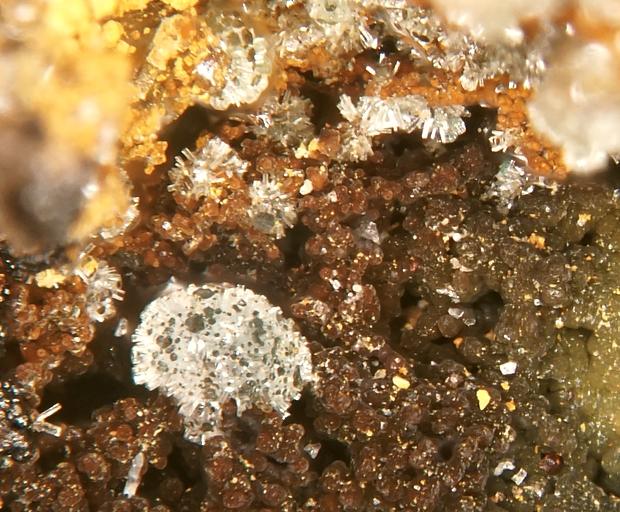
Kuksite is a rare secondary lead-zinc tellurate-phosphate mineral belonging to the dugganite group, with the ideal chemical formula Pb₃Zn₃TeO₆(PO₄)₂. First identified in the oxidized zones of the Kuranakh gold deposit in the Aldan Shield of eastern Siberia, Russia, it typically occurs as minute, gray to brownish-gray adamantine crystals associated with other supergene tellurium-bearing phases such as cheremnykhite and dugganite.
View article
Basic Information Show Hide
Mineral ID
kuksite
Common Synonyms / Aliases
IMA 1989-018; Kuksite-(PO₄) (informal compositional descriptor)
Chemistry Show Hide
Chemical Formula
Pb₃Zn₃TeO₆(PO₄)₂
Elements
Lead (Pb), Zinc (Zn), Tellurium (Te), Phosphorus (P), Oxygen (O)
Minor Elements / Impurities
Vanadium (V) substituting for phosphorus toward cheremnykhite, Arsenic (As) substituting for phosphorus toward dugganite, minor Copper (Cu), Silicon (Si)
Empirical Formula
Pb₃Zn₃Te⁶⁺P₂O₁₄
Molecular Weight (g/mol)
1231.28
Solubility
Insoluble in water; dissolves slowly in dilute mineral acids such as nitric acid (HNO₃) and hydrochloric acid (HCl).
Reaction to Acid
Soluble in dilute HNO₃ and HCl without effervescence.
Classification Show Hide
Mineral Type
Mineral Species
IMA Status
Approved
IMA Symbol
Kuk
Strunz Classification
08.BE.45 (Nickel-Strunz 10th Edition: Phosphates with additional anions, without H₂O, with only medium-sized and large cations)
Dana Classification
41.01.03.01 (Anhydrous Phosphates, etc., Containing Hydroxyl or Halogen)
Mineral Group
Dugganite Group
Crystal Structure Show Hide
Crystal System
Orthorhombic
Crystal Habit
Forms minute tabular, platy, or short prismatic crystals, typically less than 0.5 mm in size, often grouped into subparallel intergrowths, rosettes, or thin crystalline crusts lining vugs and fractures.
Crystal Class
Disphenoidal (222)
Space Group
C222₁
Cell Parameter A (Angstrom)
8.50
Cell Parameter B (Angstrom)
14.72
Cell Parameter C (Angstrom)
5.19
Cell Angle Alpha (Degrees)
90
Cell Angle Beta (Degrees)
90
Cell Angle Gamma (Degrees)
90
Unit Cell Z
2
Crystal Twinning
Pseudohexagonal sector or lamellar twinning may occur due to the strong metric relationship with hexagonal dugganite-group members (b ≈ a√3).
Common Crystal Faces
{001}, {010}, {110}, {100}
Physical Properties Show Hide
Primary Color
ColorlessGrayBrown
Common Colors
Gray, brownish-gray, pale brown, colorless in very thin fragments
Streak
White
Luster
Adamantine
Transparency / Diaphaneity
Translucent
Hardness (Mohs)
3 - 3.5
Cleavage
None
Cleavage Direction
None
Cleavage / Parting Description
No distinct cleavage or parting planes have been reliably observed owing to the microscopic size and brittle nature of natural crystals.
Fracture
Uneven to subconchoidal
Tenacity
Brittle
Specific Gravity
6.15 - 6.25
Magnetism
Non-magnetic
Melting Point
Decomposes upon strong heating prior to congruent melting, volatilizing tellurium and lead oxides.
Thermal Stability
Stable under ambient supergene conditions; undergoes thermal decomposition at elevated temperatures with loss of TeO₂ and breakdown of the tellurate-phosphate framework.
Optical Properties Show Hide
Refractive Index
1.96 - 1.99
Refractive Index Alpha
1.965
Refractive Index Beta
1.978
Refractive Index Gamma
1.982
Optical Axial Angle (2V)
Small (measured ~15°–25°)
Optical Sign / Extinction
Parallel extinction in prismatic sections; optically negative
Birefringence
0.017
Dispersion
Weak to moderate
Optical Character
Biaxial-
Pleochroism
Absent to very weak
Pleochroism Details
Colorless to very pale gray in transmitted light without noticeable directional absorption changes.
Fluorescence
Inert under both shortwave (254 nm) and longwave (365 nm) ultraviolet light.
Luminescence / Phosphorescence / Thermoluminescence
None observed
Occurrence and Formation Show Hide
Formation Process
Forms as a rare supergene oxidation product during the weathering of primary gold-telluride and base-metal sulfide ores in carbonate-hosted hydrothermal deposits, where hexavalent tellurium (Te⁶⁺) combines with mobilized Pb²⁺, Zn²⁺, and PO₄³⁻ ions.
Geological Environment
Oxidized zones of low-temperature, carbonate-hosted gold-telluride-sulfide deposits developed at the contact between Cambrian limestones/dolomites and Jurassic sandstones.
Associated Minerals
Cheremnykhite, dugganite, yafsoanite, descloizite, native gold, calcite, quartz, goethite, anglesite
Type Locality
Delbe ore body, Kuranakh gold deposit, Aldan Shield, Sakha Republic (Yakutia), Russia
Major Producing Countries / Localities
RussiaUnited States
Economic Deposit Type
Kuranakh-type karst-hosted / contact-metasomatic gold-telluride deposits (non-economic mineralogical curiosity)
History and Naming Show Hide
Discovery Year
1989
Name Origin
Named in honor of Anatolii Ivanovich Kuks (1910–1986), a Russian geologist who conducted extensive geological investigations of the gold deposits in the Aldan region of Siberia.
Type Specimen Repository
A.E. Fersman Mineralogical Museum, Russian Academy of Sciences, Moscow, Russia; Central Siberian Geological Museum, Novosibirsk, Russia
Safety and Related Information Show Hide
Wearability
Display only
Health Hazards
Contains toxic heavy metals and metalloids, specifically lead (Pb) and tellurium (Te). Ingestion or inhalation of dust can cause systemic lead poisoning and tellurium toxicity.
Handling Precautions
Wash hands thoroughly after handling specimens; avoid grinding, crushing, or generating airborne dust; store in enclosed micromount boxes away from food, drink, and children.
Varieties
Vanadian kuksite (intermediate compositions toward cheremnykhite); Arsenian kuksite (intermediate compositions toward dugganite)
Related Minerals
Cheremnykhite (Pb₃Zn₃TeO₆(VO₄)₂, vanadate analogue), Dugganite (Pb₃Zn₃TeO₆(AsO₄)₂, arsenate analogue), Joëlbruggerite (Pb₃Zn₃(Sb⁵⁺,Te⁶⁺)As₂O₁₃(OH,O))
Commercial and Gemology Show Hide
Common Cuts
None (occurs exclusively as microscopic crystals unsuitable for faceting or cabochon cutting)
Rarity / Market Grade
Extremely rare; known almost exclusively from type-locality micromount specimens preserved in research collections and specialized systematic mineral cabinets.