Names
Pseudorutile
Intro
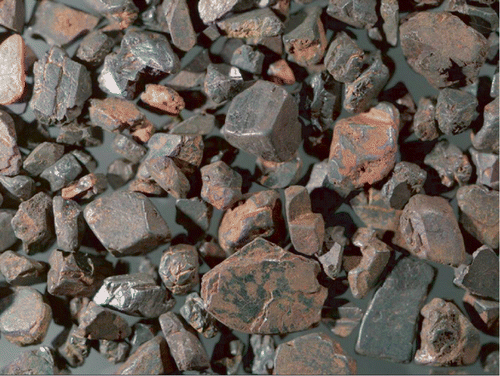
Pseudorutile is an intermediate titanium-iron oxide mineral formed primarily during the low-temperature weathering and progressive leaching of ilmenite in heavy mineral sand deposits. Structurally and chemically distinct from rutile and ilmenite, it plays a vital transitional role in the supergene alteration sequence from ilmenite to leucoxene and secondary rutile/anatase, making it an essential phase in global titanium placer mining and processing.
Basic Information Show Hide
Mineral ID
pseudorutile
Common Synonyms / Aliases
Acharavalite, Leucoxene (in part), Protolencoxene, Hydroxypseudorutile (related)
Chemistry Show Hide
Chemical Formula
Fe³⁺₂Ti₃O₉
Elements
Fe, Ti, O
Minor Elements / Impurities
Al, Si, Mn, V, Nb, H₂O
Empirical Formula
Fe³⁺₂Ti₃O₉
Molecular Weight (g/mol)
399.28
Solubility
Insoluble in water and dilute acids; slowly soluble in hot concentrated sulfuric acid (H₂SO₄) and hydrofluoric acid (HF).
Reaction to Acid
None (Resistant to common room-temperature mineral acids).
Classification Show Hide
Mineral Type
Mineral Species
IMA Status
Approved
IMA Symbol
Prt
Strunz Classification
04.CB.05
Dana Classification
04.03.09.01
Mineral Group
Pseudorutile Group / Oxides
Crystal Structure Show Hide
Crystal System
Hexagonal
Crystal Habit
Microcrystalline, finely granular, porous aggregates, earthy masses, and pervasive pseudomorphic replacements after ilmenite crystals or detrital grains. Well-formed euhedral crystals are extremely rare.
Crystal Class
6/mmm (dihexagonal dipyramidal)
Space Group
P6₃/mmc
Cell Parameter A (Angstrom)
2.87
Cell Parameter B (Angstrom)
2.87
Cell Parameter C (Angstrom)
4.60
Cell Angle Alpha (Degrees)
90
Cell Angle Beta (Degrees)
90
Cell Angle Gamma (Degrees)
120
Unit Cell Z
0.333
Crystal Twinning
None observed (disordered microdomain structures predominate).
Common Crystal Faces
{0001}, {10-10} pseudomorphically inherited from parent ilmenite {0001} and {10-11}.
Physical Properties Show Hide
Primary Color
BrownBlack
Common Colors
Dark brown, reddish brown, brownish black, black
Streak
Reddish brown to dark brown
Luster
Submetallic to dull / earthy
Transparency / Diaphaneity
Opaque (translucent reddish-brown on extremely thin splinter edges).
Hardness (Mohs)
3.0 - 4.0
Cleavage
None
Cleavage Direction
None
Cleavage Angle / Parting Quality
Parting inherited from parent ilmenite {0001} occasionally observed.
Fracture
Uneven to sub-conchoidal; earthy in heavily altered grains.
Tenacity
Brittle
Specific Gravity
3.80 - 4.25
Magnetism
Weakly magnetic to non-magnetic (paramagnetic, significantly lower magnetic susceptibility than unweathered ilmenite).
Melting Point
Not applicable (decomposes into rutile and pseudobrookite/hematite phases at high temperatures).
Thermal Stability
Unstable above ~500 °C – 800 °C in oxidizing atmospheres, converting into a mixture of hematite (Fe₂O₃) and rutile (TiO₂) or pseudobrookite (Fe₂TiO₅).
Optical Properties Show Hide
Refractive Index
2.20 - 2.30
Refractive Index Alpha
2.20
Refractive Index Beta
2.30
Refractive Index Gamma
2.30
Optical Axial Angle (2V)
0°
Optical Sign / Extinction
Positive (+)
Birefringence
0.10
Dispersion
Moderate
Optical Character
Uniaxial+
Pleochroism
Weak to moderate in reflected light (grayish-white with brownish tint).
Pleochroism Details
Exhibits distinctive reddish-brown to blood-red internal reflections in polished section microscopy.
Optical Phenomena
None
Fluorescence
Inert under UV excitation.
Luminescence / Phosphorescence / Thermoluminescence
No characteristic fluorescence or phosphorescence is generally reported; luminescence is usually absent.
Absorption Spectrum
Reflectance spectrum exhibits characteristic iron-titanium charge transfer absorption bands in the near-UV and visible ranges; distinct X-ray diffraction (XRD) profile intermediate between ilmenite and rutile.
Occurrence and Formation Show Hide
Formation Process
Formed as an autigenic or supergene weathering phase via topotactic leaching of Fe²⁺ from the ilmenite lattice (FeTiO₃ → Fe³⁺₂Ti₃O₉ + Fe³⁺ in solution). Under continued leaching and weathering, pseudorutile progressively breaks down into microcrystalline leucoxene (anatase/rutile + goethite).
Geological Environment
Heavy mineral strandline sand deposits, beach placers, fluvial alluvial deposits, and deeply weathered saprolitic regolith profiles over mafic/felsic igneous complexes.
Associated Minerals
Ilmenite, Rutile, Anatase, Leucoxene, Zircon, Monazite, Magnetite, Hematite, Quartz, Goethite.
Type Locality
South Neptune Island and Kangaroo Island, South Australia, Australia.
Major Producing Countries / Localities
AustraliaBrazilIndiaMadagascarNorwaySouth AfricaUnited States
Economic Deposit Type
Shoreline Heavy Mineral Sands Placer Deposit (Titanium Feedstock).
History and Naming Show Hide
Discovery Year
1968 (Described by G. Teufer and A. K. Temple).
Name Origin
Named with the Greek prefix pseudo- ("false") and rutile, in reference to its deceptive physical and chemical resemblance to rutile and former confusion with fine-grained rutile/ilmenite mixtures.
Type Specimen Repository
National Museum of Natural History (Smithsonian Institution), Washington, D.C., USA.
Safety and Related Information Show Hide
Wearability
Display only
Health Hazards
Non-hazardous in solid grain form; standard industrial dust inhalation precautions apply during heavy mineral sand bulk processing and milling.
Handling Precautions
Safe for open handling; non-water-soluble and non-toxic. Store dry to avoid further oxidation/breakdown in humid atmospheric test suites.
Varieties
Hydroxypseudorutile (hydroxyl-dominant analog, Fe³⁺₁.₃₃Ti₃O₆(OH)₂), Kleberite.
Polytypes
None
Related Minerals
Ilmenite (FeTiO₃), Rutile (TiO₂), Anatase (TiO₂), Brookite (TiO₂), Pseudobrookite (Fe₂TiO₅), Armalcolite ((Mg,Fe)Ti₂O₅), Kleberite.
Commercial and Gemology Show Hide
Common Treatments
Industrial thermal reduction and synthetic rutile (SR) processing via Becher process in titanium dioxide (TiO₂) pigment manufacturing.
Enhancements
None
Common Cuts
None (Strictly an industrial ore mineral and scientific mineralogical specimen).
Rarity / Market Grade
Common in heavy mineral placers (though rare as macroscopic crystalline collector specimens).