Names
Manandonite
Intro
Manandonite is an extraordinarily rare, lithium- and boron-bearing trioctahedral-dioctahedral phyllosilicate mineral species belonging structurally to the 1:1 serpentine-kaolinite group. First documented in the highly fractionated granitic pegmatites of Madagascar, it is unique in mineralogy as one of the few sheet silicates that accommodates essential structural boron into the tetrahedral layers along with essential octahedral lithium and aluminum.
Basic Information Show Hide
Mineral ID
manandonite
Common Synonyms / Aliases
Boron-bearing serpentine, Boro-corundophilite, Manandonite-2H, Boron chlorite (archaic)
Chemistry Show Hide
Chemical Formula
Li₂Al₄(Si₂AlB)O₁₀₈
Elements
Lithium (Li), Aluminum (Al), Boron (B), Silicon (Si), Oxygen (O), Hydrogen (H)
Minor Elements / Impurities
Fe, Mg, Na, K, Ca, F, H₂O
Empirical Formula
Li₂.₀₀Al₄.₀₀(Si₂.₀₀Al₁.₀₀B₁.₀₀)O₁₀.₀₀(OH)₈.₀₀
Molecular Weight (g/mol)
440.03
Solubility
Insoluble in cold or boiling deionized water; poorly soluble in common organic solvents.
Reaction to Acid
None (Resistant to cold dilute hydrochloric (HCl) and nitric (HNO₃) acids; slightly decomposed by concentrated hydrofluoric acid (HF) or prolonged hot concentrated sulfuric acid (H₂SO₄)).
Classification Show Hide
Mineral Type
Mineral Species
IMA Status
Approved
IMA Symbol
Mnd
Strunz Classification
09.ED.15 (Class: Silicates; Division: Phyllosilicates; Subdivision: Phyllosilicates with kaolinite layers composed of 1:1 tetrahedral and octahedral sheets)
Dana Classification
71.01.02c.03 (Phyllosilicates: Layered Silicates with 1:1 Layers - Trioctahedral and Interstratified)
Mineral Group
Serpentine-Kaolinite Group (Phyllosilicates)
Crystal Structure Show Hide
Crystal System
Triclinic (pseudo-hexagonal / pseudo-monoclinic geometry)
Crystal Habit
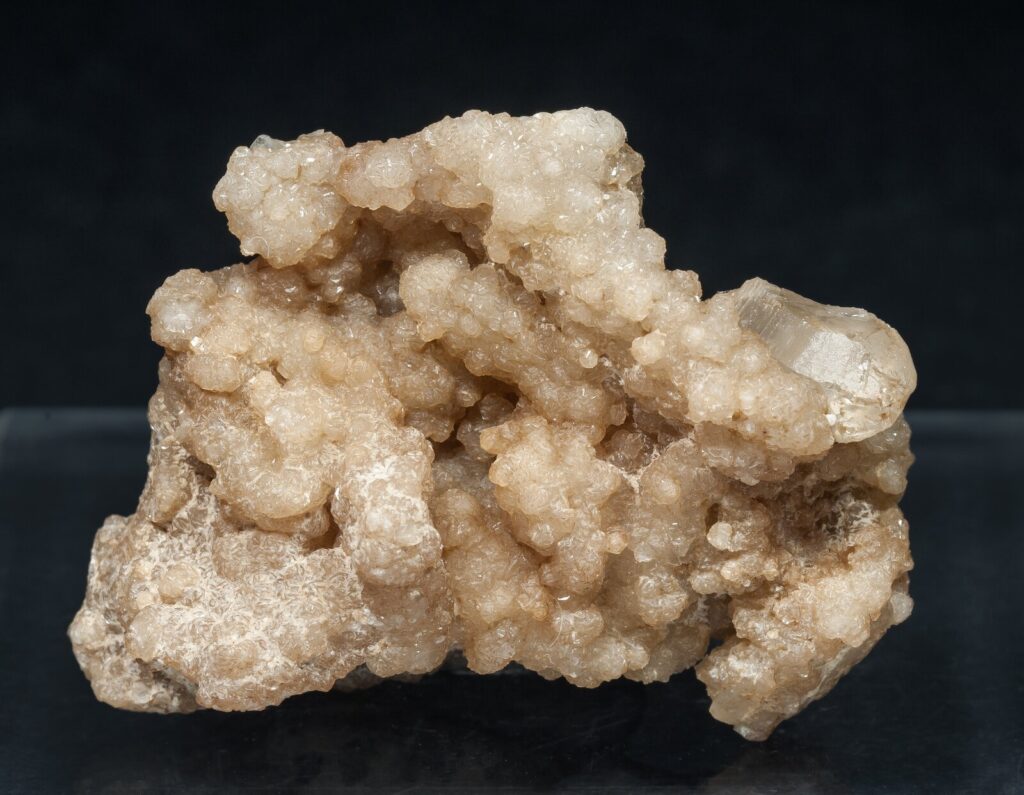
Microcrystalline aggregate masses, tabular pseudo-hexagonal lamellar plates, micaceous foliated flakes, chalky or dense nodular encrustations, and cryptocrystalline pseudomorphic replacements.
Crystal Class
1 or -1 (Pedial or Pinacoidal)
Space Group
C1 or P1 / P-1 (commonly exhibiting pronounced 1-layer and 2-layer polytypic stacking disorder)
Cell Parameter A (Angstrom)
5.06 Å
Cell Parameter B (Angstrom)
8.78 Å
Cell Parameter C (Angstrom)
13.78 Å (with sub-cell repeating c-spacings around 7.12 Å characteristic of 1:1 layer phyllo-architectures)
Cell Angle Alpha (Degrees)
90.00°
Cell Angle Beta (Degrees)
90.00°
Cell Angle Gamma (Degrees)
90.00°
Unit Cell Z
2
Crystal Twinning
Pervasive pseudo-hexagonal sectoral and polysynthetic lamellar twinning on {001}, complicated by random rotational stacking faults along the layer stacking vector.
Common Crystal Faces
{001} prominent basal pinacoid; subordinate {010}, {110}, {-110}.
Physical Properties Show Hide
Primary Color
ColorlessWhite
Common Colors
Pure white, chalky cream-white, colorless, occasionally faint grayish-white or pale yellowish-pink when influenced by trace inclusions of manganese or lithium micas.
Streak
White
Luster
Pearly to vitreous on fresh basal cleavage planes {001}; dull, silky, to waxy/earthy in dense compact microcrystalline aggregates.
Transparency / Diaphaneity
Translucent
Hardness (Mohs)
2.5 - 3.5
Cleavage
Perfect
Cleavage Direction
{001} Perfect basal cleavage parallel to the structural tetrahedral-octahedral sheet interface.
Cleavage Angle / Parting Quality
Highly pronounced lamellar parting parallel to {001}; individual split flakes are flexible but entirely inelastic.
Fracture
Uneven to micaceous/flaky; sub-conchoidal on dense massive varieties.
Tenacity
Sectile to flexible; inelastic (bends under directional stress without springing back).
Specific Gravity
2.89 - 2.95
Magnetism
Non-magnetic
Melting Point
Not applicable (thermal dehydroxylation and structural breakdown occur prior to congruent melting).
Thermal Stability
Thermally stable under moderate hydrothermal regimes; undergoes progressive dehydroxylation and collapse of the 1:1 layer structure above 500 °C – 600 °C, transitioning to mullite-like and lithium aluminoborosilicate glassy phases at elevated temperatures.
Optical Properties Show Hide
Refractive Index
1.560 - 1.575
Refractive Index Alpha
1.560
Refractive Index Beta
1.565
Refractive Index Gamma
1.575
Optical Axial Angle (2V)
0° – 20° (nearly pseudo-uniaxial positive)
Optical Sign / Extinction
Positive (+)
Birefringence
0.015
Dispersion
Weak (r < v)
Optical Character
Biaxial+
Pleochroism
None
Pleochroism Details
Colorless, non-pleochroic in plane-polarized transmitted light.
Optical Phenomena
None
Fluorescence
Inert under UV excitation; no discernible phosphorescence or thermoluminescence.
Luminescence / Phosphorescence / Thermoluminescence
Non-fluorescent under both shortwave (254 nm) and longwave (365 nm) ultraviolet radiation.
Absorption Spectrum
Displays sharp, diagnostic FTIR and Raman absorption bands corresponding to tetrahedral [BO₄] and [SiO₄] vibrational stretching (around 800–1150 cm⁻¹), along with characteristic OH-stretching vibrational fundamentals in the 3400–3700 cm⁻¹ range.
Occurrence and Formation Show Hide
Formation Process
Originates as a late-stage low-temperature hydrothermal alteration product in lithium-cesium-tantalum (LCT) enriched granitic pegmatites. It typically forms via the metasomatic breakdown and replacement of primary lithium and boron minerals—such as elbaite, spodumene, or bityite—under highly alkaline, boron- and lithium-saturated residual fluid regimes.
Geological Environment
Highly fractionated, boron-rich rare-element granitic pegmatites and associated contact-metasomatic greisen veins.
Associated Minerals
Elbaite, Rubellite, Bityite, Spodumene, Lepidolite, Microcline, Albite, Quartz, Apatite, Cookeite, Tourmaline.
Type Locality
Antandrokomby pegmatite, Manandona Valley, Antsirabe II District, Vakinankaratra Region, Madagascar.
Major Producing Countries / Localities
CzechiaMadagascarRussia
Economic Deposit Type
LCT-type Rare-Element Complex Granitic Pegmatite Deposit.
History and Naming Show Hide
Discovery Year
1912
Name Origin
Named by French mineralogist Antoine Lacroix in 1912 in honor of the type geographical locality along the Manandona River Valley, Madagascar.
Type Specimen Repository
Muséum National d'Histoire Naturelle (MNHN), Paris, France (Specimen Catalog No. 112.98).
Safety and Related Information Show Hide
Wearability
Poor
Health Hazards
Non-toxic under normal handling; however, prolonged inhalation of generated crystalline particulate dust during cutting, grinding, or crushing operations presents mechanical respiratory irritation risks.
Handling Precautions
Standard laboratory hygiene: avoid dust inhalation; store in dry, acid-free display cases; clean using non-reactive, dry mechanical dusting rather than chemical solvents or ultrasonic cleaners.
Varieties
None commercially differentiated.
Polytypes
Manandonite-1T, Manandonite-2M₁, and complex disordered stacking polytypes.
Related Minerals
Amesite, Bityite, Kellyite, Berthierine, Cronstedtite, Kaolinite, Lizardite, Cookeite.
Commercial and Gemology Show Hide
Common Treatments
None
Enhancements
None
Common Cuts
Not cut for commercial jewelry; strictly prepared as mineralogical thin sectionspolished scientific display slabsor kept intact as micromount/cabinet matrix specimens.
Rarity / Market Grade
Museum-grade (Extremely rare scientific mineral species with very limited worldwide occurrences).