Names
Bismutotantalite
Intro
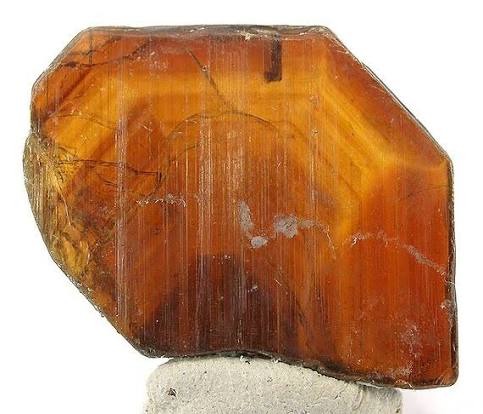
Bismutotantalite is a rare heavy tantalum-bismuth oxide mineral belonging to the columbite-tantalite group, crystallizing in the orthorhombic crystal system. Characterized by an exceptionally high specific gravity (up to 8.98–9.0 g/cm³), sub-adamantine to resinous luster, and high refractive indices, it occurs as a late-stage accessory mineral in highly fractionated, lithium-cesium-tantalum (LCT) enriched granitic pegmatites.
Basic Information Show Hide
Mineral ID
bismutotantalite
Common Synonyms / Aliases
Bismuthian tantalite, Bismuth tantalite
Chemistry Show Hide
Chemical Formula
BiTaO₄
Elements
Bismuth (Bi), Tantalum (Ta), Oxygen (O)
Minor Elements / Impurities
Nb, Sb, Fe, Mn, Sn, Ca, Ti, U, Th
Empirical Formula
Bi₁.₀₀(Ta₀.₈₅Nb₀.₁₅)O₄.₀₀
Molecular Weight (g/mol)
453.92
Solubility
Insoluble in water and dilute mineral acids; slowly dissolved by hot concentrated hydrofluoric acid (HF) and molten potassium pyrosulfate flux.
Reaction to Acid
None (Resistant to cold concentrated hydrochloric (HCl) and nitric (HNO₃) acids).
Classification Show Hide
Mineral Type
Mineral Species
IMA Status
Approved
IMA Symbol
Btt
Strunz Classification
04.DG.10 (Class: Oxides; Division: Metal:Oxygen = 1:2 and similar; Group: With large to medium-sized cations; with Ta, Nb, etc. - Stibiotantalite Group)
Dana Classification
08.01.03.01 (Multiple Oxides with Nb, Ta, and Ti: A(XO₄) Type - Stibiotantalite Series)
Mineral Group
Stibiotantalite Group (Oxides)
Crystal Structure Show Hide
Crystal System
Orthorhombic
Crystal Habit
Tabular to prismatic crystals flattened on {010}, rough blocky crystals, rounded alluvial pebbles, and dense crystalline massive aggregates.
Crystal Class
mm2 (Orthorhombic Pyramidal)
Space Group
Pcn2₁ (or Pna2₁)
Cell Parameter A (Angstrom)
4.971 Å
Cell Parameter B (Angstrom)
11.775 Å
Cell Parameter C (Angstrom)
5.646 Å
Cell Angle Alpha (Degrees)
90.00°
Cell Angle Beta (Degrees)
90.00°
Cell Angle Gamma (Degrees)
90.00°
Unit Cell Z
4
Crystal Twinning
Polysynthetic lamellar twinning common on {010}.
Common Crystal Faces
Dominant pinacoid {010}, prisms {110}, {120}, and terminal pedions/pyramids {111}.
Physical Properties Show Hide
Primary Color
BrownBlack
Common Colors
Dark brown, pitch-black, yellowish-brown, reddish-brown, straw-yellow, honey-yellow.
Streak
Grayish-white to pale yellowish-brown
Luster
Sub-adamantine, resinous, to pitchy metallic on fresh fractures.
Transparency / Diaphaneity
Translucent to sub-translucent (semi-transparent in thin splinters; nearly opaque in thick dark specimens).
Hardness (Mohs)
5.0 - 5.5
Cleavage
Good
Cleavage Direction
{010} Good / Distinct cleavage.
Cleavage Angle / Parting Quality
Faint parting along {100} or lamellar twin boundaries.
Fracture
Sub-conchoidal to uneven.
Tenacity
Brittle
Specific Gravity
8.15 - 9.00
Magnetism
Non-magnetic (weakly paramagnetic if rich in iron/manganese impurities).
Melting Point
Not precisely defined (congruently melts at refractory high temperatures >1400 °C).
Thermal Stability
Highly refractory and thermally stable; does not dehydroxylate or decompose under standard geological metamorphic temperatures.
Optical Properties Show Hide
Refractive Index
2.38 - 2.47
Refractive Index Alpha
2.38
Refractive Index Beta
2.42
Refractive Index Gamma
2.47
Optical Axial Angle (2V)
80° – 85°
Optical Sign / Extinction
Positive (+)
Birefringence
0.090
Dispersion
Strong (r > v)
Optical Character
Biaxial+
Pleochroism
Weak to Moderate
Pleochroism Details
X = yellow to pale brownish-yellow, Y = brownish-yellow to greenish-yellow, Z = dark reddish-brown.
Optical Phenomena
None
Fluorescence
Inert under UV excitation.
Luminescence / Phosphorescence / Thermoluminescence
Non-fluorescent under shortwave (254 nm) and longwave (365 nm) ultraviolet radiation.
Absorption Spectrum
High refractive dispersion and strong absorption in the blue-violet visible region; distinct Raman vibrational peaks characteristic of [TaO₆] octahedral stretching around 800–850 cm⁻¹.
Occurrence and Formation Show Hide
Formation Process
Formed during late-stage hydrothermal-metasomatic replacement zones in complex rare-element granitic pegmatites (specifically the lithium-cesium-tantalum / LCT geochemical family). Typically crystallizes alongside secondary albite, lepidolite, and bismuth sulfosalts.
Geological Environment
Highly fractionated granitic pegmatites and associated eluvial/alluvial heavy mineral placer deposits.
Associated Minerals
Tantalite, Columbite, Bismite, Native Bismuth, Lepidolite, Spodumene, Tourmaline, Microcline, Albite, Quartz, Cassiterite, Microlite.
Type Locality
Gamba Hill, Busiro County, Wakiso District, Central Region, Uganda.
Major Producing Countries / Localities
AustraliaBrazilMadagascarMozambiqueNamibiaRwandaUgandaUnited States
Economic Deposit Type
LCT-type Rare-Element Complex Granitic Pegmatite Deposit / Alluvial Placer Heavy Mineral Deposit.
History and Naming Show Hide
Discovery Year
1929 (Described and named by Kenneth A. Davies and Arthur W. Groves).
Name Origin
Named in allusion to its essential chemical composition containing Bismuth and Tantalum.
Type Specimen Repository
Natural History Museum (NHM), London, UK; Geological Survey of Uganda, Entebbe, Uganda.
Safety and Related Information Show Hide
Wearability
Poor
Health Hazards
Low toxicity in solid form; heavy metal handling precautions apply (contains bismuth and potential minor traces of U/Th). Avoid inhaling airborne dust during cutting or polishing.
Handling Precautions
Safe for open handling; avoid ultrasonic cleaning if micro-fractures or cleavage cracks are present; store in dry, cushioned specimen containers.
Varieties
Niobian Bismutotantalite (niobium-rich variety).
Polytypes
None
Related Minerals
Stibiotantalite (SbTaO₄), Stibiocolumbite (SbNbO₄), Bismutocolumbite (BiNbO₄), Tantalite-(Mn), Tantalite-(Fe).
Commercial and Gemology Show Hide
Common Treatments
None
Enhancements
None
Common Cuts
Faceted collector gemstones (extremely rareexceptional sub-adamantine luster)Cabochonsand natural polished crystalline/placer specimens.
Rarity / Market Grade
Museum-grade (Transparent facetable crystals are exceedingly rare on the global gem market).