Names
Kernowite
Intro
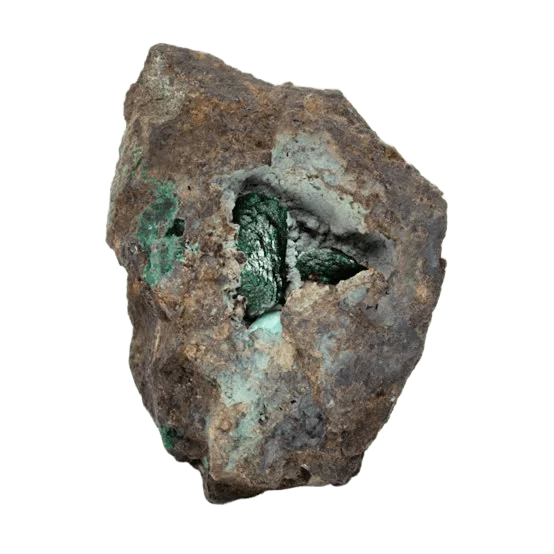
Kernowite is a rare copper iron arsenate hydrate mineral discovered in St Day, Cornwall, UK. It is the iron-dominant analogue of liroconite. Known for its distinct emerald-green crystals, it crystallizes in the monoclinic system and typically forms as tabular to wedge-shaped crystals in oxidized copper deposit zones.
View article
Basic Information Show Hide
Mineral ID
kernowite
Common Synonyms / Aliases
IMA2020-053
Chemistry Show Hide
Chemical Formula
Cu₂Fe(AsO₄)(OH)₄·4H₂O
Elements
Cu, Fe, As, O, H
Minor Elements / Impurities
Al, P
Empirical Formula
Cu₂Fe³⁺(AsO₄)(OH)₄·4H₂O
Molecular Weight (g/mol)
436.93
Solubility
Soluble in acids
Reaction to Acid
Dissolves in cold dilute hydrochloric acid (HCl)
Classification Show Hide
Mineral Type
Mineral Species
IMA Status
Approved
IMA Symbol
Knw
Strunz Classification
08.DF.35
Dana Classification
42.02.01.02
Mineral Group
Liroconite Group
Crystal Structure Show Hide
Crystal System
Monoclinic
Crystal Habit
Tabular, wedge-shaped (lense-like) crystals, often in small clusters or crusts
Crystal Class
2/m (Prismatic)
Space Group
I2/a
Cell Parameter A (Angstrom)
12.925
Cell Parameter B (Angstrom)
7.549
Cell Parameter C (Angstrom)
9.951
Cell Angle Alpha (Degrees)
90
Cell Angle Beta (Degrees)
91.29
Cell Angle Gamma (Degrees)
120
Unit Cell Z
4
Crystal Twinning
Rarely observed
Common Crystal Faces
{110}, {001}, {101}
Physical Properties Show Hide
Primary Color
Green (G)bluish Green (bG)
Common Colors
Emerald green
Streak
Pale green
Luster
Vitreous to resinous
Transparency / Diaphaneity
Transparent to translucent
Hardness (Mohs)
2 - 2.5
Cleavage
Poor
Cleavage Direction
{010} poor, {100} poor
Cleavage Angle / Parting Quality
Indistinct or poor cleavage parallel to the crystal axis
Fracture
Subconchoidal to uneven
Tenacity
Brittle
Specific Gravity
3.02 - 3.08
Magnetism
Non-magnetic
Melting Point
Decomposes at elevated temperatures before melting
Thermal Stability
Dehydrates and breaks down upon heating
Optical Properties Show Hide
Refractive Index
1.625 - 1.680
Refractive Index Alpha
1.625
Refractive Index Beta
1.655
Refractive Index Gamma
1.680
Optical Axial Angle (2V)
65° - 75°
Optical Sign / Extinction
Inclined extinction, Biaxial negative
Birefringence
0.055
Dispersion
Strong
Optical Character
Biaxial-
Pleochroism
Weak to moderate
Pleochroism Details
X = pale green, Y = green, Z = dark emerald green
Optical Phenomena
None
Fluorescence
Non-fluorescent under SW and LW UV light
Luminescence / Phosphorescence / Thermoluminescence
Non-fluorescent
Absorption Spectrum
Not specified
Occurrence and Formation Show Hide
Formation Process
Secondary mineral formed in the oxidized zones of arsenic-rich copper sulfide deposits
Geological Environment
Hydrothermal copper-bearing veins hosted in granitic rocks and slate
Associated Minerals
Liroconite, Olivenite, Clinoclase, Pharmacosiderite, Malachite, Quartz
Type Locality
Wheal Gorland, St Day, Gwennap, Cornwall, England, UK
Major Producing Countries / Localities
United Kingdom
Economic Deposit Type
Hydrothermal vein-type oxidation zone deposits
History and Naming Show Hide
Discovery Year
2020
Name Origin
Named after "Kernow", the Cornish language word for Cornwall, where the mineral was discovered
Type Specimen Repository
Natural History Museum, London, UK (BM 1964,280)
Safety and Related Information Show Hide
Wearability
Poor
Health Hazards
Contains arsenic (As) and copper (Cu). Toxic if swallowed or inhaled as dust.
Handling Precautions
Wash hands thoroughly after handling. Avoid inhaling dust or powder. Store in a secure, dry place out of reach of children.
Varieties
None
Polytypes
None
Related Minerals
Liroconite (Al-dominant counterpart)
Commercial and Gemology Show Hide
Common Treatments
None
Enhancements
None
Common Cuts
None (Collector mineral specimens only)
Rarity / Market Grade
Extremely rare (Highly prized by specimen collectors)