
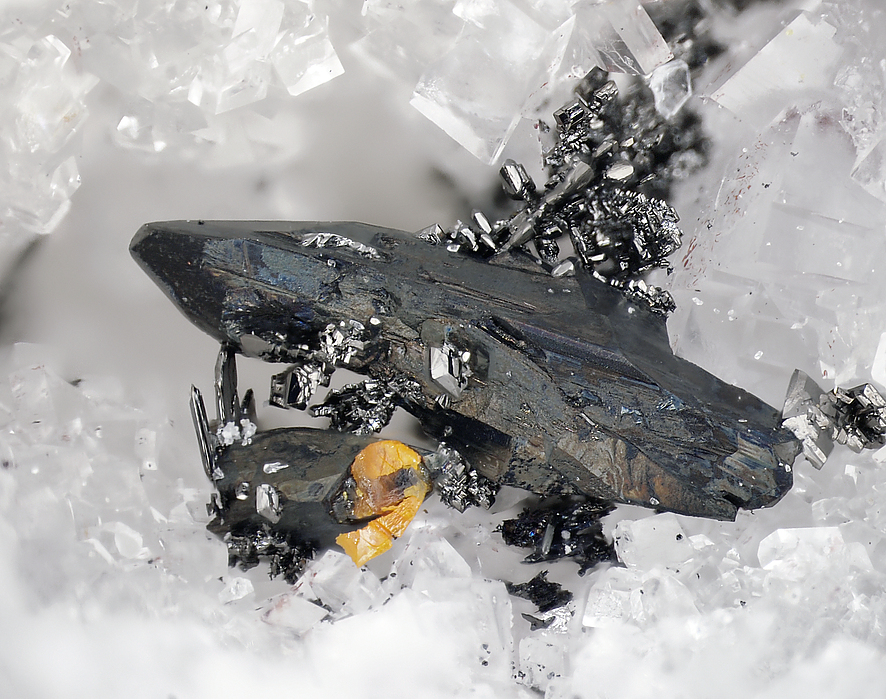
Sicherite is a rare mineral species associated with complex manganese-bearing mineral assemblages. It is known for its distinctive chemical composition and occurrence in specialized geological environments where manganese-rich fluids or alteration processes have produced a variety of uncommon secondary minerals. Because sicherite is not a common rock-forming or ore mineral, information about its physical characteristics and geological occurrence is primarily of interest to mineralogists, collectors, and researchers studying rare mineral species.
Like many uncommon manganese minerals, sicherite is generally encountered in association with other manganese-bearing phases rather than as large, isolated crystals. Its identification depends on a combination of physical appearance, chemical composition, crystal structure, and geological context. The mineral’s restricted occurrence and relatively uncommon status make verified specimens useful for mineralogical collections and reference material. Understanding sicherite also contributes to the broader study of how manganese is transported, concentrated, and incorporated into minerals during hydrothermal alteration, oxidation, and other geological processes.
History and Discovery of Sicherite
Sicherite is a rare sulfosalt mineral that was first identified from the Lengenbach Quarry in the Binntal region of Valais, Switzerland. The mineral was formally described as a new species in a 2001 paper published in American Mineralogist by Stefan Graeser, Peter Berlepsch, Emil Makovicky, and Tonči Balić-Žunić. Its IMA approval dates to 1997, with the mineral subsequently established through detailed chemical, crystallographic, and structural investigations. The type locality is the Lengenbach Quarry, a well-known Swiss locality particularly famous for its diverse assemblage of rare thallium-, arsenic-, silver-, and sulfosalt minerals.
The name Sicherite honors Valentin Sicher (1925–2017), who was an active member and financial contributor to the Lengenbach syndicates involved in operating the quarry for scientific research and mineral specimen recovery. The discovery of sicherite added another structurally distinctive sulfosalt to the already complex Lengenbach mineral assemblage. Its recognition was based not simply on its unusual chemical composition but also on its orthorhombic crystal structure and characteristic relationship between thallium, silver, arsenic, antimony, and sulfur.
Formation and Geological Occurrence of Sicherite
Sicherite is associated with the highly specialized mineral-forming environment of the Lengenbach Quarry in the Binntal region of Valais, Switzerland. Lengenbach is a famous Alpine locality for rare sulfosalt minerals and is hosted by dolomitic rocks that contain unusually high concentrations of elements such as thallium, arsenic, antimony, and silver. These elements became concentrated during geological processes affecting the carbonate host rocks, creating conditions suitable for the formation of a diverse assemblage of complex sulfide and sulfosalt minerals. Sicherite occurs as a minor phase within this assemblage rather than as a major component of the deposit.
The formation of sicherite is closely related to the interaction of sulfur-bearing mineralizing fluids with the chemically unusual rocks of the Lengenbach deposit. Variations in temperature, sulfur activity, and the relative availability of thallium, silver, arsenic, and antimony allowed different sulfosalt phases to crystallize during the evolution of the mineral assemblage. Sicherite is commonly found together with other rare Tl-bearing sulfosalts, illustrating the complex chemical relationships that characterize Lengenbach. Its restricted occurrence reflects the specialized geochemical conditions required to combine these elements into a stable mineral structure.
Crystal Structure of Sicherite
Sicherite crystallizes in the orthorhombic crystal system and belongs to the complex structural family of sulfosalt minerals. Its ideal chemical formula is TlAg₂(As,Sb)₃S₆, showing that thallium and silver occupy important cation sites while arsenic and antimony occur together within the sulfur-based structural framework. The substitution between arsenic and antimony is an important feature of its composition and reflects the close chemical relationship between these two elements in the Lengenbach sulfosalt assemblage. This combination gives sicherite a considerably more complex structure than simple sulfide minerals such as galena or sphalerite.

At the atomic scale, sulfur forms the principal anion framework around which the metallic and semimetallic elements are arranged. Silver and thallium occupy structurally distinct positions, while arsenic and antimony participate in sulfur-bonded structural groups. The resulting arrangement is characteristic of sulfosalt chemistry, in which sulfur combines with elements such as arsenic and antimony to produce complex structural units. Detailed crystallographic studies of sicherite have been important in distinguishing it from chemically related Lengenbach minerals and in establishing its status as an independent mineral species.
Physical and Chemical Properties of Sicherite
Sicherite is a rare sulfosalt mineral with a composition dominated by thallium, silver, arsenic, antimony, and sulfur. Its ideal formula is TlAg₂(As,Sb)₃S₆, although the relative proportions of arsenic and antimony can vary because these elements can substitute for one another within the crystal structure. This compositional flexibility is consistent with the complex mineral chemistry of the Lengenbach deposit, where numerous related sulfosalt minerals contain combinations of Tl, Ag, As, Sb, and S. The presence of thallium and silver also contributes to the relatively high density expected for the mineral compared with many common non-metallic minerals.
In hand specimens, sicherite is generally encountered as a very small mineral phase within complex sulfide and sulfosalt aggregates rather than as large, easily recognizable crystals. Its physical appearance can therefore be influenced by associated minerals and the size of individual grains. As with many rare sulfosalts, reliable identification cannot be based on color, luster, or crystal habit alone. Chemical analysis and crystallographic methods are particularly important because sicherite can occur together with other visually similar thallium-bearing minerals at the Lengenbach locality. Its characteristic elemental composition and orthorhombic crystal structure provide more dependable criteria for distinguishing it from related species.
Color, Luster, Hardness, and Other Physical Characteristics of Sicherite
Sicherite is generally encountered as a very fine-grained mineral, so its individual physical characteristics can be difficult to observe directly in hand specimens. Reported material is associated with the metallic to submetallic appearance typical of many sulfosalt minerals, although the visible surface can be strongly affected by the minerals surrounding it. Because sicherite commonly occurs as small grains within complex mineral aggregates, crystal faces and cleavage are not always readily apparent. Its relatively high density is consistent with its thallium and silver content, while its sulfide-rich composition gives it physical characteristics distinct from lighter non-metallic minerals occurring in the same host rocks.
The hardness of sicherite is relatively low compared with many common silicate minerals, as is typical of numerous sulfosalts. However, hardness measurements can be difficult to obtain accurately when the mineral occurs only as microscopic or very small grains. For this reason, properties such as color, streak, luster, and apparent hardness are mainly useful as preliminary observations rather than definitive identification criteria. In practice, sicherite is best distinguished through its chemical composition and crystallographic properties, particularly its combination of Tl, Ag, As, Sb, and S and its orthorhombic structure.
Types and Varieties of Sicherite
Sicherite is recognized as a distinct mineral species rather than a mineral with numerous officially established varieties. Because it is rare and occurs mainly within the complex sulfosalt assemblage of the Lengenbach Quarry, mineralogical descriptions generally focus on its chemical composition, crystal structure, and relationships with associated minerals rather than on separately named varieties. The substitution of arsenic and antimony in its structure can produce compositional differences between individual grains, but these variations do not necessarily represent formally recognized mineral varieties.
Sicherite may therefore be described according to its physical and compositional occurrence:
- Sicherite sensu stricto — The recognized mineral species with the idealized composition TlAg₂(As,Sb)₃S₆ and an orthorhombic crystal structure.
- As-rich Sicherite — Material in which arsenic is relatively more abundant than antimony within the As-Sb structural sites.
- Sb-rich Sicherite — Material showing comparatively greater antimony substitution for arsenic.
- Fine-grained Sicherite — The common form in which sicherite occurs as small grains within complex sulfosalt aggregates at Lengenbach.
These descriptions primarily reflect compositional or textural differences rather than formally approved varieties. The As-Sb substitution is particularly relevant when analyzing sicherite because arsenic and antimony commonly substitute for one another among the minerals of the Lengenbach assemblage.
Associated Minerals of Sicherite
Sicherite occurs within one of the most chemically diverse sulfosalt assemblages known from the Lengenbach Quarry. The deposit contains numerous rare minerals enriched in thallium, silver, arsenic, and antimony, and sicherite is found as a minor phase within this broader assemblage. Its occurrence alongside chemically related sulfosalts is important because the same elements can be distributed among several different mineral structures depending on local changes in composition and mineral-forming conditions. The close association of these minerals makes Lengenbach an important locality for studying complex sulfosalt mineralogy.

The mineral assemblage at Lengenbach includes a number of uncommon Tl-bearing and Ag-bearing sulfosalts, as well as sulfides and other minerals hosted by the dolomitic rocks of the deposit. Sicherite can therefore be difficult to identify visually when it occurs as very small grains intergrown with neighboring phases. Mineralogical studies of the locality rely on detailed chemical and crystallographic analyses to determine the relationships between individual species. These associations also provide information about the distribution of thallium, silver, arsenic, and antimony during the formation and subsequent alteration of the deposit.
How to Identify Sicherite
Sicherite is difficult to identify reliably by appearance alone because it is rare and commonly occurs as very small grains within complex sulfosalt aggregates. Its geological locality provides an important initial clue: specimens from the Lengenbach Quarry in the Binntal region of Switzerland are particularly relevant because this locality is the type locality of sicherite. The mineral’s association with other thallium-, silver-, arsenic-, and antimony-bearing sulfosalts can further support a preliminary identification, but visual characteristics alone are insufficient to distinguish it confidently from closely related species.
Definitive identification generally requires chemical and crystallographic analysis. The characteristic combination of thallium, silver, arsenic, antimony, and sulfur can be established through analytical techniques such as electron-microprobe analysis, while powder or single-crystal X-ray diffraction can confirm the orthorhombic crystal structure. The As-Sb substitution is also important when interpreting analytical results because these two elements can occupy related structural positions. A combination of composition, crystal structure, mineral associations, and locality information therefore provides a much more reliable identification of sicherite than color, luster, or crystal habit alone.
Uses and Significance of Sicherite
Sicherite has no significant industrial or commercial use. Its rarity, limited occurrence, and very small grain size make it unsuitable as an ore mineral for the extraction of thallium, silver, arsenic, or antimony. Instead, its primary importance is mineralogical and scientific. Sicherite is studied as an example of a complex sulfosalt containing several chemically important elements within a single crystal structure, providing information about the ways in which thallium, silver, arsenic, antimony, and sulfur can combine under specialized geological conditions.
The mineral is particularly significant because of its occurrence at the Lengenbach Quarry, a locality renowned for its exceptional diversity of rare sulfosalts. Sicherite contributes to the understanding of the mineralogical evolution and chemical complexity of this deposit, especially the distribution and substitution of arsenic and antimony among related mineral species. Verified specimens may also be preserved in specialist mineralogical and museum collections as reference material. For researchers, sicherite provides an opportunity to study the crystal chemistry, phase relationships, and formation conditions of rare thallium-bearing sulfosalts.