
Ferrokentbrooksite is a rare sodium-calcium iron zirconium niobium silicate mineral belonging to the eudialyte group. It is distinguished by its complex chemical composition, which includes iron, zirconium, niobium, and silicon, together with sodium and calcium as major structural constituents. The mineral typically occurs in reddish-brown to red crystals and is most commonly associated with highly alkaline igneous rocks, particularly nepheline syenites and their related pegmatitic formations. Its crystal structure and chemical composition make it an important member of the eudialyte group for mineralogical classification and the study of complex silicate minerals.
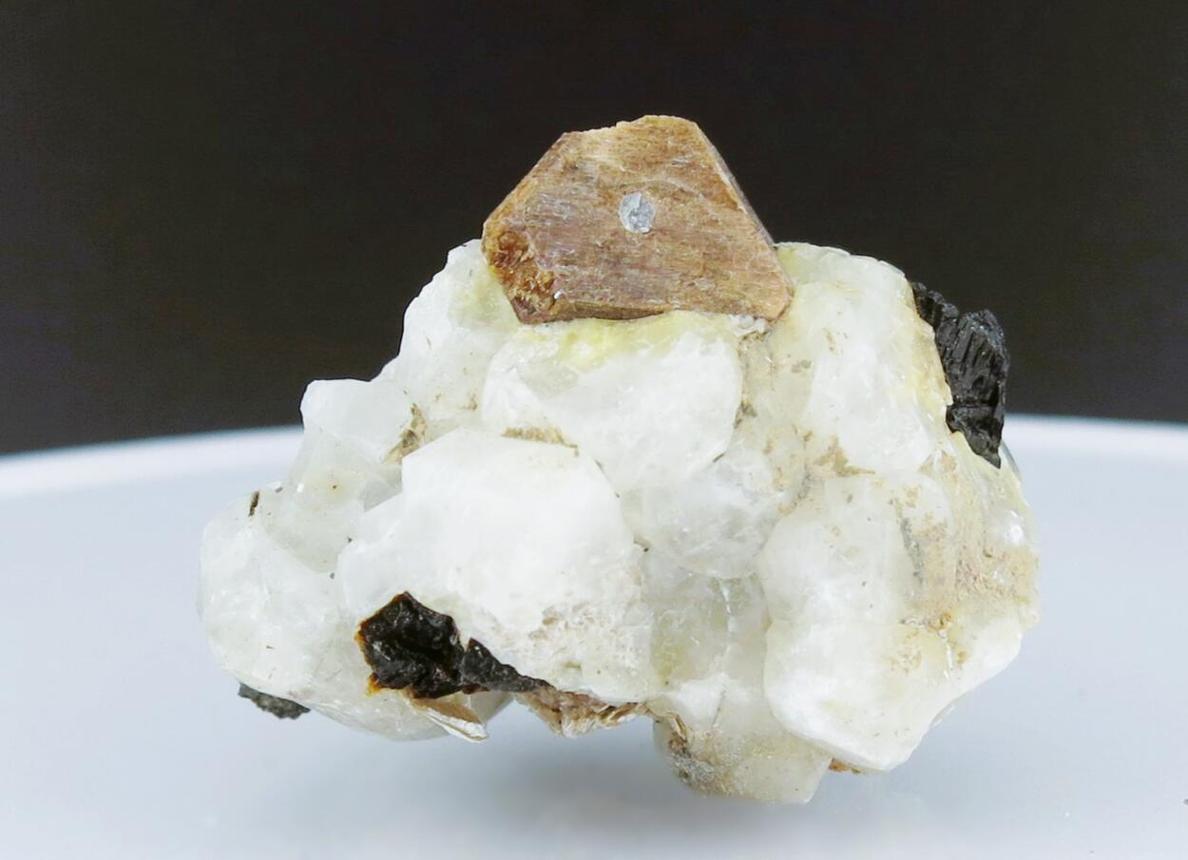
Ferrokentbrooksite was first described as a distinct mineral species in 2003 by Ole Johnsen, Joel D. Grice, and Robert A. Gault, based on specimens collected from the Poudrette Quarry at Mont Saint-Hilaire in Quebec, Canada. Its approval was originally registered under IMA proposal 1999-046. The name reflects its chemical relationship with kentbrooksite, representing the iron-dominant analogue in which ferrous iron (Fe²⁺) is the principal divalent transition metal. The name kentbrooksite itself commemorates Charles Kent Brooks, a Danish geologist known for his research and geological expeditions in Greenland.
As a member of the eudialyte group, ferrokentbrooksite shares a complex silicate framework with minerals containing large amounts of sodium, calcium, zirconium, and other transition metals. However, variations in the occupancy of specific structural sites produce differences in chemical composition among individual group members. Ferrokentbrooksite is particularly notable for the combination of iron and niobium within its structure, distinguishing it from several chemically related species. It is primarily of interest to mineralogists and collectors of uncommon alkaline-rock minerals rather than being widely used as an industrial or commercial material.
Chemical Composition and Classification
Ferrokentbrooksite belongs to the silicate class and is classified within the eudialyte group, a structurally complex group of minerals characterized by large, interconnected silicate frameworks and variable chemical compositions. Its ideal chemical formula is:
Na₁₅Ca₆Fe²⁺₃Zr₃Nb(Si₂₅O₇₃)(O,OH,H₂O)₃(F,Cl)₂
The composition includes sodium (Na), calcium (Ca), ferrous iron (Fe²⁺), zirconium (Zr), niobium (Nb), silicon (Si), oxygen (O), hydrogen (H), fluorine (F), and chlorine (Cl). Natural specimens may contain additional elements, including manganese, rare earth elements, yttrium, potassium, strontium, titanium, hafnium, and tantalum. Substitution among these elements contributes to the chemical variability observed in ferrokentbrooksite specimens and other members of the eudialyte group.
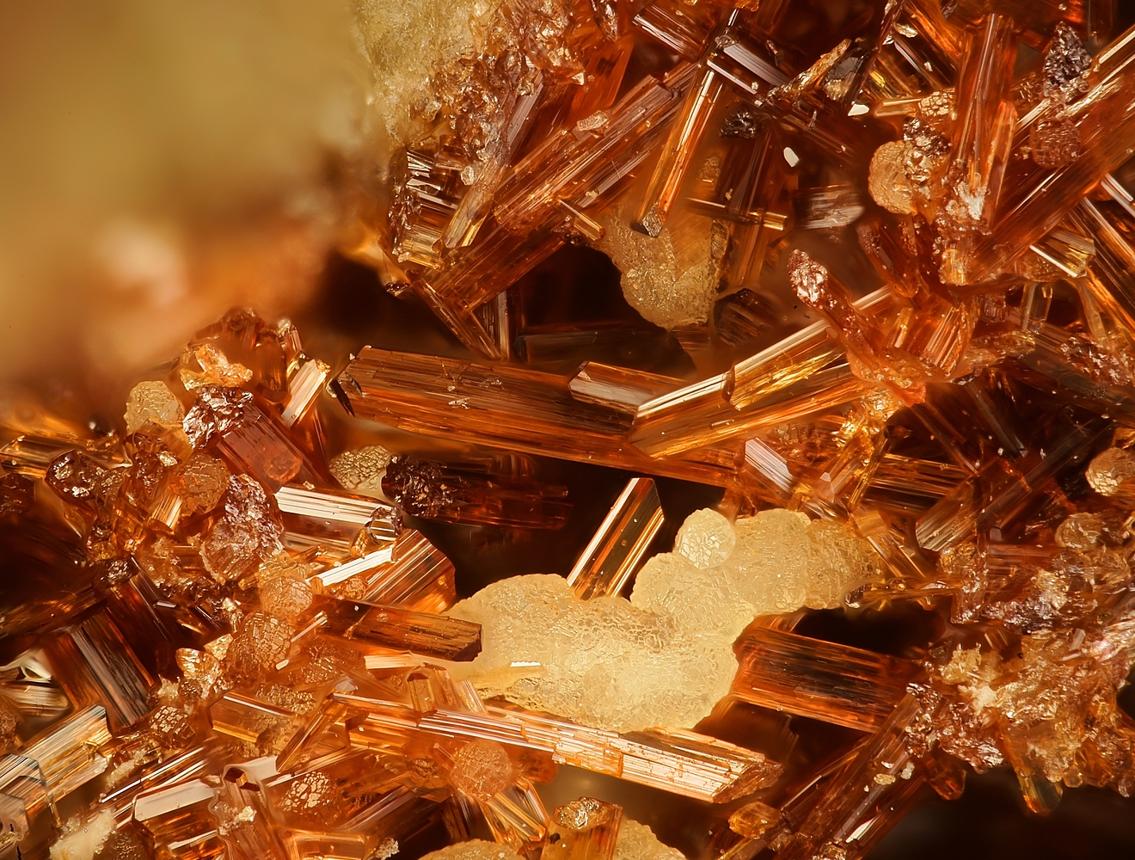
The dominant structural components are the silicate framework and the large cation sites occupied primarily by sodium and calcium. Zirconium and niobium are also important constituents, while iron occupies specific positions within the structure. The relative abundance of iron distinguishes ferrokentbrooksite from its closely related analogue kentbrooksite, in which manganese is the dominant divalent transition metal.
Its classification reflects both its silicate framework and its complex chemical characteristics. In the Strunz mineral classification, ferrokentbrooksite is placed among the cyclosilicates, reflecting the structural arrangement of silicon-oxygen units within the mineral. Its identification therefore depends on a combination of chemical analysis and crystallographic examination rather than visual characteristics alone.
Crystal Structure of Ferrokentbrooksite
Ferrokentbrooksite crystallizes in the trigonal crystal system, with space group R3m. Its structure is characterized by a complex arrangement of silicate groups and multiple crystallographically distinct cation sites. The unit cell has lattice parameters of approximately a = 14.2099 Å and c = 30.067 Å, with three formula units per unit cell (Z = 3). Although its crystallographic description uses hexagonal axes, its symmetry belongs to the trigonal system.
As a member of the eudialyte group, ferrokentbrooksite possesses a framework containing interconnected silicon-oxygen groups arranged into ring-like structural units. These silicate units are linked through a network of additional cations, including sodium, calcium, zirconium, iron, and niobium. The structure accommodates a relatively large number of different elements because its crystallographic sites vary in size, coordination environment, and chemical preference. This flexibility accounts for the extensive compositional variation observed among eudialyte-group minerals.
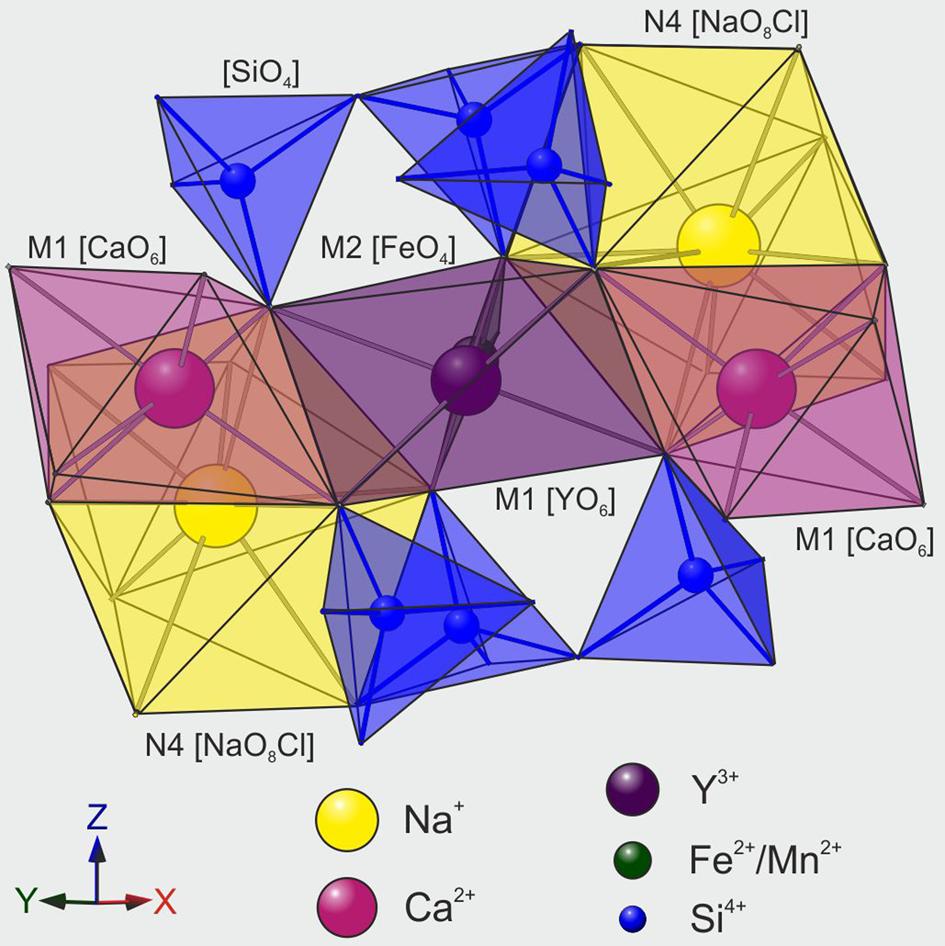
Iron occupies important positions within the structure, with ferrous iron (Fe²⁺) being the dominant divalent transition metal in the ideal composition. Zirconium and niobium occupy additional structural sites, while sodium and calcium contribute to the larger coordination environments throughout the framework. Minor substitutions involving manganese, rare earth elements, yttrium, and other elements may also occur in natural specimens. These substitutions can influence the detailed structural parameters and chemical characteristics without necessarily changing the mineral’s overall structural classification.
The combination of a complex silicate framework and multiple substitutional sites makes ferrokentbrooksite an example of the structural diversity found within alkaline-rock silicate minerals. Its identification as a separate mineral species relies on the relationship between its chemical composition and crystal structure, particularly the dominance of ferrous iron over manganese at the relevant structural positions. X-ray diffraction and electron-microprobe analysis are therefore important methods for distinguishing it from chemically related members of the eudialyte group.
Optical Properties of Ferrokentbrooksite
Ferrokentbrooksite is optically uniaxial negative, reflecting its trigonal crystal symmetry and the directional behavior of light passing through its crystal structure. Its refractive indices are measured at approximately ω = 1.6221 and ε = 1.6186. The difference between these values produces a relatively low birefringence of approximately 0.0035. Under polarized light microscopy, this optical behavior helps distinguish ferrokentbrooksite from minerals with substantially higher birefringence.
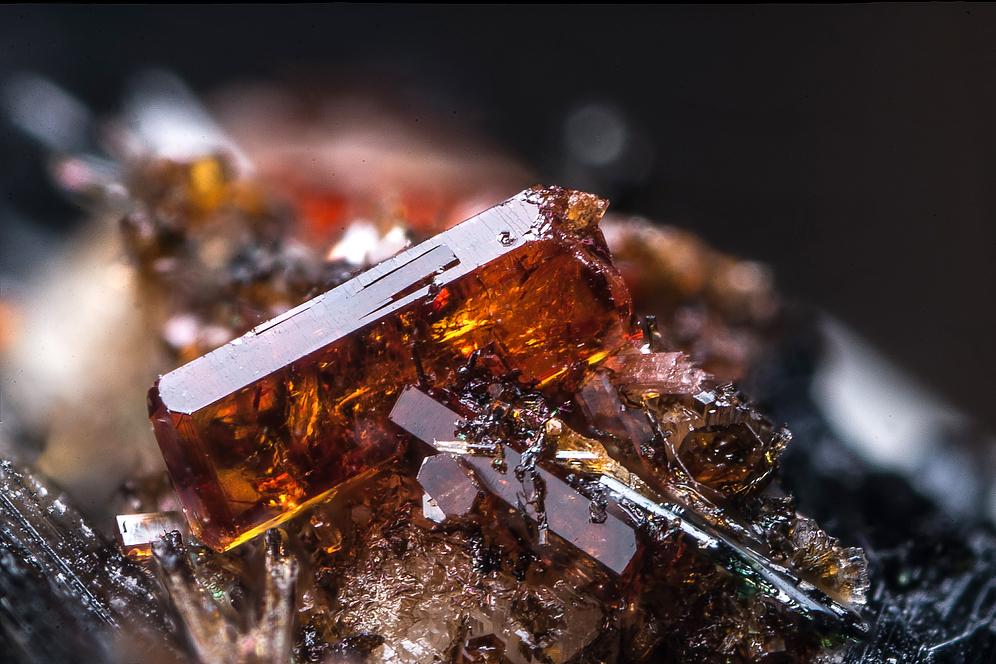
The mineral is generally transparent, with reddish-brown to red coloration in hand specimens. Thin grains may display pale rose-orange tints when examined in transmitted light. Unlike some other colored silicate minerals, ferrokentbrooksite is reported to be non-pleochroic, meaning that its body color does not show a significant change when the mineral is rotated under plane-polarized light. This characteristic can be useful during petrographic examination, particularly when comparing it with related minerals that exhibit more noticeable pleochroism.
Ferrokentbrooksite may occasionally display anomalously biaxial optical behavior, with a measured optic axial angle of approximately 5°. This deviation does not necessarily indicate a different mineral species, as complex crystal chemistry, structural variations, and internal distortions can influence the observed optical response. Its relatively low birefringence and characteristic refractive indices are therefore important diagnostic properties when examined alongside chemical and crystallographic data.
Formation and Geological Occurrence of Ferrokentbrooksite
Ferrokentbrooksite is primarily associated with highly alkaline igneous environments, particularly agpaitic nepheline syenites and their associated pegmatitic dikes. These rocks develop in silica-undersaturated, alkali-rich magmatic systems in which sodium and other incompatible elements become concentrated during magmatic differentiation. As crystallization progresses, the residual melt may become enriched in elements such as zirconium, niobium, rare earth elements, and other components that are relatively uncommon in ordinary igneous rocks. Such chemical conditions provide an environment in which complex minerals belonging to the eudialyte group can crystallize.
The mineral is described as a primary but late-stage mineral phase in pegmatite dikes cutting nepheline syenite. Its formation is associated with the evolution of residual alkaline melts during the later stages of magmatic crystallization. As earlier-forming minerals remove major elements from the melt, the remaining liquid becomes progressively enriched in sodium, zirconium, niobium, and other incompatible elements. Under suitable conditions, these components combine with calcium, iron, and silicon to produce ferrokentbrooksite and related complex silicates. The availability of fluorine and chlorine may also influence the composition of the mineral because both elements can occupy anion sites within its crystal structure.
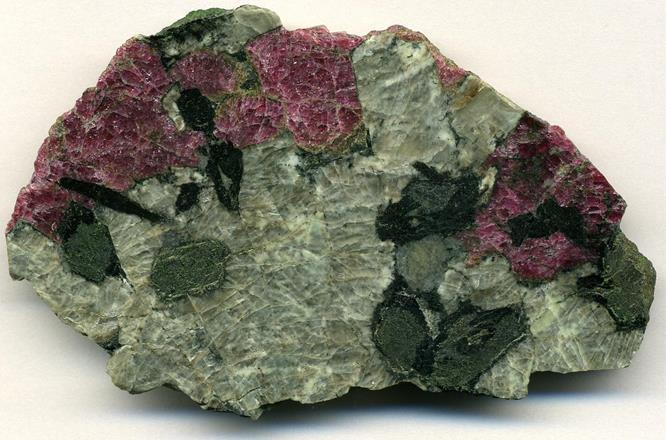
The formation of ferrokentbrooksite is closely related to the broader geochemical processes responsible for the development of eudialyte-group minerals. Variations in oxidation conditions, melt composition, temperature, and the availability of different cations can influence which species crystallize within an individual alkaline intrusion. The relative proportions of iron and manganese are particularly important in determining whether the resulting composition corresponds to ferrokentbrooksite or a chemically related member of the group.
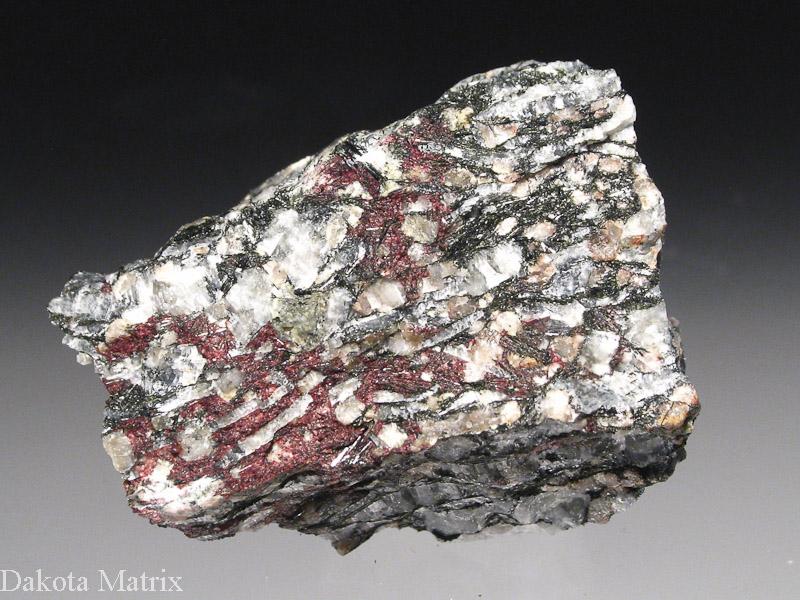
Ferrokentbrooksite commonly occurs alongside other minerals characteristic of alkaline igneous rocks, including microcline, nepheline, aegirine, albite, fluorite, natrolite, and several rare silicates and carbonates. These mineral associations provide information about the chemical evolution of the host rock and the conditions under which late-stage pegmatitic minerals formed. Its occurrence is therefore closely connected to specialized alkaline magmatic environments rather than widespread geological processes such as ordinary sedimentation or regional metamorphism.
Mineral Associations of Ferrokentbrooksite
Ferrokentbrooksite occurs in complex mineral assemblages associated with highly alkaline igneous rocks, particularly nepheline syenites and agpaitic pegmatites. At its type locality, the Poudrette Quarry at Mont Saint-Hilaire in Quebec, Canada, it is found alongside a diverse range of silicate, carbonate, oxide, and fluoride minerals. These associations reflect the chemically evolved nature of the host rocks and the concentration of elements such as sodium, zirconium, niobium, iron, and rare earth elements during late-stage magmatic crystallization.
Common associated minerals include microcline, nepheline, albite, aegirine, natrolite, gonnardite, fluorite, fluorapatite, rhodochrosite, calcite, sérandite, ancylite-(Ce), and catapleiite. Nepheline and microcline represent major feldspathoid and feldspar components of the alkaline host rocks, while aegirine is a sodium-rich iron-bearing pyroxene commonly encountered in these environments. Natrolite and gonnardite may occur as secondary or late-stage minerals, particularly where earlier feldspathoid minerals have undergone alteration.
The presence of fluorite and fluorapatite reflects the availability of fluorine and phosphorus in the mineral-forming environment. Carbonates such as calcite, rhodochrosite, and ancylite-(Ce) provide additional evidence of the chemical diversity of these assemblages. Catapleiite, another zirconium-bearing mineral, is particularly relevant because it illustrates the range of zirconium-bearing phases that can develop in alkaline intrusive complexes.
The specific mineral associations vary between localities and individual pegmatite bodies. Some specimens may contain ferrokentbrooksite as isolated crystals within a complex silicate matrix, whereas others occur in association with several rare minerals. Examining these relationships helps establish the paragenetic sequence of mineral formation and provides information about the chemical evolution of alkaline magmatic systems.
Major Occurrences and Localities of Ferrokentbrooksite
Ferrokentbrooksite is a relatively uncommon mineral with documented occurrences in several alkaline igneous complexes. Its type locality is the Poudrette Quarry at Mont Saint-Hilaire, Quebec, Canada, where it was first identified and formally described. Additional occurrences have been reported in Greenland, Norway, and Russia. These localities are associated with unusual alkaline rocks and pegmatitic environments that provide the chemical conditions required for the formation of complex zirconium- and niobium-bearing silicates.
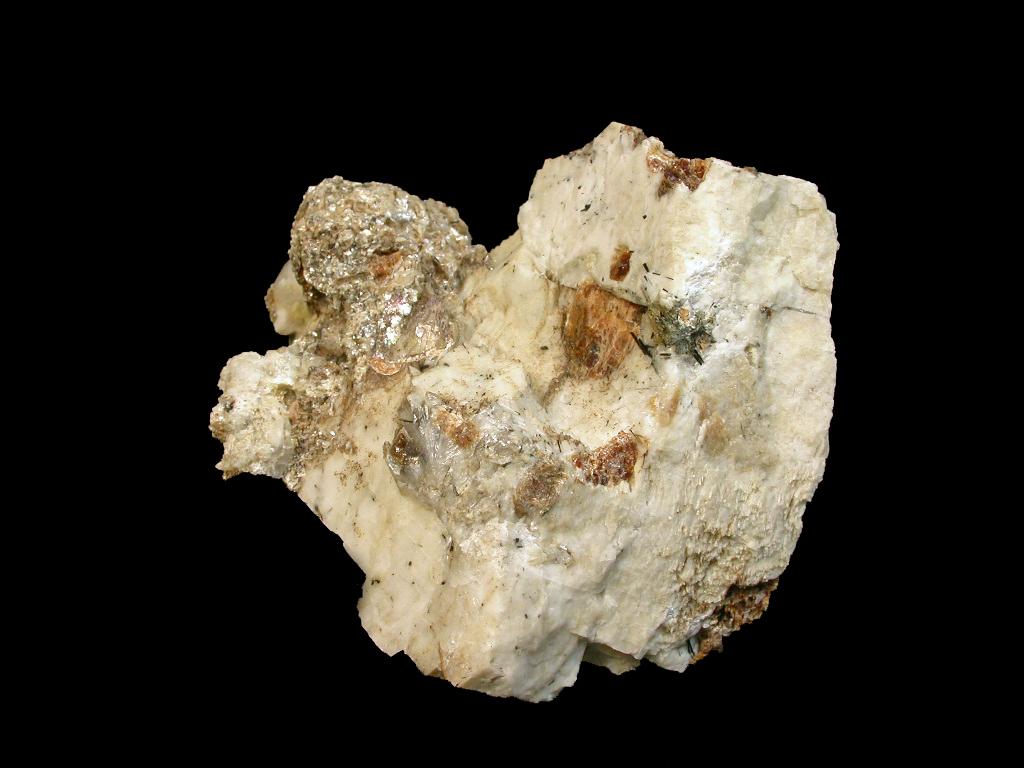
The Poudrette Quarry at Mont Saint-Hilaire in Quebec is the type locality and the principal reference occurrence for ferrokentbrooksite. The mineral was identified in a small pegmatite dike cutting nepheline syenite within the Mont Saint-Hilaire alkaline intrusive complex. Specimens from this locality typically contain reddish-brown to red pseudo-octahedral crystals, with individual crystals reaching approximately 1 cm in diameter. The quarry is also known for its exceptional diversity of rare alkaline-rock minerals, making it an important locality for studying complex silicate mineral chemistry.
Greenland: Narssârssuk Pegmatite
In Norway, ferrokentbrooksite has been documented at several localities in the Langesundfjord area, including Brønnebukta, Siktesøya, Barkevik Strand, and the Bjørndalen Quarry at Tvedalen. It has also been reported from Kariåsen in the Sandefjord area. These localities are associated with the alkaline igneous geology of the Oslo Rift, which contains numerous unusual intrusive rocks and mineral-rich pegmatites. The regional geological setting supports the formation of a wide range of sodium-rich silicates, zirconium-bearing minerals, and other uncommon mineral species.
Russia: Burpala Alkaline Complex
Another reported occurrence is the Burpala alkaline complex in the Baikal region of Russia. This locality represents an additional geological environment in which ferrokentbrooksite has been identified. The complex contains alkaline igneous rocks associated with specialized mineral assemblages, including minerals enriched in zirconium, niobium, and other incompatible elements. Its occurrence in the Burpala complex extends the known geographical distribution of the species beyond its better-known Canadian, Greenlandic, and Norwegian localities.
The distribution of ferrokentbrooksite across these regions demonstrates that its formation is not restricted to a single geological complex. Instead, it is associated with a relatively specific combination of alkaline magmatic conditions, unusual bulk-rock chemistry, and late-stage crystallization processes.
Identification of Ferrokentbrooksite
Ferrokentbrooksite can be recognized provisionally by its reddish-brown to red coloration, vitreous luster, white streak, and characteristic pseudo-octahedral crystal habit. Crystals may occur as individual forms or as aggregates within complex alkaline-rock pegmatites. Its moderate Mohs hardness of 5–6 and specific gravity of approximately 3.06 provide additional physical characteristics for preliminary examination. However, these properties overlap with those of several other silicate minerals, so visual identification alone is unreliable.
One of the more useful distinguishing features is its chemical composition. Ferrokentbrooksite contains substantial amounts of sodium, calcium, ferrous iron, zirconium, niobium, and silicon. The dominance of Fe²⁺ over manganese at the relevant structural sites is particularly important in distinguishing it from kentbrooksite. Electron microprobe analysis can determine the relative concentrations of these elements and establish whether a specimen meets the compositional requirements for ferrokentbrooksite.
X-ray diffraction provides another important method of identification. It reveals the mineral’s trigonal crystal structure and characteristic diffraction pattern, allowing it to be distinguished from minerals with similar external appearances but different internal structures. Optical examination under polarized light can provide supporting information, including its uniaxial negative optical character and relatively low birefringence.
Geological context is also useful when evaluating a suspected specimen. Ferrokentbrooksite is associated primarily with highly alkaline igneous rocks, particularly agpaitic pegmatites cutting nepheline syenite. Its occurrence alongside minerals such as aegirine, nepheline, microcline, natrolite, fluorite, and catapleiite can support a preliminary identification. Nevertheless, definitive classification requires chemical and crystallographic evidence.
Ferrokentbrooksite and Similar Minerals
Ferrokentbrooksite belongs to the eudialyte group, which contains numerous chemically related cyclosilicate minerals. Many members share similar crystal structures, geological environments, and overlapping physical characteristics. Their differences are primarily associated with the elements occupying specific crystallographic sites, particularly iron, manganese, zirconium, niobium, titanium, and rare earth elements. Consequently, distinguishing individual species often requires detailed chemical analysis rather than relying on color or crystal habit.
| Mineral | Main distinguishing characteristics |
|---|---|
| Kentbrooksite | The manganese-dominant analogue of ferrokentbrooksite, with Mn²⁺ predominating over Fe²⁺ at the relevant structural site. |
| Eudialyte | A chemically variable zirconium-rich cyclosilicate, commonly containing iron, calcium, sodium, and other substituting elements. |
| Carbokentbrooksite | A related eudialyte-group mineral distinguished by carbonate-bearing structural components and a different chemical arrangement. |
| Alluaivite | A titanium- and niobium-bearing member of the eudialyte group, characterized by a different distribution of transition metals. |
| Feklichevite | A complex zirconium- and niobium-bearing silicate containing both ferrous and ferric iron, with a different overall structural composition. |
The closest chemical comparison is kentbrooksite because the two minerals share closely related structural and compositional characteristics. Their principal distinction is the relative dominance of iron and manganese. Eudialyte is another important comparison because it represents the broader mineral group to which both species belong, although its composition is more variable and may differ considerably between localities.
Carbokentbrooksite and alluaivite illustrate the wider chemical diversity of the group. Although they share aspects of the eudialyte structural framework, differences in anion composition and transition-metal occupancy result in separate mineral species. These distinctions are important in mineralogical classification because visually similar specimens may represent different species with substantially different chemical compositions.
Uses and Applications of Ferrokentbrooksite
Ferrokentbrooksite has no significant established industrial or commercial applications. Its rarity, complex chemical composition, and limited natural occurrence make it unsuitable for large-scale extraction or conventional manufacturing. Although it contains zirconium and niobium, its geological distribution and mineralogical characteristics do not currently support its use as a practical source of these elements. Both metals are generally obtained from more abundant and economically viable mineral deposits.
Its principal importance lies in mineralogical research and scientific collections. As a member of the eudialyte group, ferrokentbrooksite provides an example of how different chemical elements can occupy specific structural positions within complex cyclosilicate frameworks. Research on its composition and crystal structure contributes to the understanding of mineral substitution, crystallographic relationships, and the chemical evolution of highly alkaline igneous systems.
Ferrokentbrooksite is also collected as a rare mineral specimen, particularly when it occurs as well-developed reddish-brown to red pseudo-octahedral crystals. Specimens from Mont Saint-Hilaire are of particular interest because of the locality’s diverse mineral assemblages and importance in the study of unusual alkaline-rock minerals. Its value as a collector mineral depends on factors such as crystal development, specimen condition, size, association with other minerals, and documented provenance.
Overall, ferrokentbrooksite is primarily a mineralogical and collecting subject rather than an industrial material. Its significance comes from its distinctive chemical composition, relationship with other eudialyte-group minerals, and occurrence in specialized alkaline geological environments.