
Violarite is a relatively rare nickel-iron sulfide mineral with the chemical formula FeNi₂S₄. It belongs to the thiospinel group within the broader spinel supergroup and is characterized by its cubic crystal structure and distinctive violet-gray appearance in reflected light. The mineral typically occurs as massive aggregates, irregular grains, or replacement products within nickel-bearing sulfide ores rather than as well-developed individual crystals. Its composition and occurrence are closely associated with other nickel sulfide minerals, particularly pentlandite, millerite, and pyrrhotite.
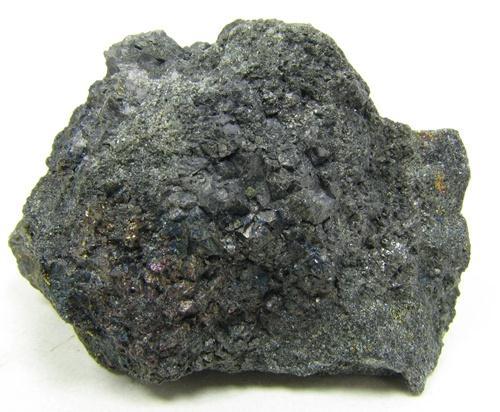
Violarite is found in both primary hydrothermal mineral deposits and secondary alteration zones, where it may develop through the chemical transformation of pre-existing nickel sulfides. It is particularly associated with nickel-rich ore systems, including those formed through magmatic and hydrothermal processes. Although individual occurrences may contain only small quantities of the mineral, violarite is of interest in economic geology, mineralogy, and the study of sulfide mineral alteration. Its name derives from the Latin word viola, meaning violet, referring to its characteristic color under reflected-light microscopy.
Violarite is an iron-nickel sulfide mineral composed primarily of iron, nickel, and sulfur, with an ideal chemical formula of FeNi₂S₄. It is classified as a member of the linnaeite subgroup of the thiospinel group, a family of sulfide minerals characterized by a general structural formula of AB₂S₄. In violarite, iron and nickel occupy different crystallographic positions within the sulfide framework, producing a structure comparable to that of other spinel-type sulfide minerals. Its nickel-rich composition distinguishes it from iron-dominant members of the same structural family.
The mineral commonly occurs as an alteration product of pentlandite, an important nickel-bearing sulfide mineral, particularly in weathered or chemically modified portions of nickel deposits. During this process, changes in oxidation conditions and the movement of fluids can promote the redistribution of iron and nickel, resulting in the formation of violarite. It may also occur in primary hydrothermal assemblages, where it develops alongside other sulfide minerals without necessarily being associated with extensive surface weathering.
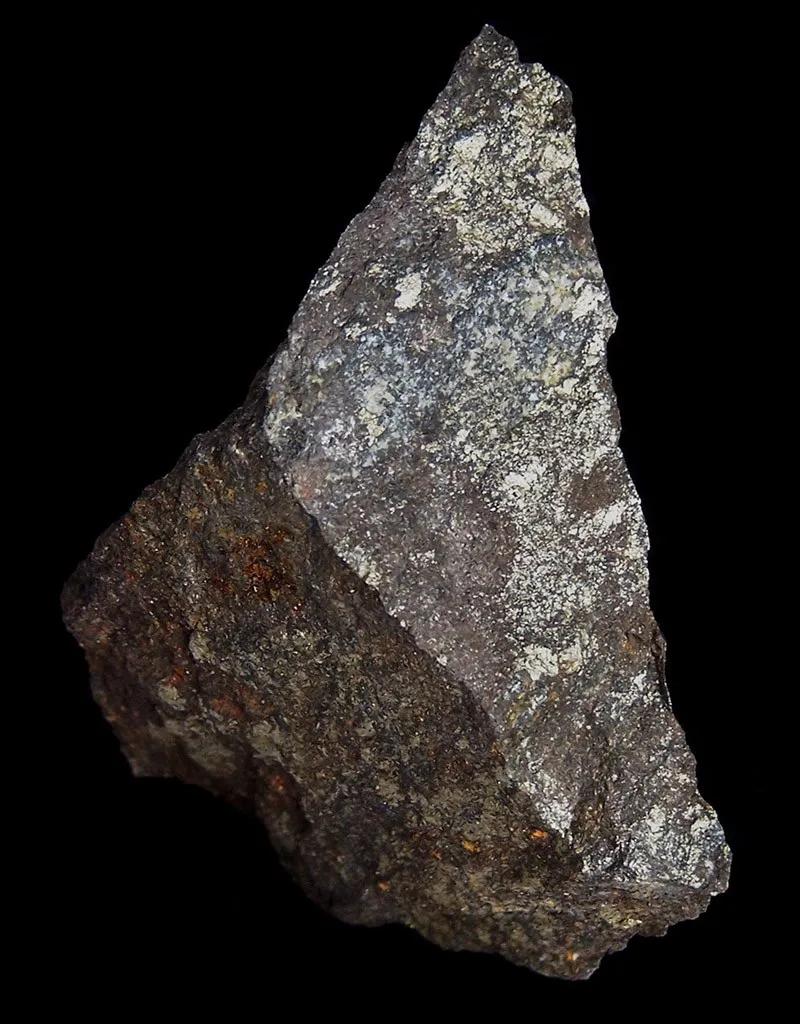
Violarite is generally opaque and has a metallic luster. Its color varies from light gray and steel gray to violet-gray and copper-red, depending on the specimen’s surface condition and degree of alteration. The characteristic violet coloration is particularly noticeable in polished sections examined under reflected light, making optical microscopy an important method for its identification. With a Mohs hardness of approximately 4.5–5.5 and a calculated specific gravity of about 4.79, violarite is a relatively dense but moderately hard sulfide mineral.
History and Discovery of Violarite
Violarite was formally described in 1924 by American geologist Waldemar Lindgren and mineralogist W. Myron Davy during investigations of nickel-bearing ore deposits in southern Nevada, United States. Their study focused on sulfide minerals from the Key West Mine, where they identified a mineral with distinctive violet-gray coloration in polished sections. The mineral differed in color, hardness, and stability from previously described polydymite, another nickel sulfide mineral with a closely related composition and crystal structure. Lindgren and Davy introduced the name violarite, derived from the Latin viola, meaning violet, to describe its characteristic appearance under reflected light microscopy.
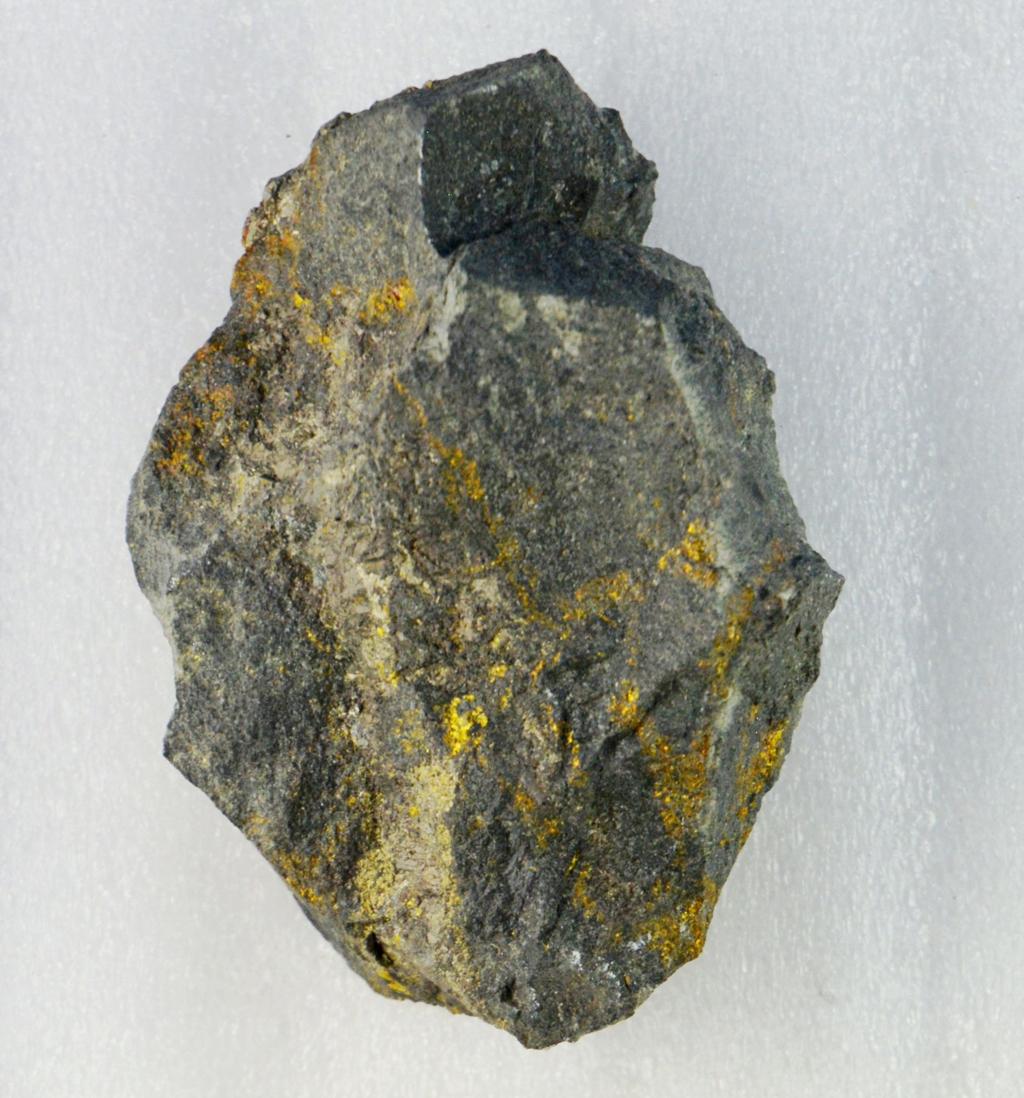
The early understanding of violarite’s chemical composition was not entirely accurate. Lindgren initially considered it to have a composition close to nickel disulfide, NiS₂, partly because iron detected in earlier analyses of similar material was interpreted as contamination from associated pentlandite. Subsequent investigations demonstrated that iron was an essential constituent of the mineral rather than simply an impurity. In 1930, Short and Shannon proposed the composition FeNi₂S₄ based on improved chemical analyses, establishing the formula that became widely accepted in mineralogical literature. Later research also clarified the distinction between violarite and polydymite, despite their close chemical and structural relationships.
Further research during the twentieth century expanded knowledge of violarite’s crystal chemistry, optical characteristics, and geological formation. Experimental investigations of the iron-nickel-sulfur system helped establish its relationship with other thiospinel minerals, including greigite and polydymite. Studies published in the 1970s and 1980s also examined its occurrence as an alteration product of pentlandite in nickel sulfide deposits. Modern analytical techniques, including X-ray diffraction, electron microprobe analysis, and Mössbauer spectroscopy, have provided more detailed information about its crystal structure and the distribution of iron and nickel within the mineral. Violarite is now recognized as an approved mineral species with an established position in sulfide mineral classification.
Chemical Composition and Crystal Structure of Violarite
Violarite has the ideal chemical formula FeNi₂S₄, indicating that it contains iron, nickel, and sulfur in a fixed stoichiometric relationship. The mineral belongs to the thiospinel group, a family of sulfides whose structures resemble those of oxide spinels but contain sulfur instead of oxygen. Its ideal composition corresponds to approximately 18.52% iron, 38.93% nickel, and 42.54% sulfur by weight. Natural specimens, however, may show compositional variations, particularly in the relative proportions of iron and nickel. These variations reflect the ability of the mineral structure to accommodate different cation distributions and form intermediate compositions within the iron-nickel thiospinel series.
Violarite crystallizes in the cubic crystal system and has an inverse spinel-type structure. Its space group is Fd3̅m, and the unit cell contains eight formula units. Sulfur atoms form a cubic close-packed arrangement, while iron and nickel occupy tetrahedral and octahedral sites within this framework. Structural investigations indicate that nickel predominantly occupies tetrahedral positions, while iron and additional nickel are distributed across octahedral positions. This arrangement produces the characteristic inverse spinel structure and distinguishes violarite from some other sulfide minerals with related chemical compositions.
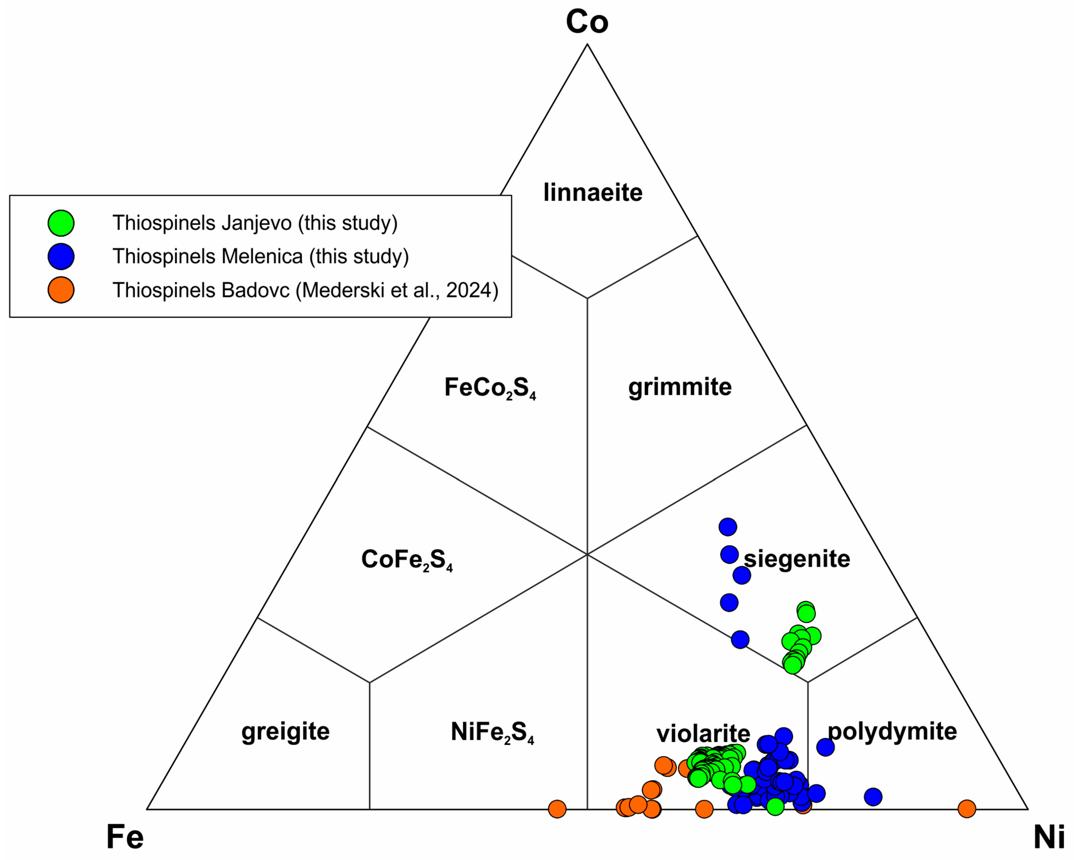
The crystal structure is closely related to those of polydymite (Ni₃S₄) and greigite (Fe₃S₄). These minerals form an iron-nickel thiospinel series in which variations in iron and nickel content influence structural parameters and physical properties. Violarite represents an iron-bearing member of this series, although its natural compositions can extend beyond the ideal formula. Research using neutron diffraction and Mössbauer spectroscopy has helped establish the distribution and oxidation states of metal cations within its structure. These structural characteristics are important for understanding its stability, mineral associations, and formation under different geological conditions.
Physical and Chemical Properties of Violarite
Violarite is an opaque sulfide mineral with a metallic luster and a characteristic violet-gray color. Its appearance can also range from copper-red and light gray to steel gray, depending on its chemical composition, surface condition, and associated minerals. In polished sections examined under reflected light, it commonly displays a distinctive violet coloration that helps distinguish it from other nickel-bearing sulfides. Its streak is gray-black to black, while its brittle tenacity and relatively moderate hardness are typical of many metallic sulfide minerals.
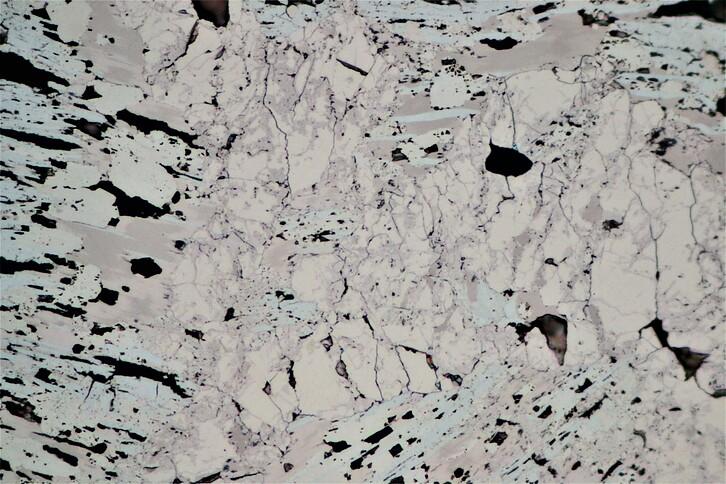
Violarite has a Mohs hardness of approximately 4.5–5.5 and a calculated specific gravity of about 4.79. It exhibits perfect cleavage along the crystallographic planes, although natural specimens are more commonly encountered as massive aggregates, irregular grains, or small nodules rather than clearly developed crystals. Individual nodules may reach approximately 0.5 cm in diameter. The mineral is generally isotropic under reflected polarized light, a characteristic associated with its cubic crystal symmetry, although some natural specimens may exhibit weak optical variations related to structural or compositional modifications.
Chemically, violarite consists primarily of iron, nickel, and sulfur, with an ideal formula of FeNi₂S₄. The theoretical composition contains approximately 18.52% iron, 38.93% nickel, and 42.54% sulfur by weight. Natural samples may contain minor amounts of cobalt and copper, reflecting their formation within complex sulfide mineral assemblages. Its chemical behavior is influenced by oxidation conditions, temperature, and the composition of surrounding fluids. During weathering, violarite may undergo further oxidation and alteration, producing secondary iron- and nickel-bearing compounds. These reactions are particularly relevant in the near-surface portions of nickel sulfide deposits, where changes in mineral composition can affect ore processing characteristics.
Formation and Geological Occurrence of Violarite
Violarite forms in several geological environments, but its most characteristic occurrence is associated with the alteration of primary nickel sulfide minerals. It commonly develops through the transformation of pentlandite, an important iron-nickel sulfide found in magmatic nickel deposits. When sulfide-bearing rocks are exposed to circulating groundwater and oxygen-rich conditions, chemical weathering can modify the original mineral assemblage. During this process, iron and nickel are redistributed, and violarite may develop along the margins, fractures, and internal boundaries of pentlandite grains. In some cases, the replacement is sufficiently extensive that violarite preserves the external shape and textures of the original mineral.
This process is particularly important in the supergene zones of nickel deposits, where groundwater movement and near-surface oxidation produce substantial changes in sulfide mineral assemblages. Violarite may occur together with secondary nickel minerals and partially altered remnants of pentlandite and pyrrhotite. The degree of transformation depends on several factors, including oxygen availability, groundwater chemistry, temperature, permeability, and the original composition of the sulfide ore. Experimental studies have investigated the transformation of pentlandite and pyrrhotite into violarite to better understand the chemical and structural changes involved in this process.
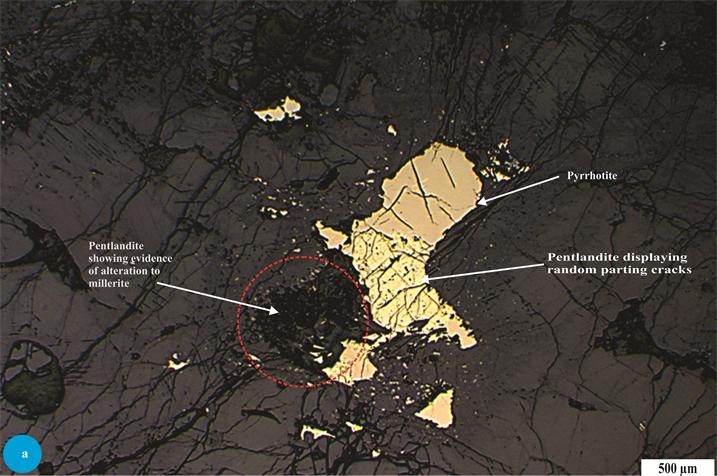
Although supergene alteration is a major formation mechanism, violarite is not exclusively a secondary mineral. It can also form through exsolution during the cooling of nickel-bearing sulfide assemblages, as well as through hydrothermal deposition from mineral-rich fluids. In hydrothermal environments, it may occur with other members of the linnaeite subgroup and associated sulfide minerals. These occurrences demonstrate that violarite can develop under different geological conditions, although its formation through the alteration of pre-existing nickel sulfides is particularly well documented.
Violarite is commonly associated with pentlandite, pyrrhotite, millerite, and chalcopyrite. These minerals occur together in various types of nickel-bearing sulfide deposits, particularly those associated with mafic and ultramafic igneous rocks. Its presence can provide information about the alteration history of an ore body, especially where replacement textures reveal the progressive transformation of primary sulfides. Because the mineral’s formation and distribution are influenced by oxidation and fluid movement, it is also relevant to studies of supergene enrichment and the mineralogical evolution of nickel deposits.
Major Occurrences and Localities of Violarite
Violarite has been identified in numerous nickel-bearing sulfide deposits around the world, particularly in regions with significant magmatic nickel mineralization and secondary alteration of sulfide ores. Its occurrence is closely associated with the geological history of nickel deposits, including hydrothermal activity, weathering, and supergene enrichment. Although it is not commonly encountered as a well-formed crystal species, it has been documented in many mining districts through mineralogical investigations of polished ore sections and microscopic analyses.
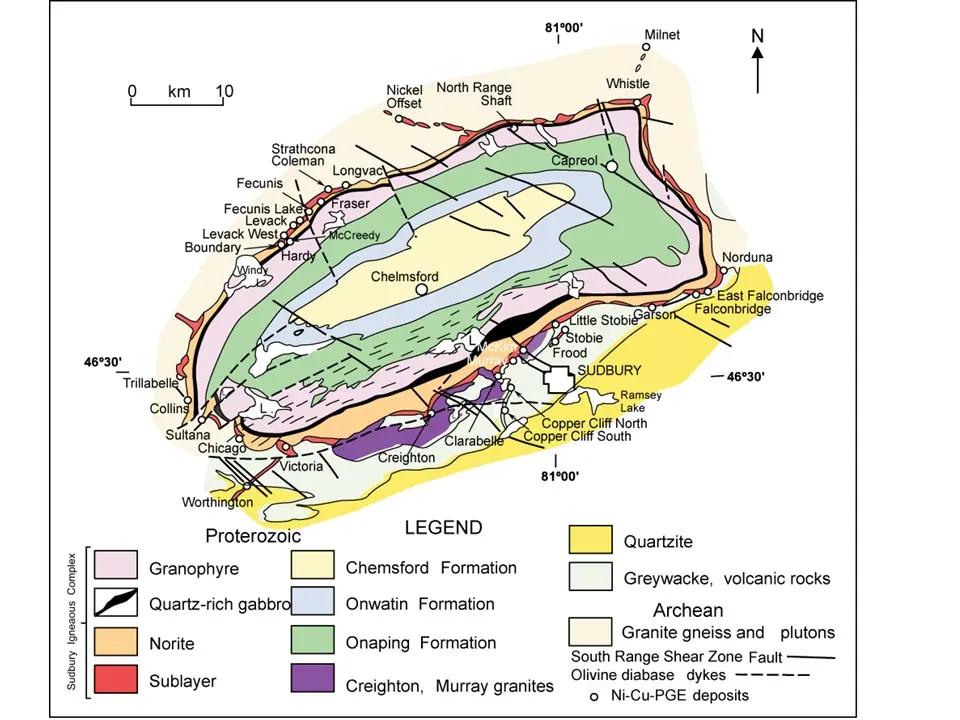
One of the most important localities for violarite is the Vermilion Mine in the Greater Sudbury area of Ontario, Canada. This locality is recognized as the type locality of the mineral and played an important role in its early scientific investigation. Violarite occurs within nickel-bearing sulfide assemblages associated with minerals such as pentlandite, pyrrhotite, millerite, and chalcopyrite. The Sudbury region contains extensive magmatic nickel-copper sulfide deposits, providing geological conditions suitable for the occurrence of iron-nickel sulfide minerals. Other documented occurrences in the district include the Levack, Worthington, and Crean Hill mines.
In the United States, violarite has been reported from several localities, including the Key West Mine in Clark County, Nevada, and the Friday Mine near Julian in San Diego County, California. The Key West Mine is particularly significant because material from this locality contributed to the original description of the mineral in 1924. Additional occurrences have been documented at the Copper King Mine in Colorado, the Gap Nickel Mine in Pennsylvania, and deposits in Virginia. Some of these occurrences are associated with the replacement of pentlandite by secondary nickel-bearing sulfides, providing evidence of post-depositional alteration within the original ore bodies.
Australia is another important region for violarite occurrences, particularly in Western Australia, where numerous nickel sulfide deposits are associated with ultramafic rocks. The Kambalda and Kalgoorlie districts have yielded examples of the mineral, often in association with other nickel sulfides and secondary alteration products. Violarite has also been reported near Mount Colin in Queensland. In these environments, its formation is related to the alteration of primary nickel sulfides within weathered portions of mineralized ultramafic rocks. The mineral may occur alongside pentlandite, millerite, and other nickel-bearing phases, reflecting the complex mineralogical development of these deposits.
Other documented occurrences include the Madziwa Mine in Zimbabwe, the Rottenstone Mine in Saskatchewan, Canada, and the Marbridge Mine in Quebec, Canada. Violarite has also been reported from the Praborna Mine in Saint-Marcel, Valle d’Aosta, Italy. These localities demonstrate that the mineral is geographically widespread, although its abundance and geological significance vary considerably between deposits. Its identification often requires detailed mineralogical examination because it commonly occurs as fine-grained replacement material or microscopic intergrowths with other sulfide minerals.
Uses and Applications of Violarite
Violarite has limited direct commercial applications as an independent mineral species, primarily because it rarely forms large, concentrated deposits suitable for separate extraction. Its principal economic relevance comes from its nickel content and its occurrence within nickel-bearing sulfide ore systems. In some deposits, violarite represents an important component of the mineralized material and contributes to the overall nickel grade of the ore. Its presence can therefore influence the evaluation and processing of nickel resources, particularly in deposits where primary sulfides have undergone extensive secondary alteration.
In the mining industry, the identification of violarite is relevant to nickel ore characterization and metallurgical assessment. Its physical and chemical properties differ from those of primary nickel sulfides such as pentlandite, which can influence mineral liberation, flotation behavior, and processing efficiency. In weathered nickel deposits, violarite may occur within transitional zones between relatively fresh sulfide ores and more extensively oxidized material. Understanding its distribution helps geologists and metallurgists evaluate changes in ore mineralogy and determine appropriate processing methods.
Violarite is also important in mineralogical and geological research. Its relationship with pentlandite, polydymite, and other iron-nickel sulfides provides useful information about the chemical evolution of sulfide mineral assemblages. Researchers study its composition, crystal structure, and replacement textures to investigate the effects of hydrothermal alteration, oxidation, and supergene enrichment. These studies contribute to a broader understanding of nickel deposit formation and the redistribution of metals during geological alteration.
In addition, violarite occasionally appears in mineral collections and educational reference materials. However, its limited availability as attractive, well-developed specimens means that it is less commonly collected than more visually distinctive nickel minerals. Its scientific value is generally greater than its use as a decorative or gemstone material.
How to Identify Violarite
Identifying violarite requires attention to its color, optical properties, chemical composition, and association with other sulfide minerals. Because it commonly occurs as fine-grained replacement material within nickel-bearing ores, it is not always possible to distinguish it reliably through visual examination alone. Its characteristic violet appearance under reflected light microscopy is one of its most useful diagnostic features, particularly when compared with pentlandite and other nickel sulfides occurring in the same geological environment.
In polished sections, violarite typically displays a distinctive violet to violet-gray color under ordinary reflected light. Depending on the specimen and surrounding mineral assemblage, it may also appear light gray, steel gray, or copper-red. Its metallic luster and opaque nature are consistent with its sulfide composition. Unlike many nonmetallic minerals, violarite does not transmit visible light through ordinary specimens, and its optical identification generally relies on reflected-light microscopy rather than transmitted-light examination.
Its cubic crystal structure produces predominantly isotropic optical behavior under crossed polarized reflected light. However, some natural specimens may exhibit weak anisotropic effects, potentially associated with structural changes, compositional variations, or alteration. Violarite has a Mohs hardness of approximately 4.5–5.5, a specific gravity of about 4.79, and perfect cleavage on . It is also brittle and commonly occurs as irregular grains, nodules, or replacement textures within other sulfide minerals.
Chemical analysis is particularly important for distinguishing violarite from closely related minerals. Its ideal formula, FeNi₂S₄, indicates a characteristic iron-to-nickel relationship within the thiospinel structure. Electron microprobe analysis and X-ray diffraction can help establish its composition and crystal structure, while reflected-light microscopy provides useful preliminary identification. Because violarite may occur as microscopic intergrowths with pentlandite, pyrrhotite, and millerite, combining optical observations with quantitative chemical analysis generally provides more reliable results than relying on appearance alone.
Violarite and Similar Minerals
Violarite can be confused with several other nickel- and iron-bearing sulfide minerals because they frequently occur together in the same ore deposits. Pentlandite, polydymite, siegenite, and greigite are particularly relevant comparisons because of their related chemical compositions, mineral associations, or spinel-type crystal structures. Although these minerals may have similar metallic appearances, differences in chemical composition, crystal chemistry, and optical properties help distinguish them.
| Mineral | Chemical Formula | Main Differences from Violarite |
|---|---|---|
| Pentlandite | (Fe,Ni)₉S₈ | Commonly bronze-yellow to pale yellowish bronze in reflected light; has a different crystal structure and higher nickel-iron sulfide complexity. |
| Polydymite | Ni₃S₄ | A nickel-rich thiospinel with little or no essential iron; generally differs in reflected-light color and chemical composition. |
| Siegenite | (Co,Ni)₃S₄ | A cobalt-nickel thiospinel with cobalt as an essential constituent; compositionally distinct from iron-dominant violarite. |
| Greigite | Fe₃S₄ | An iron sulfide thiospinel with magnetic properties and a substantially lower nickel content. |
| Millerite | NiS | A nickel sulfide that commonly forms slender needles or fibrous aggregates and has a different crystal structure. |
Among these minerals, polydymite is one of the closest structural relatives of violarite. Both belong to the thiospinel group and share the same general AB₂S₄ structural arrangement. Their principal chemical difference is the presence of essential iron in violarite, whereas polydymite is the nickel-dominant end member. Natural compositions and intermediate members can complicate identification, making chemical analysis particularly useful.
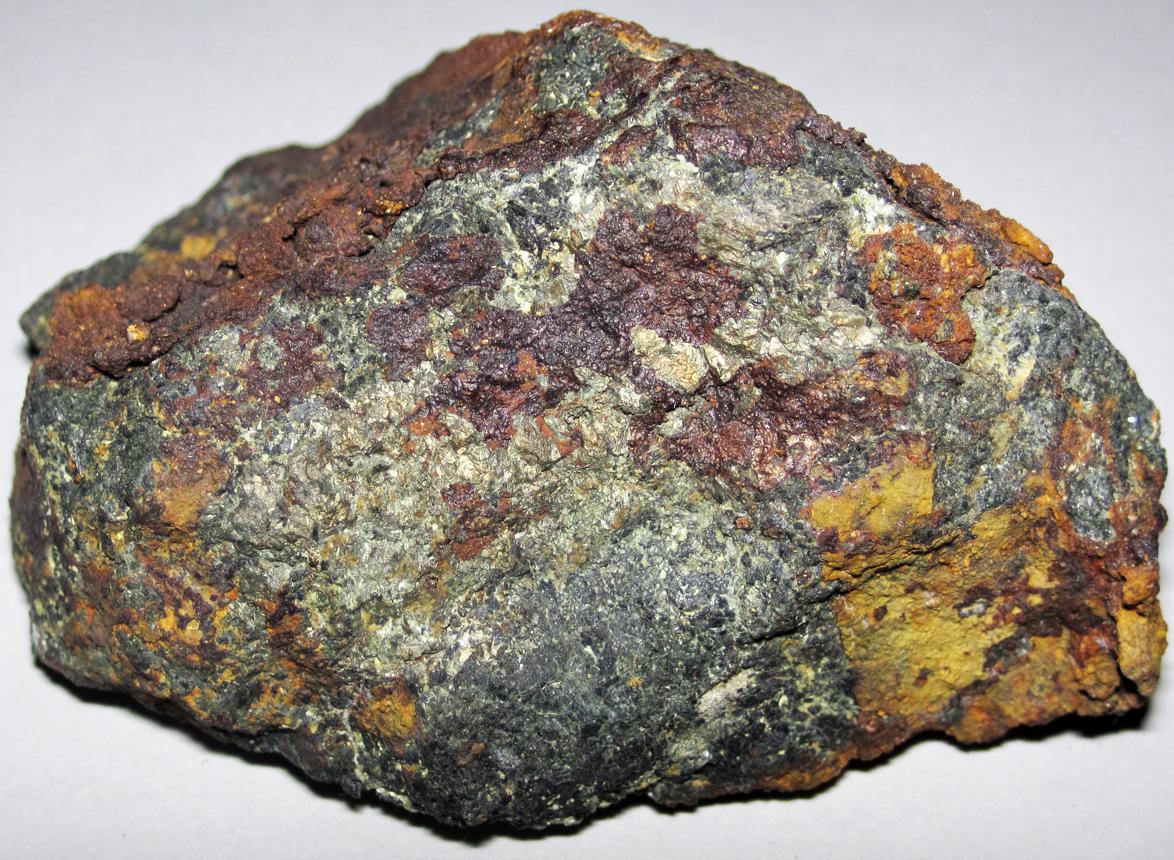
Pentlandite is another important comparison because it is frequently replaced by violarite during secondary alteration. The two minerals may occur in direct contact, sometimes preserving the original grain boundaries and textures of the pentlandite. Their distinction is important in mineralogical studies because they represent different stages in the evolution of nickel-bearing sulfide assemblages.
Siegenite and greigite are also structurally related to violarite. Siegenite contains substantial cobalt and nickel, while greigite is an iron-dominant sulfide. Their chemical differences provide useful criteria for identification, particularly when optical properties alone are insufficient. Millerite, although not a member of the same structural group, commonly occurs alongside violarite as part of altered nickel sulfide assemblages.
Types and Varieties of Violarite
Violarite is recognized as an individual mineral species rather than a mineral group with formally established varieties. Its chemical composition is defined by the ideal formula FeNi₂S₄, and it belongs to the linnaeite subgroup of the thiospinel group within the spinel supergroup. Although it does not have widely recognized formal varieties, natural specimens can exhibit differences in chemical composition, color, texture, and mineral associations.
Compositional variations are mainly related to the substitution of iron, nickel, and minor amounts of other metals within the crystal structure. Cobalt and copper may occur in small quantities in some natural samples, reflecting the chemistry of the surrounding sulfide deposits. Violarite also belongs to the siegenite-violarite series, which reflects compositional relationships between iron-bearing and cobalt-nickel-bearing thiospinels. These variations are relevant to mineralogical classification but do not necessarily represent separately recognized varieties.
In terms of physical appearance, violarite may occur as violet-gray, steel-gray, light-gray, or copper-red material. Some specimens form compact massive aggregates, while others occur as small rounded nodules or irregular replacement grains within nickel sulfide ores. These differences primarily reflect geological conditions, alteration history, and associated mineral assemblages rather than distinct mineral varieties.