Names
Charoite
Intro
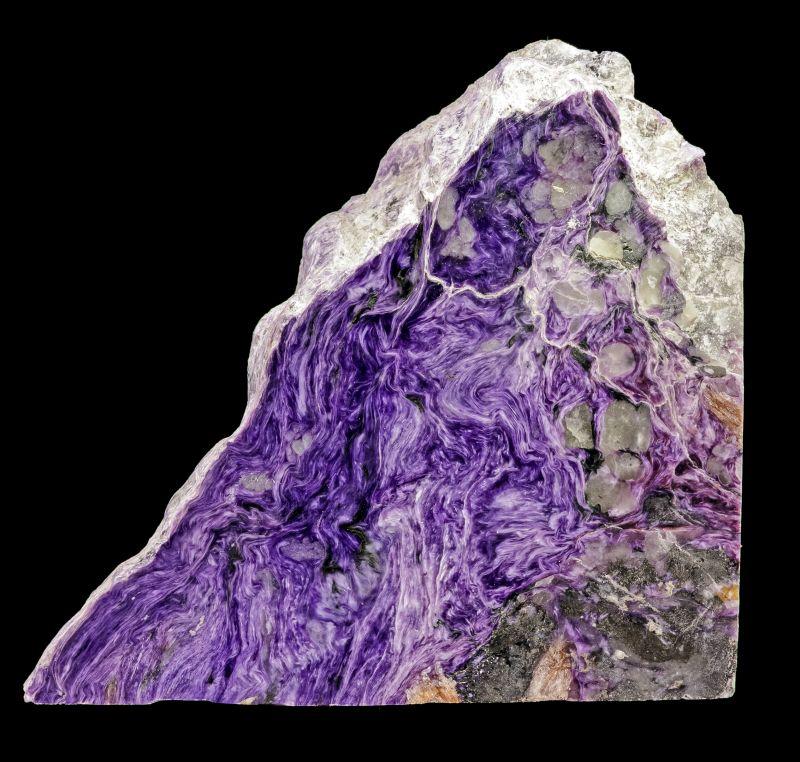
Charoite is a rare silicate mineral discovered in 1978 in the Sakha Republic, Russia. Renowned for its vibrant swirling patterns of lavender, violet, and purple intertwined with white and black inclusions, it is exclusively sourced from the Murun Massif and widely prized as an ornamental gemstone.
View article
Basic Information Show Hide
Mineral ID
charoite
Common Synonyms / Aliases
Charoit, Lilac Stone, Sirenevyi Kamen
Chemistry Show Hide
Chemical Formula
(K,Sr,Ba,Mn)₁₅₋₁₆(Ca,Na)₃₂Si₇₀(O,OH)₁₈₀₄ · nH₂O
Elements
Potassium (K), Strontium (Sr), Barium (Ba), Manganese (Mn), Calcium (Ca), Sodium (Na), Silicon (Si), Oxygen (O), Hydrogen (H), Fluorine (F)
Minor Elements / Impurities
Aluminum (Al) and iron (Fe) occur in minor amounts in reported chemical analyses.
Empirical Formula
K₁₄Sr₂Ca₃₀Na₂Si₇₀O₁₇₈(OH)₄F₂ · 2H₂O
Molecular Weight (g/mol)
7295.44
Solubility
Insoluble in water
Reaction to Acid
Decomposed slowly by concentrated hydrochloric acid (HCl) with separation of silica gel
Classification Show Hide
Mineral Type
Mineral Species
IMA Status
Approved
IMA Symbol
Cha
Strunz Classification
9.DG.92
Dana Classification
70.05.01.03
Mineral Group
Unclassified Silicates / Tubular Silicates
Crystal Structure Show Hide
Crystal System
Monoclinic
Crystal Habit
Massive, fibrous, radiating aggregates, swirling matted fibers (rarely found as distinct individual crystals)
Crystal Class
Prismatic (2/m)
Space Group
P2₁/m
Cell Parameter A (Angstrom)
32.11
Cell Parameter B (Angstrom)
19.65
Cell Parameter C (Angstrom)
7.16
Cell Angle Alpha (Degrees)
90°
Cell Angle Beta (Degrees)
90.0(1)°
Cell Angle Gamma (Degrees)
90°
Unit Cell Z
1
Crystal Twinning
Polysynthetic twinning along [001]
Common Crystal Faces
{100}, {010}, {001}, {110}
Physical Properties Show Hide
Primary Color
Purple (P)Violet (V)
Common Colors
Lavender, Violet, Lilac, Deep Purple, often mottled with White (quartz/feldspar), Black (aegirine), and Orange-Brown (tinaksite)
Streak
White
Luster
Vitreous, Silky, Pearly
Transparency / Diaphaneity
Translucent to Opaque
Hardness (Mohs)
5 - 6
Cleavage
Good
Cleavage Direction
{100}, {010}, {110}
Cleavage / Parting Description
Three good cleavages parallel to [001] ({100}, {010}, {110}), often obscured by the dense interlocking fibrous aggregate habit
Fracture
Splintery, Uneven, Subconchoidal
Tenacity
Tough
Specific Gravity
2.54 - 2.78
Magnetism
Non-magnetic
Melting Point
~1000–1100 °C (melts to a dark glass)
Thermal Stability
Dehydrates and loses color upon heating above 300–400 °C; sensitive to thermal shock
Optical Properties Show Hide
Refractive Index
1.547 - 1.559
Refractive Index Alpha
1.550
Refractive Index Beta
1.553
Refractive Index Gamma
1.559
Optical Axial Angle (2V)
28°–30° (measured)
Optical Sign / Extinction
Parallel or small inclined extinction (Z ∧ c ≈ 0° - 5°); Biaxial (+)
Birefringence
0.009
Dispersion
Weak (r less than v)
Optical Character
Biaxial+
Pleochroism
Distinct
Pleochroism Details
X = colorless to pale pink/violet; Y = colorless to pale lilac; Z = rose-violet to deep purple
Optical Phenomena
Chatoyancy, silky sheen
Fluorescence
Inert to weak dull green or pale orange under SW/LW UV
Luminescence / Phosphorescence / Thermoluminescence
Weak fluorescence under UV; non-phosphorescent
Absorption Spectrum
Non-diagnostic; weak broad absorption in the yellow-green region (~550 nm) due to Mn³⁺
Occurrence and Formation Show Hide
Formation Process
Formed through potassium-rich metasomatism (fenitization) of limestone and dolomite intruded by alkaline syenite magma
Geological Environment
Alkaline massif contact metasomatic zones (potassic metasomatites / charoitites)
Associated Minerals
Aegirine, Tinaksite, Microcline, Quartz, Canasite, Fedorite, Calcite, Apatite
Type Locality
Sirenevyi Kamen Deposit, Murunskii Massif, Chara and Tokko Rivers Confluence, Aldan Shield, Sakha Republic (Yakutia), Russia
Major Producing Countries / Localities
Russia
Economic Deposit Type
Contact metasomatic / Alkaline-ultramafic complex gemstone deposit
History and Naming Show Hide
Discovery Year
1948 / 1978 (IMA approved)
Name Origin
Named after the Chara River near the Murun Massif in Siberia, Russia, and alluding to the Russian word chary (meaning "charms" or "magic")
Type Specimen Repository
Fersman Mineralogical Museum, Russian Academy of Sciences, Moscow, Russia (Catalog #78424)
Safety and Related Information Show Hide
Wearability
Good
Health Hazards
Cutting and grinding generate respirable silicate dust; rare trace radioactive accessory minerals may be present in raw matrix
Handling Precautions
Wear a dust mask/respirator and use wet cutting when shaping; avoid ultrasonic cleaners, steam cleaners, and harsh acids
Varieties
Cat's-eye Charoite, Dragon Scale Charoite
Polytypes
Charoite-90, Charoite-96
Related Minerals
Canasite, Frankamenite, Tinaksite, Tokkoite, Miserite
Commercial and Gemology Show Hide
Common Treatments
Fracture filling / Resin stabilization
Enhancements
Polymer impregnation, waxing/surface sealing
Common Cuts
Cabochon, Beads, Carvings, Spheres & Slabs
Rarity / Market Grade
Rare / Single-locality gem material; graded by purity of vibrant violet color, silkiness, swirling texture, and minimal matrix inclusions