
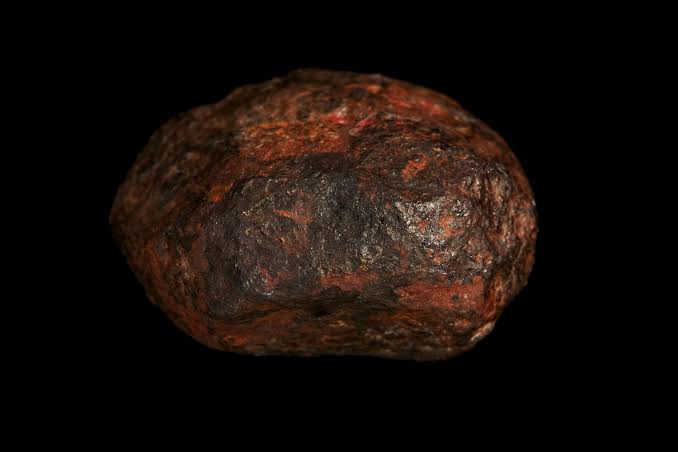
Edscottite is a rare, naturally occurring iron carbide mineral with the chemical formula Fe₅C₂. It is best known from meteorites, especially the iron-rich Wedderburn meteorite found in Australia. Unlike common rock-forming minerals such as quartz, feldspar, and calcite, edscottite generally occurs as microscopic grains inside extraterrestrial metal rather than as large crystals in ordinary terrestrial rocks.
The mineral belongs to the iron carbide family. Its structure contains iron as the dominant element, while carbon occupies specific positions within an ordered crystalline framework. Edscottite is therefore not simply carbon dissolved randomly in metallic iron. Its chemical composition and atomic arrangement are sufficiently distinct for it to be recognized as an independent mineral species.
Edscottite was formally accepted as a mineral species by the International Mineralogical Association in 2019. The mineral is named after Edward R. D. Scott, a researcher known for work on meteorites and planetary materials.
Edscottite is associated with strongly reducing, iron-rich, and carbon-bearing environments. These conditions are uncommon at Earth’s surface but can occur inside metallic portions of differentiated asteroids and other planetary bodies.
Edscottite Mineral Quick Facts
The mineral name is edscottite. Its ideal chemical formula is Fe₅C₂, and it belongs to the iron carbide group. Edscottite is associated with the orthorhombic crystal system and occurs mainly in iron-rich meteorites and other extraterrestrial metallic material. Its type occurrence is the Wedderburn meteorite in Australia. The mineral was recognized by the IMA in 2019 and named after Edward R. D. Scott. Known grains are microscopic to extremely fine-grained, and no established commercial or gemstone market exists for the mineral.
Discovery, Type Occurrence, and Naming
Edscottite was identified during detailed studies of the Wedderburn meteorite, an unusual iron meteorite discovered in Australia. The specimen contains a high proportion of metallic material and an unusual mineral assemblage. When researchers examined its microscopic phases using modern analytical methods, they identified a distinct iron carbide with the composition Fe₅C₂ and a characteristic crystal structure.
The occurrence demonstrates that meteorites can preserve mineral phases formed under chemical conditions different from those in Earth’s oxygen-rich crust. A phase that is uncommon or difficult to preserve in terrestrial rocks may remain present in meteorite material.
After its composition and crystallography were sufficiently characterized, the phase was approved as a new mineral species and named edscottite in honor of Edward R. D. Scott. The Wedderburn meteorite serves as the type occurrence for comparison with possible future discoveries in other meteorites or planetary samples.
Chemical Composition and Formula
The chemical formula of edscottite is Fe₅C₂, meaning that its ideal composition contains five iron atoms for every two carbon atoms. This places it among the iron carbides, compounds in which carbon is incorporated into an iron-dominated crystal structure.
The composition is consistent with an environment containing a large supply of metallic iron and enough carbon to enter the growing carbide structure. Oxygen activity must be low enough for metallic iron and iron carbide to remain stable. The material must also pass through a suitable temperature range during cooling for the carbide to crystallize or remain preserved.
Edscottite may occur alongside metallic iron, nickel-iron phases, sulfides, phosphides, silicates, and other carbide minerals. The complete mineral assemblage is often more informative than the isolated formula because it records aspects of the oxidation state, temperature, pressure, and chemical evolution of the parent body.
Crystal Structure and Mineral Classification
Edscottite is associated with the orthorhombic crystal system. In an orthorhombic structure, the crystal lattice has three mutually perpendicular axes of unequal lengths.
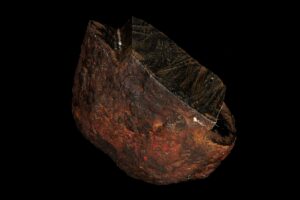
At the atomic scale, iron forms the dominant structural framework, while carbon occupies ordered positions within the lattice. This arrangement distinguishes edscottite from other iron carbide phases with similar compositions.
Several iron carbides can occur in comparable meteorite environments, so chemical analysis alone may not be sufficient for a definitive identification. Researchers normally combine chemical composition with diffraction data, crystal parameters, and microscopic observations.
The structural position of carbon is also important. Carbon is part of a defined mineral lattice rather than an irregular impurity in native iron. This ordered structure is one of the reasons edscottite is classified as a separate mineral species.
How Does Edscottite Form?
Edscottite forms under strongly reducing, iron-rich, and carbon-bearing conditions. In such environments, oxygen is scarce relative to iron, allowing metallic iron to remain stable. As the metal cools, carbon can react with iron and crystallize as an iron carbide.
The most likely setting is the metallic interior or metal-rich portion of an extraterrestrial parent body. During melting and differentiation, iron-rich metal separates from silicate material. Carbon can dissolve in the metallic liquid or become concentrated in solid metal. As temperature falls, iron-carbon compounds become stable and carbide phases form. Continued cooling can preserve microscopic edscottite grains within the meteorite’s metal matrix.
The exact formation pathway may vary with pressure, temperature, bulk composition, cooling rate, and the availability of sulfur, nickel, phosphorus, and other elements. For this reason, edscottite should be interpreted as part of a mineral assemblage rather than as evidence of a single temperature or event.
Where Is Edscottite Found?
The best-known and type occurrence of edscottite is the Wedderburn meteorite in Australia. It occurs there as a very small phase associated with iron-rich meteoritic material. Because the mineral is difficult to recognize without laboratory analysis, the number of confirmed localities remains limited.
Edscottite is not known as a common mineral in ordinary terrestrial ore deposits. Its documented occurrence is primarily extraterrestrial, although the meteorite containing it is currently located on Earth.
Locality information for edscottite may refer to a meteorite, polished meteorite section, planetary sample, asteroid sample, or laboratory-prepared mineral mount rather than to a conventional mine or geological outcrop.
Potential occurrences in other iron meteorites, returned asteroid samples, or planetary materials would require formal chemical and crystallographic confirmation.
Edscottite in Meteorites
Meteorites preserve mineral phases that formed in the early Solar System or inside differentiated parent bodies. Iron meteorites are particularly relevant because they may represent fragments of metallic cores or deep metal-rich regions of asteroids that were later disrupted by impacts.
In an iron meteorite, edscottite can occur as microscopic grains within or next to metallic iron. It may be intergrown with other carbide phases, nickel-iron minerals, sulfides, phosphides, or silicate inclusions. These relationships can be examined when interpreting the oxidation-reduction state of the parent body, the distribution of carbon in metallic material, the cooling rate of iron-rich melts, and the sequence in which carbide and metal phases crystallized.
The mineral’s occurrence may also be considered when comparing different meteorite groups and examining the separation of metal from silicate during planetary differentiation.
Physical Properties of Edscottite
Because edscottite is exceptionally rare and normally occurs as microscopic grains, many standard hand-specimen properties are poorly constrained. It is not usually available as a large, isolated crystal that can be examined with a loupe or tested using simple field methods.
The properties most relevant to identification are chemistry, crystal structure, and occurrence. Individual grains are typically too small for reliable macroscopic color description. A metallic or submetallic appearance may be suggested by the surrounding iron-rich matrix, but luster alone cannot identify the mineral.
Edscottite is not normally encountered as a transparent or translucent gem-quality crystal. A dependable hand-specimen streak is generally unavailable because the grains are very small and commonly intergrown with other phases. Cleavage and fracture are also difficult to observe.
Its iron-rich composition indicates a relatively high density compared with many common nonmetallic minerals, although a bulk meteorite measurement includes other components. A definitive field hardness value is not commonly used because isolated grains are too small for a meaningful scratch test.
How Is Edscottite Identified?
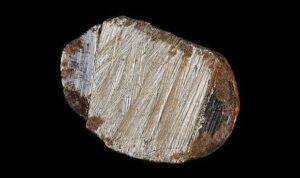
Visual inspection is not sufficient to identify edscottite. A meteorite that contains it may simply look metallic, gray, or iron-rich to the unaided eye. Confirming the mineral requires evidence for both its Fe₅C₂ composition and its characteristic crystal structure.
Researchers may combine scanning electron microscopy to examine grain morphology and intergrowths, energy-dispersive X-ray spectroscopy for rapid chemical analysis, electron-probe microanalysis for quantitative composition, electron diffraction for crystallographic order, and X-ray diffraction or microdiffraction when enough material is available.
Reflected-light microscopy and petrographic analysis can show how edscottite is associated with metallic iron and neighboring mineral phases. High-resolution methods may be required when the grains are too small or closely intergrown for routine analysis.
A reliable identification should consider the full mineral context. Composition, diffraction behavior, texture, and association with other phases should agree before a grain is reported as edscottite.
Types and Varieties of Edscottite
Edscottite is a single recognized mineral species, not a broad commercial mineral group with numerous established varieties. There are no officially recognized gemstone grades, named color varieties, or ornamental forms.
The types of material commonly discussed in mineralogical descriptions include:
- Type occurrence material: Edscottite from the Wedderburn meteorite, which serves as the reference occurrence.
- Microscopic meteoritic grains: Small individual grains dispersed through an iron-rich meteorite matrix.
- Intergrown edscottite: Grains occurring in direct contact with metallic iron or other carbide phases.
- Textural forms: Differences in grain size, shape, orientation, and distribution caused by local crystallization conditions.
- Compositional variation: Minor chemical differences related to neighboring phases or analytical uncertainty.
- Research specimens: Polished sections, grain mounts, and meteorite fragments prepared for laboratory analysis.
These descriptions refer to occurrence and texture rather than officially named varieties. A new variety or related mineral would require separate chemical and crystallographic characterization.
Edscottite Compared with Other Iron Carbides
Edscottite is one member of a broader family of iron-carbon compounds. Other iron carbide phases may form under similar reducing conditions and can occur in comparable meteorite materials.
The distinction between edscottite and another carbide is based on the measured iron-to-carbon relationship, crystal symmetry, unit-cell parameters, diffraction reflections, structural order, microscopic texture, and association with metallic iron and other phases.
A chemical formula alone should not be used to identify an unknown grain. Two phases may have similar compositions but different crystal structures. Mineral classification therefore depends on both chemical and crystallographic data.
Geological and Meteoritical Context
Edscottite is associated with iron-rich, carbon-bearing material formed under low oxygen activity. In a meteorite section, its composition and textural relationship with metallic iron, sulfides, phosphides, silicates, and other carbides can be considered when interpreting the parent body’s cooling and crystallization history.
The mineral should not be used as a stand-alone thermometer or oxygen-fugacity indicator. Temperature, pressure, redox conditions, and cooling rate must be evaluated using the complete mineral assemblage and independent analytical evidence.
Uses and Commercial Status
Edscottite has no established commercial, industrial, or jewelry use. It is not mined as an ore, cut as a gemstone, or traded as a common mineral commodity. Confirmed material is limited and is generally preserved in meteorite samples, polished sections, research collections, or institutional repositories.
Its documented uses are restricted to mineral identification and description, meteorite classification, study of iron-carbon phase relations, and reference or teaching collections.
Claims that ordinary terrestrial iron-rich rocks or metallic objects contain edscottite should be treated cautiously. Laboratory analysis is required because visual similarity cannot distinguish edscottite from native iron, other carbides, or industrial iron-carbon materials.
Edscottite Mineral Summary
Edscottite is a rare iron carbide mineral with the formula Fe₅C₂ and an orthorhombic crystal structure. Recognized as a distinct mineral species in 2019, it was named for meteorite researcher Edward R. D. Scott and is best known from the Wedderburn meteorite in Australia.
The mineral forms under highly reducing conditions where metallic iron and carbon can coexist. Because it usually occurs as microscopic grains, edscottite cannot be reliably identified by color, luster, hardness, or other simple field tests. Definitive identification requires chemical and crystallographic analysis.
Although edscottite has no established industrial or gemstone use, its composition, structure, and relationship to neighboring phases document iron-carbon chemistry in extraterrestrial material. These features are considered when describing meteorites and their parent-body history.