
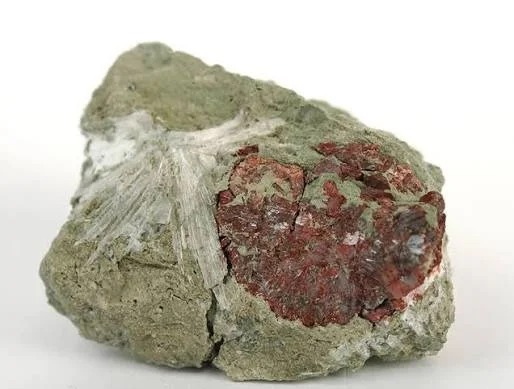
Gerstleyite is a rare hydrated sodium antimony sulfide mineral with the chemical formula Na₄(Sb₂S₅)S·6H₂O. It is an uncommon sulfide mineral known primarily from highly alkaline, evaporite-related environments and is particularly associated with the famous borate deposits of California, United States. Gerstleyite typically occurs as very fine-grained or massive material rather than as well-developed crystals, and its appearance can range from pale yellow and yellowish brown to orange-brown or reddish tones depending on the specimen and associated minerals. Because of its rarity and unusual chemical composition, gerstleyite is of interest mainly to mineral collectors, mineralogists, and researchers studying complex sulfide and evaporite mineral assemblages.
The mineral is a hydrated compound containing sodium, antimony, and sulfur, with structurally bound water as an important component of its composition. Its formation is closely related to unusual low-temperature geochemical conditions in which alkaline, sulfur-bearing fluids interact with antimony-rich materials. Gerstleyite is generally found together with other minerals characteristic of highly specialized evaporite and borate-bearing deposits, making its geological occurrence particularly useful for understanding the chemical evolution of these mineral-forming systems. Although it has little direct industrial importance, gerstleyite represents an uncommon example of a naturally occurring hydrated antimony sulfide and is included in mineralogical databases because of its distinctive composition and geological setting.
History and Discovery of Gerstleyite
Gerstleyite was first recognized as a distinct mineral from material collected in the Kramer Borate District of Kern County, California, an area known for its unusual concentration of borate minerals and other evaporite-related mineral species. The mineral was named in honor of William H. Gerstley, who was associated with the mineralogical study and collection of material from the deposit. Its identification added another uncommon antimony-bearing mineral to the complex assemblage found in the region, where strongly alkaline geological conditions have produced a wide variety of unusual mineral phases.
The occurrence of gerstleyite in the Kramer Borate District is particularly significant because the deposit contains minerals formed through a combination of evaporitic concentration, hydrothermal or groundwater-related processes, and prolonged chemical alteration. Unlike common sulfide minerals formed in high-temperature hydrothermal systems, gerstleyite is associated with a comparatively unusual low-temperature environment characterized by high alkalinity and abundant soluble elements. Studies of specimens from this locality have helped establish gerstleyite as a mineralogical phase with a distinctive combination of sodium, antimony, sulfur, and water in its structure. Its restricted occurrence and limited availability of well-crystallized specimens have also made it primarily a mineralogical and collector’s specimen rather than a commercially important mineral.
Formation and Geological Occurrence of Gerstleyite
Gerstleyite forms under highly specialized geological conditions that are uncommon among sulfide minerals. It is mainly associated with strongly alkaline, evaporite-rich environments where mineral-forming solutions become enriched in sodium, sulfur, and antimony. In the Kramer Borate District of Kern County, California, gerstleyite occurs within a complex assemblage of borate, carbonate, sulfate, sulfide, and other secondary minerals. The geological setting was capable of concentrating elements that are normally present only in very small amounts, allowing unusual hydrated antimony sulfides such as gerstleyite to develop during later stages of mineral formation and alteration.
The formation of gerstleyite is also related to relatively low-temperature chemical processes rather than the high-temperature conditions commonly associated with many primary sulfide deposits. As alkaline solutions circulate through mineralized sediments and evaporite-bearing rocks, changes in chemical composition, oxidation-reduction conditions, sulfur availability, and water content can promote the precipitation of secondary minerals. Gerstleyite is therefore best understood as part of a highly specialized mineral assemblage rather than as an isolated sulfide phase. Its occurrence alongside other uncommon minerals provides useful information about the chemical conditions that existed during the later evolution of the deposit.
Crystal Structure of Gerstleyite
Gerstleyite has a complex structure that reflects its unusual combination of sodium, antimony, sulfur, and structurally bound water. Its chemical formula, Na₄(Sb₂S₅)S·6H₂O, indicates that water is an integral part of the mineral rather than simply moisture contained between grains. The presence of multiple sulfur species together with antimony contributes to a relatively complicated structural arrangement, distinguishing gerstleyite from simpler sulfide minerals such as galena or stibnite. Sodium occupies structural positions associated with the sulfur-bearing framework, while the hydrated component helps stabilize the mineral under the low-temperature, alkaline conditions in which it occurs.
The structural chemistry of gerstleyite is closely related to its geological environment. Hydrated sulfide minerals are generally sensitive to changes in temperature, moisture, oxidation state, and chemical composition, and gerstleyite represents a mineral phase that can form within a restricted range of these conditions. Its structure and composition therefore provide mineralogists with information about the chemical environment of its host deposit. Because gerstleyite is rare and commonly occurs as fine-grained material, detailed structural investigation can be more challenging than for common minerals that produce large, well-developed crystals. Nevertheless, its unusual chemistry makes it an important example of the structural diversity found among hydrated antimony sulfide minerals.
Physical and Chemical Properties of Gerstleyite
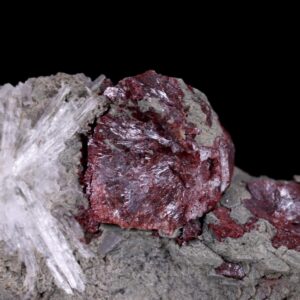
Gerstleyite is typically yellow to yellowish brown, orange-brown, or reddish brown, although its exact appearance can vary depending on the specimen, grain size, weathering, and associated minerals. It commonly occurs as fine-grained, earthy, massive, or compact material rather than as large, well-formed crystals. The mineral has a relatively high specific gravity compared with many common evaporite minerals because of its antimony content, while its hydrated nature and fine-grained habit can give specimens a relatively soft or fragile character. Its luster is generally described as resinous to submetallic or earthy depending on the form and surface, and its streak may differ from the apparent color of the specimen.
Chemically, gerstleyite is a hydrated sodium antimony sulfide containing four principal components: sodium, antimony, sulfur, and water. Its idealized formula is Na₄(Sb₂S₅)S·6H₂O. The combination of antimony and sulfur places it within the broader group of sulfide and sulfosalt-related mineral chemistry, while the significant water content distinguishes it from many anhydrous antimony sulfides. The mineral’s chemical stability is strongly influenced by its geological environment, particularly the alkaline and relatively low-temperature conditions associated with its known occurrence. Changes in hydration, oxidation, or surrounding fluid chemistry may affect its preservation and association with secondary minerals.
Color, Luster, Streak, and Hardness of Gerstleyite
Gerstleyite commonly displays yellow, orange-yellow, yellowish brown, orange-brown, or reddish-brown colors. The color can vary considerably between specimens because the mineral is often fine-grained and occurs together with other minerals in complex evaporite assemblages. Fresh surfaces may show a resinous to somewhat submetallic appearance, while weathered or earthy material can have a duller luster. Its streak is generally lighter than the external color, which can be useful when examining small fragments or powdered material. Because gerstleyite is rarely encountered as large, isolated crystals, its physical appearance is often influenced by the texture and mineral associations of the host material.
Gerstleyite is relatively soft compared with many common sulfide minerals, although its exact apparent hardness can be affected by its fine-grained or massive habit and by associated phases. The mineral’s combination of softness, relatively high specific gravity, distinctive yellow to orange-brown coloration, and occurrence in unusual alkaline evaporite deposits can help distinguish it from more common sulfide minerals. However, visual identification alone is not considered reliable because gerstleyite can occur as fine-grained material and may resemble other yellow or brown secondary minerals. Mineralogical identification is therefore normally supported by chemical and crystallographic analysis when accurate determination is required.
Types and Varieties of Gerstleyite
Gerstleyite is recognized primarily as a distinct mineral species rather than as a mineral with a large number of formally established varieties. Because it is rare and has a relatively restricted geological occurrence, mineralogical literature generally focuses on its composition, structure, and associated mineral assemblage rather than on numerous named varieties. Specimens may nevertheless show differences in color, grain size, texture, and degree of alteration depending on the conditions under which they formed.
Common descriptive forms of gerstleyite include:
- Massive Gerstleyite — Occurs as compact or irregular fine-grained material and is more typical than well-developed crystals.
- Earthy Gerstleyite — Has a dull, powdery, or earthy appearance and may occur in altered or finely disseminated material.
- Yellow to Orange-Brown Gerstleyite — Describes specimens showing the characteristic yellow, orange-yellow, or brownish coloration associated with the mineral.
- Associated Gerstleyite — Occurs intergrown with borates, sulfides, carbonates, and other secondary minerals in complex evaporite assemblages.
These descriptions refer mainly to physical or textural forms rather than officially recognized mineral varieties. The limited number of known occurrences means that differences between specimens are usually interpreted in terms of geological environment, alteration, and associated minerals rather than as separate gerstleyite species or varieties.
Where Is Gerstleyite Found?
Gerstleyite is a very rare mineral with a highly restricted known distribution. Its best-known occurrence is the Kramer Borate District in Kern County, California, United States, particularly within the complex evaporite and borate deposits of the region. The Kramer District is internationally recognized for its diverse assemblage of borate minerals, including both common and unusual species that developed under strongly alkaline conditions. Gerstleyite occurs as part of this broader mineral assemblage rather than as a major constituent of the deposit, and its limited abundance contributes to its rarity in mineral collections.
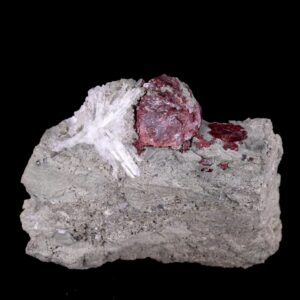
The geological setting of the Kramer Borate District provides the combination of chemical conditions required for gerstleyite formation. Evaporative concentration allowed elements and compounds to become highly concentrated, while alkaline fluids and later alteration processes promoted the development of secondary mineral phases. Gerstleyite is particularly associated with fine-grained mineralized material and may occur together with borates, sulfides, carbonates, and other uncommon minerals. Because its occurrence is closely tied to this specialized geological environment, documented specimens from the Kramer Borate District are especially important for confirming the mineral’s identity and studying its formation.
Associated Minerals and Mineral Assemblage
Gerstleyite occurs within complex mineral assemblages that reflect the unusual alkaline and evaporitic conditions of its host environment. At the Kramer Borate District in California, it is associated with a variety of borate and evaporite minerals as well as sulfide, carbonate, and other secondary phases. These associations are important because gerstleyite does not commonly occur as large, isolated crystals. Instead, it is typically found as part of a fine-grained mixture in which several minerals formed, altered, or recrystallized during different stages of the deposit’s geological history.
The mineral associations can also provide clues about the chemical conditions under which gerstleyite developed. Borate minerals indicate an environment capable of concentrating boron, while the presence of sodium-rich and sulfur-bearing phases reflects the availability of alkaline, mineral-rich fluids. Antimony was also concentrated sufficiently to participate in the formation of gerstleyite and related phases. The close relationship between these minerals illustrates how variations in fluid composition, evaporation, hydration, and redox conditions can produce uncommon mineral species within a relatively localized geological setting. For mineral collectors and researchers, these associations are often as significant as gerstleyite itself because they help place the mineral within the broader paragenesis of the deposit.
How to Identify Gerstleyite
Identifying gerstleyite requires more than examining its color or general appearance because the mineral commonly occurs as fine-grained or massive material and can be associated with several visually similar minerals. Its yellow to orange-brown coloration, relatively high density, soft character, and occurrence in alkaline evaporite-related deposits can provide useful preliminary clues. The geological locality is particularly important because gerstleyite is a rare mineral with a very restricted known occurrence. A specimen displaying the appropriate color and texture but coming from an unrelated geological environment should therefore not be identified as gerstleyite solely on visual characteristics.
For reliable identification, mineralogical techniques such as powder X-ray diffraction and chemical analysis can be used to confirm both the crystal structure and elemental composition. X-ray diffraction is useful for distinguishing gerstleyite from other antimony-bearing or yellow secondary minerals, while analytical methods such as electron microprobe analysis can establish the presence and relative proportions of sodium, antimony, and sulfur. Because gerstleyite contains structurally bound water, its hydrated nature can also be considered during detailed characterization. Combining physical observations, chemical composition, crystallographic data, and geological context provides a much more dependable identification than relying on color or appearance alone.
Uses and Significance of Gerstleyite
Gerstleyite has no major industrial or commercial use because it is rare, occurs in limited quantities, and is generally found as fine-grained material within complex mineral assemblages. Unlike common sulfide minerals that serve as important sources of metals, gerstleyite is not mined as an economically significant ore mineral. Its occurrence is instead of interest primarily from a mineralogical and geological perspective, particularly because it records unusual conditions involving sodium, antimony, sulfur, and water in an alkaline evaporite environment.
The mineral is mainly valued as a specimen for mineral collections and as a subject of mineralogical research. Gerstleyite can be useful in studies of secondary mineral formation, evaporite-related mineral systems, and the behavior of antimony and sulfur under low-temperature alkaline conditions. Its association with borate minerals and other uncommon phases at the Kramer Borate District also makes it relevant to research into the paragenesis and geochemical evolution of complex evaporite deposits. For collectors, authenticated gerstleyite specimens can be of interest because of the mineral’s rarity and distinctive chemical composition, although its fine-grained habit means that specimens may not display the well-formed crystals associated with many other collectible minerals.