
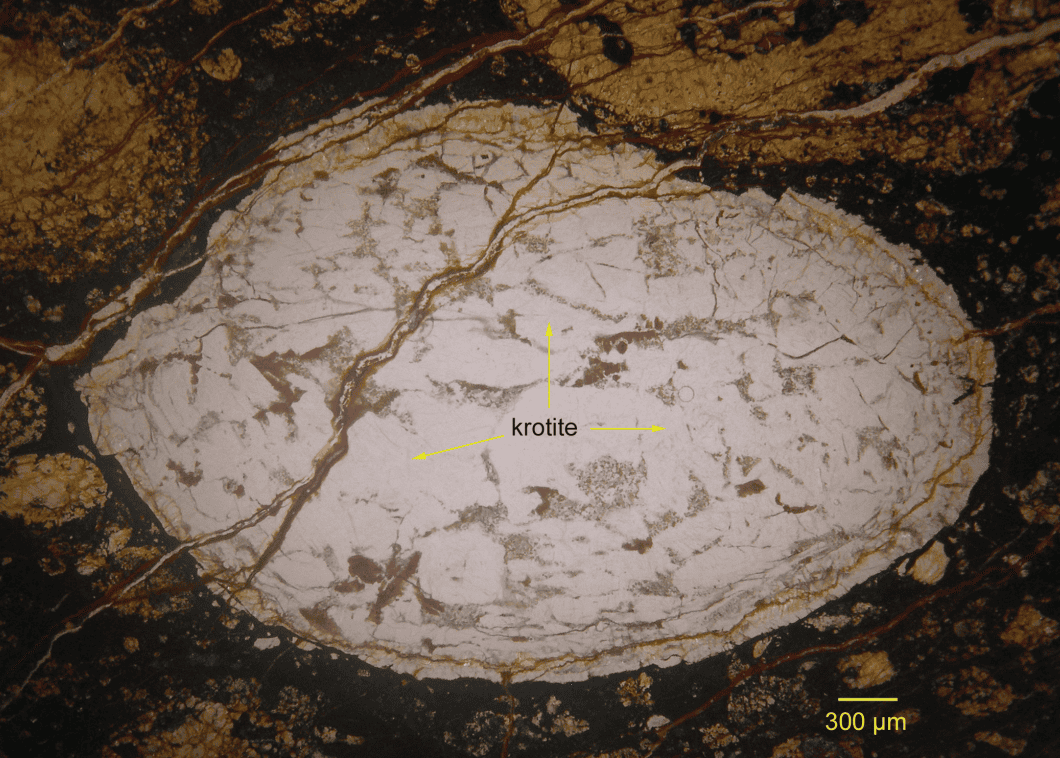
Krotite is a naturally occurring calcium–aluminium oxide mineral with the ideal chemical formula CaAl₂O₄. It is classified as an oxide mineral and is primarily known from calcium–aluminium-rich inclusions in primitive carbonaceous chondrites. Unlike most common terrestrial minerals, Krotite is generally present as microscopic grains embedded in meteorites rather than as large, isolated crystals.
The ideal formula contains one calcium atom, two aluminium atoms, and four oxygen atoms. Its theoretical composition is approximately 25.4 wt% calcium, 34.1 wt% aluminium, and 40.5 wt% oxygen. Expressed as oxides, the composition corresponds to about 35.5 wt% CaO and 64.5 wt% Al₂O₃. Natural grains may contain minor chemical deviations, but the mineral is defined by both its CaAl₂O₄ composition and its characteristic crystal structure.
Krotite is the low-pressure dimorph of CaAl₂O₄. The high-pressure dimorph is called dmitryivanovite. These two minerals have the same ideal chemical formula but different atomic arrangements, so they must be distinguished by crystallographic methods rather than by chemical composition alone. Krotite is also structurally related to synthetic calcium aluminate compounds used in refractory ceramics and calcium aluminate cements, although industrial calcium aluminates are not automatically classified as the mineral Krotite.
History and Discovery of Krotite
Krotite was formally described as a new mineral in 2011. The type material came from the meteorite NWA 1934, a CV3 carbonaceous chondrite recovered in North-West Africa. The mineral occurs within a calcium–aluminium-rich inclusion, commonly abbreviated as a CAI. These inclusions are among the most refractory components preserved in primitive chondritic meteorites.
The mineral was named after Alexander N. Krot, a cosmochemist whose research has focused on chondritic meteorites, refractory inclusions, condensation processes, and the early chemical evolution of the Solar System. The mineral was approved by the International Mineralogical Association under the designation IMA 2010-038.
The original description relied on chemical analysis, electron microscopy, crystallography, and petrographic observations. This combination was necessary because Krotite grains are small and occur in a complex assemblage of calcium–aluminium oxides, silicates, and other refractory phases. A chemical analysis close to CaAl₂O₄ would not be sufficient by itself, because several related minerals have similar elemental proportions or may occur in the same meteorite inclusion.
Formation and Geological Occurrence of Krotite
Krotite forms under high-temperature and low-pressure conditions in a strongly refractory chemical environment. The Krotite-bearing inclusion in NWA 1934 is interpreted as a product of condensation or crystallization from hot gas in the early solar nebula. Phase-equilibrium considerations indicate formation at temperatures of approximately 1,500 °C or higher under low-pressure conditions. These conditions are consistent with the formation of refractory solids before the condensation of many more volatile elements and minerals.
Calcium and aluminium are among the least volatile major elements in the solar nebula. When hot nebular gas cooled, these elements could combine with oxygen to form refractory oxides and calcium–aluminium silicates. Krotite therefore records a high-temperature stage of mineral formation that occurred before the parent asteroid of the meteorite was assembled. Its formation should not be confused with ordinary terrestrial igneous, hydrothermal, or metamorphic processes.
In NWA 1934, Krotite is concentrated in the central and mantle portions of an unusual calcium–aluminium-rich inclusion. It occurs with perovskite, gehlenite, hercynite, mayenite, grossite, hibonite, spinel, and diopside. Trace hexamolybdenum has also been reported. The mineral assemblage indicates that the inclusion experienced several stages of condensation, crystallization, reaction, and possibly partial melting rather than forming through a single simple reaction.
The external part of the inclusion has been described as having a cracked-shell or “cracked egg” appearance. Some cracks are filled with iron and aluminium hydroxides. These hydrated minerals are interpreted as products of terrestrial weathering that occurred after the meteorite reached Earth. They are not considered primary products of the solar-nebula environment. This distinction is important because weathering can modify the boundaries and surfaces of the original Krotite grains.
Crystal Structure of Krotite
Krotite crystallizes in the monoclinic crystal system. Its reported space group is P2₁/n, space group number 14. The unit-cell parameters determined for the type material are approximately a = 8.6996(3) Å, b = 8.0994(3) Å, c = 15.217(1) Å, and β = 90.188(6)°. The unit cell contains twelve formula units, expressed as Z = 12, and has a calculated volume of approximately 1,071 ų.
The structure can be described broadly as a framework dominated by aluminium–oxygen polyhedra, particularly AlO₄ tetrahedra, with calcium occupying larger structural sites within the framework. The arrangement is not equivalent to the spinel structure, even though the chemical formula has the general stoichiometric relationship of one divalent cation to two trivalent cations and four oxygen atoms.
The difference between Krotite and dmitryivanovite is structural rather than compositional. Both phases have the formula CaAl₂O₄, but they are stable under different pressure conditions and have different arrangements of their atoms. Krotite represents the low-pressure form, whereas dmitryivanovite is associated with higher-pressure conditions.
Because natural Krotite occurs as small grains enclosed by other minerals, well-developed external crystal faces are uncommon. Structural information is therefore usually obtained by X-ray diffraction, electron diffraction, or electron backscatter diffraction. These methods are particularly useful when the grains are too small for conventional single-crystal analysis.
Physical and Chemical Properties of Krotite
Krotite is normally observed as microscopic grains in polished sections or thin sections. Descriptions of its colour and luster are less diagnostic than its chemistry and crystal structure because the apparent appearance depends on grain thickness, orientation, surrounding minerals, and alteration. Natural material may appear colourless to pale brown under transmitted or reflected light, while the boundaries of individual grains may be difficult to distinguish in complex inclusions.
The reported Mohs hardness is approximately 6.5, and the calculated density is about 2.94 g/cm³. Direct measurement of density is difficult because the grains are very small and are commonly intergrown with other phases. Cleavage and fracture are also difficult to evaluate reliably on individual grains for the same reason.
The ideal chemical composition is CaAl₂O₄. Electron-microprobe analyses are generally expected to show a calcium-to-aluminium ratio close to 1:2, after accounting for oxygen and analytical uncertainty. Minor amounts of magnesium, silicon, titanium, iron, sodium, or other elements may occur at trace levels or may be introduced by contamination from adjacent minerals. Such minor components do not automatically define a separate variety of Krotite.
Krotite is stable only within a particular pressure–temperature–composition field. At higher pressures, CaAl₂O₄ may adopt the structure of dmitryivanovite. Under different chemical conditions, calcium and aluminium may instead form grossite, hibonite, gehlenite, mayenite, perovskite, or other calcium–aluminium oxides and silicates.
Types and Varieties of Krotite
Krotite has no formally recognized gemstone varieties or commercial colour varieties. The following categories are descriptive rather than official mineral subdivisions:
- Meteoritic Krotite: Natural Krotite occurring in calcium–aluminium-rich inclusions of carbonaceous chondrites, including the type material from NWA 1934.
- Low-pressure CaAl₂O₄: Krotite is the low-pressure structural form of CaAl₂O₄.
- High-pressure CaAl₂O₄: Dmitryivanovite is the high-pressure dimorph of CaAl₂O₄. It is a separate mineral species, not a variety of Krotite.
- Synthetic calcium aluminate: Laboratory-produced CaAl₂O₄ may resemble Krotite chemically or structurally, but it is an artificial material rather than a natural mineral occurrence.
Differences in grain size, trace-element content, alteration, and associated minerals may produce different appearances in individual meteorite samples. These differences describe the geological history of the grains and do not represent officially named varieties.
Where Is Krotite Found?
The best-documented natural occurrence of Krotite is the calcium–aluminium-rich inclusion in the NWA 1934 CV3 carbonaceous chondrite. The meteorite was recovered in North-West Africa, but the Krotite itself formed much earlier in the Solar System, probably in a high-temperature region of the solar nebula.
Within the meteorite, Krotite occurs mainly in the central and mantle portions of the refractory inclusion. It is associated with minerals such as perovskite, gehlenite, hercynite, mayenite, grossite, hibonite, spinel, and diopside. These minerals collectively provide evidence for high-temperature condensation and crystallization processes involving calcium, aluminium, titanium, magnesium, silicon, and oxygen.
Krotite should not be confused with a terrestrial mineral that formed at the place where the meteorite was recovered. The meteorite’s terrestrial residence affected the outer portions of the inclusion through hydration and oxidation, but the primary Krotite grains formed before the meteorite’s parent body existed. No broadly established terrestrial geological locality is associated with Krotite.
How to Identify Krotite
Krotite cannot normally be identified by unaided visual inspection. The grains are small, are commonly intergrown with other refractory phases, and may resemble several calcium–aluminium oxides and silicates. Petrographic examination is therefore used as the initial step, followed by chemical and crystallographic analysis.
Thin-section or polished-section microscopy can reveal grain morphology, contacts, zoning, inclusions, and relationships with surrounding minerals. Backscattered-electron imaging in a scanning electron microscope is useful because phases with different average atomic numbers produce different levels of image contrast. This allows Krotite-rich regions to be located before quantitative analysis.
Electron-microprobe analysis is normally used to determine the concentrations of calcium, aluminium, oxygen by stoichiometric calculation, and any minor elements. Analyses should be made away from grain boundaries because contamination from gehlenite, hibonite, grossite, mayenite, or other adjacent minerals can produce an incorrect composition.
Crystallographic confirmation is required when the distinction between related phases is important. X-ray diffraction, electron diffraction, and electron backscatter diffraction can be used to test the monoclinic structure and its compatibility with space group P2₁/n. A single energy-dispersive X-ray spectrum is generally insufficient, particularly when the grain is only a few micrometres across.
Important minerals to distinguish from Krotite include grossite, CaAl₄O₇; hibonite, CaAl₁₂O₁₉; and gehlenite, Ca₂Al₂SiO₇. Mayenite may also occur in the same refractory inclusions. Dmitryivanovite requires special attention because it has the same ideal chemical formula as Krotite but a different crystal structure.
Applications and Uses of Krotite
Natural Krotite has no established use as a gemstone, ornamental material, industrial raw material, or separately mined ore. Its grains are too small and too sparsely distributed for commercial extraction. The mineral is normally studied as part of meteorite sections and calcium–aluminium-rich inclusions.
Its principal importance is analytical and cosmochemical. Krotite-bearing inclusions provide information about high-temperature condensation, calcium–aluminium mineral formation, nebular gas composition, and the pressure–temperature conditions that existed during the earliest stages of Solar System history. It also provides a natural reference for comparing extraterrestrial mineral phases with experimentally synthesized calcium aluminates.
Synthetic CaAl₂O₄ and related calcium aluminates are used in refractory ceramics, high-temperature binders, and calcium aluminate cements. These industrial applications concern manufactured materials with controlled compositions and processing histories. They are not direct commercial applications of natural Krotite.
Krotite can also help distinguish primary nebular features from later alteration. A grain preserved in the interior of a refractory inclusion may retain evidence of high-temperature formation, whereas its margins may be modified by hydration, oxidation, or terrestrial weathering. Mineralogical interpretation must therefore consider both the primary crystal structure and the later history of the meteorite.
Related Minerals and Nomenclature
Krotite belongs to a broader assemblage of refractory calcium–aluminium minerals found in primitive meteorites. These include hibonite, grossite, perovskite, spinel, gehlenite, and mayenite. They differ in chemical proportions, structural arrangement, anion content, and stability conditions.
The name Krotite applies specifically to the natural low-pressure CaAl₂O₄ phase with the Krotite structure. It should not be used as a general term for every calcium aluminate with the same nominal composition. In particular, dmitryivanovite is treated as a separate mineral species because it represents a different structural form of CaAl₂O₄.
References
Ma, C., Kampf, A. R., Connolly, H. C., et al. (2011). “Krotite, CaAl₂O₄, a New Refractory Mineral from the NWA 1934 Meteorite.” American Mineralogist, 96, 709–715. https://doi.org/10.2138/am.2011.3693
Mineralogical Society of America. “Krotite.” Handbook of Mineralogy. PDF