
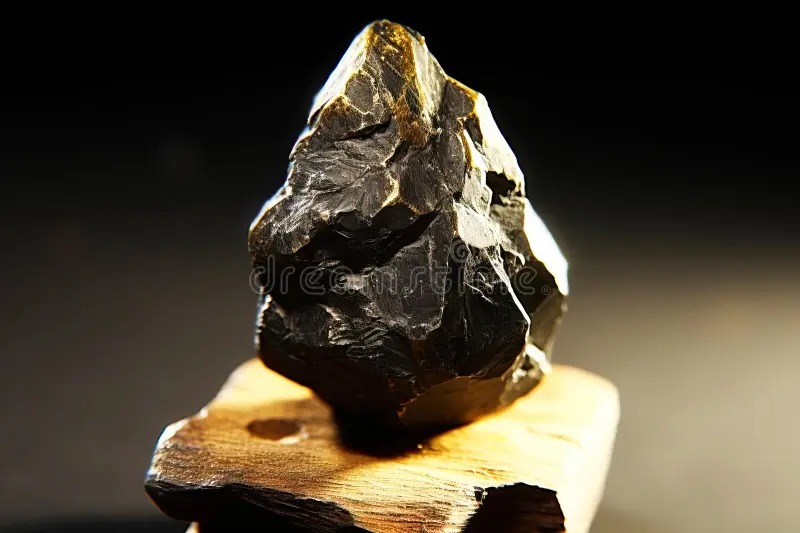
Naldrettite is a rare palladium-antimony mineral with the chemical formula Pd₂Sb. It is classified as a palladium mineral, an antimonide mineral, and a platinum-group mineral. Naldrettite commonly occurs as microscopic grains in sulfide-rich ore deposits, mafic and ultramafic igneous rocks, hydrothermal systems, and other geological environments containing palladium and antimony.
The mineral is generally found as an accessory phase rather than as a major rock-forming mineral. Individual grains are usually very small, commonly less than a few hundred micrometres across, and are commonly attached to or enclosed by sulfide minerals. Because of its small grain size and close association with other platinum-group minerals, naldrettite is normally identified through reflected-light microscopy, electron-microprobe analysis, and crystallographic methods.
Naldrettite belongs to the group of platinum-group element minerals. Its composition is dominated by palladium and antimony, although minor amounts of platinum, arsenic, iron, and sulfur may occur in natural samples. The ideal composition is represented by Pd₂Sb, while analyzed grains may show limited chemical substitution.
The mineral is opaque and metallic in appearance. Under plane-polarized reflected light, it commonly appears bright creamy white. It is orthorhombic and belongs to the space group Cmc2₁. Unlike many collectible minerals, naldrettite does not occur as large visible crystals and has no established gemstone use.
History and Name of Naldrettite
Naldrettite was first described as a new mineral in 2005. The type material came from the Mesamax Northwest deposit in the Cape Smith Fold Belt of the Ungava region in northern Québec, Canada.
The mineral was named after Anthony J. Naldrett, a geologist known for his work on magmatic sulfide deposits, nickel-copper ores, and platinum-group element mineralization. His research contributed to the understanding of how sulfide ores form in mafic and ultramafic igneous environments.
The original description identified naldrettite as a new intermetallic mineral associated with a complex assemblage of sulfides, platinum-group minerals, tellurides, antimonides, and alteration minerals. The discovery was based on its chemical composition, optical behavior, crystal structure, and relationship to other minerals in the ore.
Since the original description, naldrettite with the same or closely related composition has been reported from several additional geological settings. These include magmatic nickel-copper-platinum-group element deposits, hydrothermal veins related to porphyry copper-gold systems, Alaskan-type zoned intrusions, altered chromitites, and other metasomatic or metamorphic environments.
Formation and Geological Occurrence of Naldrettite
Naldrettite forms in geological environments where palladium and antimony are concentrated and can combine during the crystallization or alteration of ore minerals. Its formation is commonly associated with the late stages of magmatic crystallization, hydrothermal alteration, or metasomatic activity.
The type occurrence at the Mesamax Northwest deposit is located near the margins of basaltic dykes. Naldrettite occurs with sulfide minerals such as pyrrhotite, pentlandite, chalcopyrite, galena, sphalerite, and cobaltite. It is also associated with clinochlore, magnetite, sudburyite, electrum, altaite, sperrylite, michenerite, petzite, and hessite.
In this type of environment, palladium may be concentrated in a sulfide-rich melt or in late-stage fluids. Antimony and other volatile elements may become mobile during cooling and alteration. When the chemical conditions are suitable, palladium and antimony can precipitate as naldrettite.
Later studies have documented naldrettite in a variety of geological settings. It is most frequently associated with magmatic Ni-Cu-PGE sulfide deposits, where platinum-group elements are concentrated during the separation and crystallization of sulfide melts. It has also been reported from hydrothermal veins in porphyry copper-gold systems and from platinum-group element deposits related to Alaskan-type zoned intrusions.
Other documented occurrences include metasomatic antimony-arsenic sulfide ores, metamorphic nickel-oxide ores, and podiform chromitites. These occurrences indicate that naldrettite is not restricted to one specific rock type or deposit model.
In some localities, naldrettite appears to have formed during a post-magmatic hydrothermal stage. Fluids containing palladium, antimony, arsenic, bismuth, or tellurium may migrate through fractures and altered rocks and precipitate platinum-group minerals at relatively low temperatures.
A documented occurrence in the Luanga Complex of Brazil is associated with chromitite in a Neoarchaean layered intrusion of the Carajás Mineral Province. In that occurrence, naldrettite is associated with ferrianchromite, iron hydroxides, and chlorite. The mineral assemblage indicates formation from metamorphic or hydrothermal fluids, with crystallization occurring below approximately 350 °C.
Naldrettite in Platinum-Group Element Deposits
Naldrettite is one of several minerals that can host or record palladium in platinum-group element-bearing ores. Palladium is commonly more mobile than some of the other platinum-group elements, particularly during hydrothermal alteration and interaction with volatile-bearing fluids.
In magmatic sulfide deposits, naldrettite may occur after the main crystallization of sulfide minerals. The mineral can be attached to pyrrhotite, pentlandite, chalcopyrite, or other sulfides, or it may occur along grain boundaries and fractures.
The presence of naldrettite in an ore sample can therefore be related to several stages of mineral formation. It may form during the late magmatic stage when residual melts become enriched in incompatible elements, during hydrothermal alteration when fluids transport palladium and antimony, or during metamorphic and metasomatic reactions that modify an earlier mineral assemblage.
Naldrettite is usually present in very small quantities. It is not generally mined as a separate palladium ore. Instead, it occurs as one accessory mineral within deposits that may contain a broader assemblage of platinum-group minerals and base-metal sulfides.
Crystal Structure and Mineralogical Characteristics of Naldrettite
Naldrettite belongs to the orthorhombic crystal system. Its reported space group is Cmc2₁, and the unit-cell parameters are approximately a = 3.3906 Å, b = 17.5551 Å, and c = 6.957 Å.
The orthorhombic structure contains three crystallographic axes that intersect at right angles but have different lengths. The structure is distinct from that of other palladium antimonides, even where chemical compositions are similar.

Naldrettite generally occurs as anhedral grains. Anhedral grains do not display complete external crystal faces because they form between earlier minerals, along grain boundaries, or in open spaces within an ore assemblage. The grains may be attached to sulfides, moulded around sulfide grains, or included within alteration minerals.
Some grains show evidence of strain-induced polysynthetic twinning. Twinning reflects an oriented relationship between portions of the crystal structure and may develop in response to internal strain or changes during mineral growth.
The mineral is commonly found in close association with other platinum-group minerals. These relationships are important because palladium-bearing minerals can have similar appearance in polished sections. Mineral identification therefore requires chemical and structural data in addition to optical observation.
Color, Luster, and Optical Properties of Naldrettite
Naldrettite is an opaque mineral with a metallic luster. In reflected-light microscopy, it commonly appears bright creamy white, particularly when viewed in association with minerals such as pentlandite, pyrrhotite, clinochlore, and chalcopyrite.
The mineral is non-pleochroic, meaning that it does not show noticeable changes in reflected color when the microscope stage is rotated under plane-polarized light. It is distinctly anisotropic, so its brightness or color may change under crossed polars as the grain orientation changes.
Naldrettite has weak bireflectance. Bireflectance refers to a difference in reflectance observed when the mineral is viewed in different orientations. In naldrettite, this effect is generally weak but can assist with comparison against visually similar platinum-group minerals.
No discernible internal reflections are normally observed. Because the mineral is opaque, transmitted-light properties such as transparency and refractive behavior are not applicable in the same way as they are for transparent gemstones.
Reported reflectance values increase toward longer wavelengths. In air, reflectance values are approximately 49.0–50.9% at 470 nm, 53.2–55.1% at 546 nm, 55.4–57.5% at 589 nm, and 58.5–60.1% at 650 nm. In immersion oil, the corresponding values are lower. These measurements are primarily used for laboratory identification and comparison with other opaque ore minerals.
Physical and Chemical Properties of Naldrettite
The ideal chemical composition of naldrettite is represented by Pd₂Sb. Natural grains may contain small amounts of platinum, arsenic, iron, and sulfur. In some occurrences, platinum partially substitutes for palladium and arsenic partially substitutes for antimony.
The original type material contained approximately 63.49 wt.% palladium and 35.75 wt.% antimony, with minor iron, arsenic, and sulfur. The analytical total was close to 100 wt.%, consistent with the ideal Pd₂Sb composition.
Naldrettite is a dense mineral because palladium and antimony are both relatively heavy elements. Its calculated density is approximately 10.694 g/cm³. The high density helps distinguish it from many common sulfide and silicate minerals, although density cannot normally be measured directly on individual microscopic grains.
The mineral has a Mohs hardness of approximately 4 to 5. A mean micro-indentation hardness of about 393 kg/mm² has been reported. Naldrettite has no clearly observed cleavage, and its fracture is irregular. Its tenacity has been described as ductile and flexibly inelastic, which is consistent with its metallic character.
Naldrettite is opaque and metallic. It does not form transparent crystals and is not suitable for ordinary gemological testing. Its diagnostic properties are primarily chemical composition, reflected-light behavior, crystal structure, and association with other ore minerals.
How Is Naldrettite Identified?
Naldrettite cannot normally be identified by unaided visual inspection. Its grains are microscopic, opaque, and commonly attached to sulfide minerals or enclosed within complex ore textures.
The first stage of identification usually involves reflected-light microscopy. The bright creamy-white color, metallic luster, weak bireflectance, distinct anisotropy, and lack of internal reflections provide preliminary evidence. However, these properties are not unique enough to establish the mineral on their own.
Chemical analysis is normally performed using an electron microprobe. This method can measure palladium, antimony, platinum, arsenic, iron, sulfur, and other elements at the scale of individual grains. The resulting composition can be compared with the ideal Pd₂Sb formula and with known substitution patterns.
Scanning electron microscopy can be used to examine grain morphology, contacts with sulfides, alteration textures, and relationships with other platinum-group minerals. Backscattered-electron imaging is particularly useful because minerals with different average atomic numbers show contrast in the resulting image.
X-ray diffraction and electron diffraction provide information about the crystal structure. These methods are important for distinguishing naldrettite from chemically related palladium-antimony minerals, including sudburyite and other antimonides.
A complete identification should therefore combine reflected-light properties, quantitative chemical analysis, crystallographic data, and the geological context of the grain.
Types and Varieties of Naldrettite
Naldrettite is recognized as one mineral species and does not have officially established gemstone varieties or commercial color varieties. Differences between samples are generally related to chemical substitutions, grain texture, host rock, and formation environment.
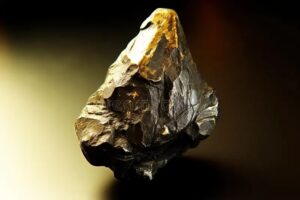
Type-occurrence naldrettite refers to material from the Mesamax Northwest deposit in Québec, Canada. These grains are associated with sulfides, clinochlore, magnetite, and other platinum-group minerals.
Magmatic sulfide-associated naldrettite occurs in nickel-copper-platinum-group element deposits and is commonly attached to pyrrhotite, pentlandite, or chalcopyrite. Hydrothermal naldrettite occurs in veins or altered zones where palladium and antimony were transported by fluids after the main igneous minerals had crystallized.
Chromitite-associated naldrettite occurs in ultramafic and layered intrusions, including documented material from the Luanga Complex in Brazil. Metamorphic and metasomatic occurrences may show different associated minerals and different substitution of platinum or arsenic.
These categories describe geological occurrence rather than formally named varieties. Chemical differences such as partial substitution of platinum for palladium or arsenic for antimony do not automatically represent separate mineral species.
Naldrettite and Related Palladium Minerals
Naldrettite may occur with several other palladium-bearing minerals. Sudburyite, with the composition PdSb, is chemically related because it also contains palladium and antimony. Ungavaite, with the composition Pd₄Sb₃, is another palladium-antimony mineral reported from the Mesamax Northwest deposit.
Other associated platinum-group minerals may include sperrylite, michenerite, electrum, and various palladium tellurides and antimonides. Distinguishing these minerals is important because they can have similar metallic appearances and occur within the same polished section.
The differences between related minerals are established through their chemical ratios, crystal structures, optical properties, and diffraction patterns. A simple visual comparison is not sufficient for reliable identification.
Uses and Commercial Status of Naldrettite
Naldrettite has no established use as a gemstone, ornamental mineral, or industrial material. It occurs as microscopic grains and is not extracted or processed as a separate commercial mineral.
Its economic relevance is related to the geological deposits in which it occurs. Naldrettite may be present in ores containing palladium, platinum, nickel, copper, cobalt, and other valuable metals. However, the mineral itself generally represents only a small proportion of the total ore and is typically evaluated as part of the complete platinum-group mineral assemblage.
The presence of naldrettite can provide information about palladium distribution, antimony activity, hydrothermal alteration, and the late-stage evolution of ore-forming systems. Mineralogical studies of naldrettite-bearing samples may therefore assist with ore characterization and process-mineralogical investigations.
Because the mineral is fine-grained and closely associated with sulfides, its recovery behavior depends on the texture of the host ore, the size of the grains, and the treatment methods used during mineral processing.