Names
Actinolite
Intro
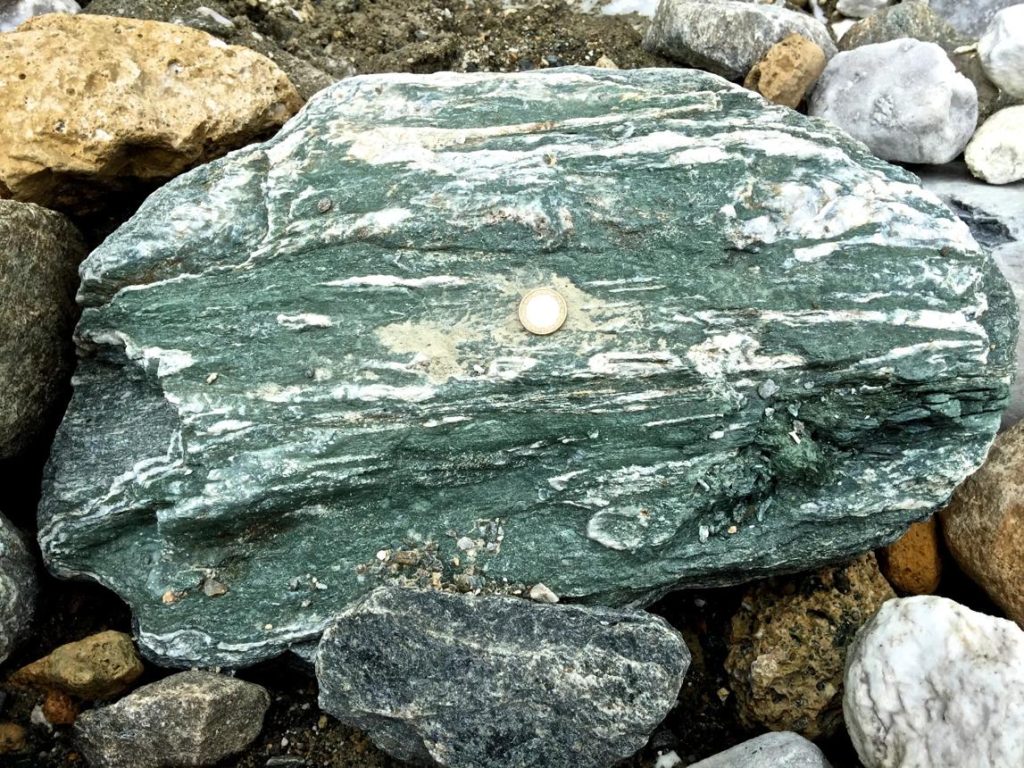
Actinolite is a common rock-forming calcic amphibole silicate mineral forming an intermediate member of the solid-solution series between magnesium-rich tremolite and iron-rich ferro-actinolite. Occurring typically as radiating, bladed, columnar, or fibrous green crystals in metamorphic rocks, it is a key indicator mineral of the greenschist facies and forms the structural basis of nephrite jade and cat's-eye cabochons.
View article
Basic Information Show Hide
Mineral ID
actinolite
Common Synonyms / Aliases
Aktinolith, Strahlstein, Actynolite, Actynolith, Zillerthite, Kalamite, Asbestus (fibrous varieties), Nephrite (massive microcrystalline variety)
Chemistry Show Hide
Chemical Formula
□Ca₂(Mg₄.₅₋₂.₅Fe²⁺₀.₅₋₂.₅)Si₈O₂₂(OH)₂
Elements
Calcium (Ca), Magnesium (Mg), Iron (Fe), Silicon (Si), Oxygen (O), Hydrogen (H)
Minor Elements / Impurities
Mn, Al, Na, K, Ti, Cr, F, Cl
Empirical Formula
Ca₂Mg₃.₅Fe²⁺₁.₅Si₈O₂₂(OH)₂
Molecular Weight (g/mol)
859.65
Solubility
Insoluble in water; practically insoluble in hydrochloric, nitric, and sulfuric acids; decomposed by hydrofluoric acid (HF)
Reaction to Acid
Virtually inert to standard cold or warm dilute HCl and HNO₃; dissolves slowly in HF
Classification Show Hide
Mineral Type
Mineral Species
IMA Status
Grandfathered
IMA Symbol
Act
Strunz Classification
09.DE.10
Dana Classification
66.01.03a.02
Mineral Group
Amphibole Supergroup (Calcium Amphibole Subgroup / Actinolite Root Name Group)
Crystal Structure Show Hide
Crystal System
Monoclinic
Crystal Habit
Long prismatic, bladed, acicular, columnar, radiating fibrous to asbestiform masses, or dense felted microcrystalline aggregates (nephrite); crystals are frequently bent, kinked, or striated parallel to the c-axis
Crystal Class
2/m (Prismatic)
Space Group
C2/m
Cell Parameter A (Angstrom)
9.884
Cell Parameter B (Angstrom)
18.145
Cell Parameter C (Angstrom)
5.294
Cell Angle Alpha (Degrees)
90
Cell Angle Beta (Degrees)
104.70
Cell Angle Gamma (Degrees)
90
Unit Cell Z
2
Crystal Twinning
Simple or lamellar twinning on {100}; occasionally polysynthetic on {001}
Common Crystal Faces
{110}, {010}, {100}, {001}, {011}, {101}, {131}
Physical Properties Show Hide
Primary Color
yellowish Green (yG)slightly yellowish Green (slyG)Green (G)very slightly bluish Green (vslbG)bluish Green (bG)WhiteGrayBlack
Common Colors
Pale green, bright emerald green (Cr-bearing), dark green, grayish-green, greenish-black, black, white to yellowish-green (low-Fe varieties)
Streak
White to pale greenish-white
Luster
Vitreous to pearly on cleavage faces; silky in fibrous and asbestiform aggregates
Transparency / Diaphaneity
Transparent to translucent; dark iron-rich masses may appear nearly opaque
Hardness (Mohs)
5 - 6
Cleavage
Perfect
Cleavage Direction
{110}
Cleavage / Parting Description
Perfect prismatic cleavage on {110} intersecting at characteristic amphibole angles of approximately 56° and 124°; parting sometimes observed on {100} and {001}
Fracture
Splintery to uneven
Tenacity
Brittle in single crystals; flexible in fine asbestiform fibers; exceptionally tough and compact in felted microcrystalline masses (nephrite)
Specific Gravity
3.03 - 3.24
Magnetism
Non-magnetic to very weakly paramagnetic (increases with higher Fe²⁺ content)
Melting Point
~1,050°C – 1,150°C (melts incongruently to pyroxene, cristobalite, magnetite, and vapor)
Thermal Stability
Undergoes dehydroxylation and oxidation of Fe²⁺ between 800°C and 1,050°C, breaking down structurally into clinopyroxene, quartz/cristobalite, and iron oxides
Optical Properties Show Hide
Refractive Index
1.613 - 1.666
Refractive Index Alpha
1.6131646
Refractive Index Beta
1.6241656
Refractive Index Gamma
1.6361666
Optical Axial Angle (2V)
73° – 86° (measured); 78° – 82° (calculated)
Optical Sign / Extinction
Inclined extinction on {010} with Z ∧ c = 10° – 18° (decreases as Fe²⁺ increases); length-slow (positive elongation)
Birefringence
0.0200027
Dispersion
Weak (r < v)
Optical Character
Biaxial-
Pleochroism
Weak to strong (intensifies with increasing iron content)
Pleochroism Details
X = colorless, pale yellow, or yellowish-green; Y = pale green to yellow-green; Z = medium green, dark green, or bluish-green (Absorption: Z > Y > X)
Optical Phenomena
Chatoyancy (cat's-eye effect) in parallel fibrous aggregates
Fluorescence
Inert under both short-wave (254 nm) and long-wave (365 nm) UV light
Luminescence / Phosphorescence / Thermoluminescence
Typically non-luminescent (iron quenches fluorescence)
Absorption Spectrum
Diagnostic iron-related absorption bands around 500–510 nm and general cutoff in the blue-violet region; chromium-bearing varieties (smaragdite) display Cr³⁺ lines near 680–690 nm
Occurrence and Formation Show Hide
Formation Process
Forms predominantly through low- to medium-grade regional metamorphism (greenschist facies) and contact metamorphism of mafic igneous rocks, impure dolomitic limestones, and ultramafic bodies, as well as via retrograde alteration of pyroxenes (uralitization).
Geological Environment
Greenschist-facies metabasalts, actinolite schists, serpentinites, contact-metamorphosed skarns, calc-silicate marbles, and hydrothermal veins.
Associated Minerals
Talc, Chlorite, Epidote, Albite, Calcite, Dolomite, Quartz, Hornblende, Glaucophane, Pumpellyite, Lawsonite, Magnetite, Titanite, Diopside, Garnet
Type Locality
Not formally designated (originally described from European Alpine localities, traditionally associated with Zillertal, Tyrol, Austria)
Major Producing Countries / Localities
AustraliaAustriaBrazilCanadaChinaItalyMadagascarNew ZealandPakistanRussiaSwitzerlandUnited States
Economic Deposit Type
Metamorphic nephrite jade deposits, industrial amphibole asbestos deposits (historically), and skarn/greenschist industrial mineral belts
History and Naming Show Hide
Discovery Year
1794
Name Origin
Named in 1794 by Irish mineralogist Richard Kirwan from the Greek words "aktina" (ἀκτίνα, meaning "ray") and "lithos" (λίθος, meaning "stone"), alluding to its characteristic radiating fibrous crystal aggregates.
Type Specimen Repository
No official type specimen designated (pre-1959 grandfathered species)
Safety and Related Information Show Hide
Wearability
Good too poor
Health Hazards
Asbestiform actinolite is a regulated carcinogenic amphibole asbestos fiber. Inhalation of airborne fibers can cause asbestosis, lung cancer, and mesothelioma. Non-asbestiform blocky crystals and massive nephrite pose minimal risk unless crushed, ground, or cut dry without dust extraction.
Handling Precautions
Avoid dry cutting, grinding, sanding, or breaking fibrous specimens; always use wet-cutting methods, local exhaust ventilation, and NIOSH-approved respiratory protection (P100) when working with rough material; store friable fibrous specimens in sealed containers.
Varieties
Nephrite (compact, tough, microcrystalline aggregate valued as jade), Byssolite (delicate hair-like or wool-like fibrous aggregates), Smaragdite (emerald-green Cr-bearing variety), Actinolite Asbestos (commercial asbestiform variety), Uralite (pseudomorph after pyroxene)
Polytypes
None (monoclinic C2/m structure; orthorhombic analogues belong to the anthophyllite–gedrite series)
Related Minerals
Tremolite, Ferro-actinolite, Magnesio-hornblende, Ferro-hornblende, Richterite, Winchite, Glaucophane, Anthophyllite
Commercial and Gemology Show Hide
Common Treatments
Usually untreated in mineral specimens; massive nephrite and cat's-eye material may undergo waxing, polymer impregnation, or dyeing
Enhancements
Surface waxing to improve luster in nephrite carvings; fracture filling in low-grade fibrous cabochons
Common Cuts
Cabochon (especially for chatoyant cat's-eye actinolite and nephrite), beads, carvings, spheres, and occasional step or emerald faceted collector stones
Rarity / Market Grade
Common as a rock-forming mineral; Rare to Very Rare as transparent facet-grade crystals or sharp chatoyant gems