Names
Cattierite
Intro
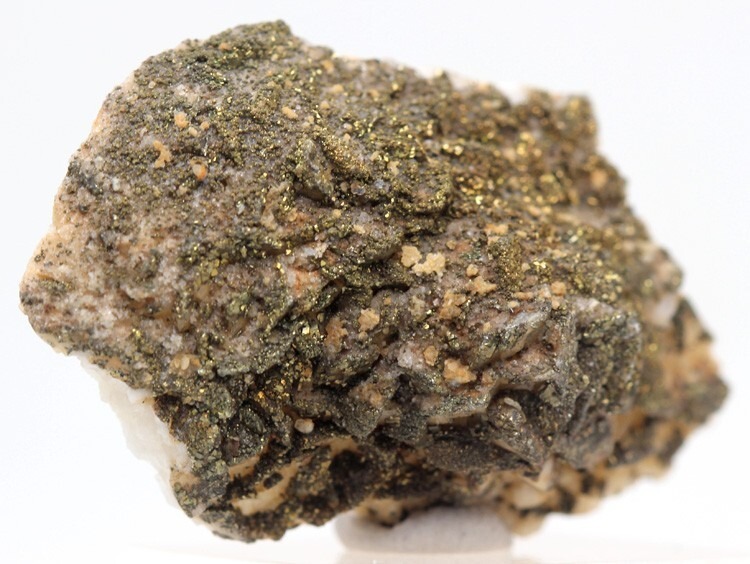
Cattierite is a rare cobalt sulfide mineral with the chemical formula CoS₂, belonging to the pyrite group. First discovered in the rich stratiform copper-cobalt deposits of the Katanga Copperbelt in the Democratic Republic of the Congo, it typically occurs as metallic pinkish-gray to dark gray microscopic crystals, cubes, and granular aggregates associated with other base-metal sulfides.
Basic Information Show Hide
Mineral ID
cattierite
Common Synonyms / Aliases
Cobalt Disulfide, Cattierit, Каттьерит
Chemistry Show Hide
Chemical Formula
CoS₂
Elements
Co, S
Minor Elements / Impurities
Ni, Fe, Cu, As, Se
Empirical Formula
(Co₀.₈₄Ni₀.₀₈Fe₀.₀₈)₁S₂.₀₀
Molecular Weight (g/mol)
123.06
Solubility
Insoluble in water and dilute acids; slowly soluble in concentrated nitric acid (HNO₃) and aqua regia.
Reaction to Acid
Effervesces and decomposes in hot concentrated HNO₃ with liberation of sulfur oxides.
Classification Show Hide
Mineral Type
Mineral Species
IMA Status
Approved
IMA Symbol
Ctr
Strunz Classification
02.EB.05a
Dana Classification
02.12.01.04
Mineral Group
Pyrite Group
Crystal Structure Show Hide
Crystal System
Isometric
Crystal Habit
Cubic crystals, octahedra, pyritohedra, granular aggregates, and microscopic inclusion blebs.
Crystal Class
Diploidal (m3̄ or 2/m3̄)
Space Group
Pa3̄
Cell Parameter A (Angstrom)
5.538
Cell Parameter B (Angstrom)
5.538
Cell Parameter C (Angstrom)
mineral_cell_c
Cell Angle Alpha (Degrees)
90
Cell Angle Beta (Degrees)
90
Cell Angle Gamma (Degrees)
90
Unit Cell Z
4
Crystal Twinning
Interpenetration twinning on {110} common, following the Pyrite Law.
Common Crystal Faces
{100}, {111}, {210}
Physical Properties Show Hide
Primary Color
PinkGrayBlack
Common Colors
Metallic pinkish-gray, steel-gray, lead-gray, tarnishing to dull black, violet-gray in reflected light.
Streak
Black to brownish-black
Luster
Metallic
Transparency / Diaphaneity
Opaque
Hardness (Mohs)
4.0 - 4.5
Cleavage
Perfect
Cleavage Direction
{100}
Cleavage Angle / Parting Quality
Distinct cubic cleavage along {100}; parting along {011} occasionally observed.
Fracture
Conchoidal to Uneven
Tenacity
Brittle
Specific Gravity
4.80 - 4.95
Magnetism
Ferromagnetic at low temperatures (below Curie temperature ~120 K); weakly paramagnetic at room temperature.
Melting Point
Decomposes above 650°C into Co₁₋ₓS and sulfur gas before melting.
Thermal Stability
Thermally unstable in oxidizing conditions above 400°C; oxidizes rapidly to cobalt oxides and sulfates.
Optical Properties Show Hide
Dispersion
None (Metallic reflectance varies slightly across visible spectra)
Optical Character
Isotropic
Pleochroism
Non Pleochroic
Pleochroism Details
Isotropic in polished reflected light; exhibits moderate reflectivity (R ≈ 38–44%) with a distinctive delicate violet-pinkish tint compared to pyrite and vaesite.
Optical Phenomena
High metallic specular reflection.
Fluorescence
Inert
Luminescence / Phosphorescence / Thermoluminescence
Non-luminescent
Absorption Spectrum
Not applicable (opaque metallic phase).
Occurrence and Formation Show Hide
Formation Process
Forms in low-to-medium temperature hydrothermal vein deposits and stratabound sediment-hosted copper-cobalt ores, typically precipitating alongside other thiospinels and disulfides during late-stage hydrothermal mineralization.
Geological Environment
Sediment-hosted stratiform copper-cobalt deposits (Katanga-type), hydrothermal veins cutting mafic-ultramafic rocks, and polymetallic replacement deposits.
Associated Minerals
Vaesite, Pyrite, Linnaeite, Carrollite, Chalcopyrite, Bornite, Chalcocite, Siegenite, Heterogenite, Dolomite, Quartz
Type Locality
Shinkolobwe Mine (Kasolo Mine), Shinkolobwe, Kambove District, Haut-Katanga, Democratic Republic of the Congo
Major Producing Countries / Localities
AustraliaAustriaCanadaDemocratic Republic Of The CongoFinlandGermanyMoroccoRussiaUnited StatesZambia
Economic Deposit Type
Sediment-hosted stratiform Cu-Co deposits and hydrothermal polymetallic vein deposits.
History and Naming Show Hide
Discovery Year
1945
Name Origin
Named in honor of Félicien Cattier (1869–1946), Belgian financier and chairman of the Union Minière du Haut-Katanga.
Type Specimen Repository
Royal Museum for Central Africa, Tervuren, Belgium; National Museum of Natural History (Smithsonian Institution), Washington, D.C., USA.
Safety and Related Information Show Hide
Wearability
Poor
Health Hazards
Contains cobalt and sulfur. Inhalation of fine dust generated by grinding/cutting may cause respiratory irritation, asthma-like symptoms, or cobalt toxicity.
Handling Precautions
Wear a dust mask and gloves when handling, cutting, or polishing raw samples. Avoid inhaling dust and wash hands thoroughly after handling.
Varieties
Nickel-bearing Cattierite (forms a continuous solid solution series towards Vaesite, NiS₂)
Polytypes
None
Related Minerals
Vaesite (NiS₂), Pyrite (FeS₂), Trogtalite (CoSe₂), Linnaeite (Co₃S₄), Carrollite (CuCo₂S₄), Fukuchilite (Cu₃FeS₈)
Commercial and Gemology Show Hide
Common Treatments
None
Enhancements
None
Common Cuts
None (Polished sections and mineral specimens for research/collectors only)
Rarity / Market Grade
Very Rare