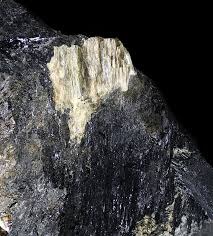
Names
Delhayelite
Intro
Delhayelite is a rare, structurally complex hydrous potassium-calcium-sodium phyllosilicate mineral containing essential volatile halogens and sulfate anions (Cl, F, and SO₄²⁻). Initially discovered in the silica-undersaturated peralkaline nephelinite lavas of Mount Shaheru in the Democratic Republic of the Congo, it crystallizes in the orthorhombic crystal system and serves as an important indicator mineral for late-stage volatile and alkali enrichment in hyper-agpaitic igneous environments.
Basic Information Show Hide
Mineral ID
delhayelite
Common Synonyms / Aliases
IMA 1961-008; Potassium calcium sodium aluminosilicate chloride fluoride sulfate
Chemistry Show Hide
Chemical Formula
K₇Na₃Ca₅[Al₆Si₁₄O₃₈]F₄Cl₂(SO₄) · 2H₂O
Elements
Potassium (K), Sodium (Na), Calcium (Ca), Aluminum (Al), Silicon (Si), Oxygen (O), Fluorine (F), Chlorine (Cl), Sulfur (S), Hydrogen (H)
Minor Elements / Impurities
Fe³⁺, Mg, Sr, Ba, Ti, CO₃²⁻, OH⁻
Empirical Formula
K₆.₉₂Na₂.₈₈Ca₄.₉₅(Al₅.₈₂Fe₀.₁₅Si₁₄.₀₃O₃₈)F₃.₈₅Cl₂.₀₅(SO₄)₀.₉₆ · 2H₂O
Molecular Weight (g/mol)
2238.45
Solubility
Insoluble to very slightly soluble in pure water; decomposes readily in warm concentrated acids.
Reaction to Acid
Decomposes in dilute hydrochloric acid (HCl) and nitric acid (HNO₃) with the precipitation of pulverulent or gelatinous silica (SiO₂).
Classification Show Hide
Mineral Type
Mineral Species
IMA Status
Approved
IMA Symbol
Dlh
Strunz Classification
09.EA.10
Dana Classification
74.03.02.01
Mineral Group
Delhayelite Group
Crystal Structure Show Hide
Crystal System
Orthorhombic
Crystal Habit
Tabular to platy crystals flattened parallel to {010} or {001}; radiating fibrous lamellar aggregates, rosettes, and compact veinlet fillings.
Crystal Class
mmm (2/m 2/m 2/m) – Orthorhombic Dipyramidal (structural sub-symmetry Pmn2₁ / Pmmn)
Space Group
Pmmn or Pmn2₁
Cell Parameter A (Angstrom)
24.65 Å
Cell Parameter B (Angstrom)
7.07 Å
Cell Parameter C (Angstrom)
6.53 Å
Cell Angle Alpha (Degrees)
90.00°
Cell Angle Beta (Degrees)
90.00°
Cell Angle Gamma (Degrees)
90.00°
Unit Cell Z
1
Crystal Twinning
Polysynthetic lamellar twinning on {100} or {010} observable in thin section under cross-polarized light.
Common Crystal Faces
{010}, {001}, {100}, {110}
Physical Properties Show Hide
Primary Color
Colorlessorangy Yellow (oY)Yellow (Y)WhiteGrayBrown
Common Colors
Colorless, snow white, grayish white, pale greenish white, light beige-yellow
Streak
White
Luster
Vitreous to pearly on cleavage planes; sub-vitreous to dull in fine-grained compact masses.
Transparency / Diaphaneity
Transparent to Translucent
Hardness (Mohs)
3.5 - 4.0
Cleavage
Perfect
Cleavage Direction
Perfect on {010}; distinct on {100}
Cleavage Angle / Parting Quality
Eminent basal/platy cleavage parallel to the silicate double-layer sheets yielding brittle, thin folia.
Fracture
Uneven to splintery / micaceous
Tenacity
Brittle
Specific Gravity
2.55 - 2.62
Magnetism
Non-magnetic (Diamagnetic)
Melting Point
Decomposes incongruently above 750 °C with the volatilization of halogens and structural water.
Thermal Stability
Undergoes continuous dehydration between 200 °C and 450 °C; framework structure collapses above 600 °C.
Optical Properties Show Hide
Refractive Index
1.528 - 1.536
Refractive Index Alpha
1.5281530
Refractive Index Beta
1.5321533
Refractive Index Gamma
1.5341536
Optical Axial Angle (2V)
2V ≈ 80° – 88° (Measured: 84°)
Optical Sign / Extinction
Biaxial Negative (-)
Dispersion
δ = 0.006 – 0.008 (Low birefringence with first-order gray to white interference colors)
Optical Character
Biaxial-
Pleochroism
Non-pleochroic (Colorless in transmitted light)
Pleochroism Details
X = Colorless, Y = Colorless, Z = Colorless
Optical Phenomena
Pearly luster and slight optical schiller on fresh {010} cleavage planes.
Fluorescence
Inert to weak cream/pale yellow under SW-UV.
Luminescence / Phosphorescence / Thermoluminescence
Occasionally exhibits weak dull yellow or cream luminescence under shortwave UV (254 nm); generally inert under longwave UV.
Absorption Spectrum
Prominent infrared absorption bands at 3400–3550 cm⁻¹ (H₂O stretching), 1100–1150 cm⁻¹ (SO₄²⁻), and 900–1050 cm⁻¹ (Si–O–Si / Si–O–Al framework modes).
Occurrence and Formation Show Hide
Formation Process
Formed during late-stage hydrothermal and post-magmatic metasomatic processes within hyper-agpaitic, peralkaline nepheline syenites, ijolites, and kalsilite-bearing lavas enriched in potassium, sodium, halogens (F, Cl), and sulfur.
Geological Environment
Alkaline and peralkaline plutonic complexes, agpaitic pegmatites, and specialized silica-deficient volcanic/subvolcanic eruptive rocks.
Associated Minerals
Nepheline, Kalsilite, Combeite, Götzenite, Eudialyte, Aegirine, Potassic Feldspar, Lamprophyllite, Pectolite, Villiaumite, Sodalite
Type Locality
Mount Shaheru, Nyiragongo Volcano, Goma, North Kivu, Democratic Republic of the Congo
Major Producing Countries / Localities
Democratic Republic Of The CongoMoroccoRussiaTanzania
Economic Deposit Type
Agpaitic alkaline pegmatite and peralkaline foidite-hosted late-stage metasomatic mineralization.
History and Naming Show Hide
Discovery Year
1959
Name Origin
Named in honor of Fernand Delhaye (1880–1946), a Belgian geologist who pioneered the geological exploration of the Kivu region and the Western Rift Valley in the Congo.
Type Specimen Repository
Royal Museum for Central Africa, Tervuren, Belgium; Natural History Museum, London, United Kingdom.
Safety and Related Information Show Hide
Wearability
Poor
Health Hazards
Standard mineral dust inhalation precautions apply during cutting, grinding, or polishing due to fine silicate particulate and bonded halide content.
Handling Precautions
Wash hands thoroughly after handling; avoid breathing particulate dust; preserve specimens in a dry, humidity-controlled environment to prevent leaching of alkali cations and halogens.
Varieties
Hydrodelhayelite (hydrated, alkali-depleted alteration product).
Polytypes
Delhayelite-1M / Delhayelite-2O stacking polytypes.
Related Minerals
Hydrodelhayelite (KCa₂AlSi₄O₁₀(OH)₂ · nH₂O), Macfallite, Carletonite, Rhodesite, Mountainite
Commercial and Gemology Show Hide
Common Treatments
None
Enhancements
None
Common Cuts
Collector micromounts and polished mineralogical research sections only; not suitable for gemological faceting due to low hardness and eminent cleavage.
Rarity / Market Grade
Extremely rare; restricted to fewer than a dozen hyper-peralkaline alkaline complexes worldwide.