Names
Ferrokentbrooksite
Intro
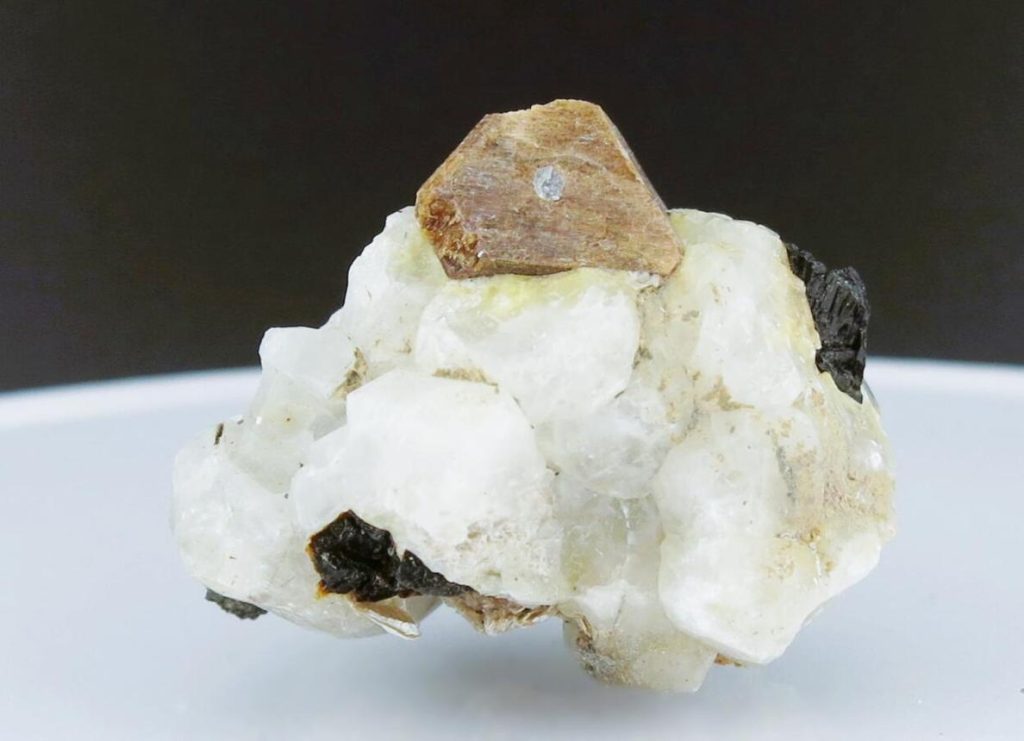
Ferrokentbrooksite is a rare cyclosilicate mineral belonging to the eudialyte group, characterized by the complex formula Na₁₅Ca₆(Fe,Mn)₃Zr₃NbSi₂₅O₇₃(O,OH,H₂O)₃(Cl,F,OH)₂. Typically occurring as distinct reddish-brown pseudo-octahedral or equant grains in alkaline pegmatites, it is prized by advanced mineral collectors for its unique structure and rare-earth element content.
View article
Basic Information Show Hide
Mineral ID
ferrokentbrooksite
Common Synonyms / Aliases
IMA1999-046, Ferrous-iron analogue of kentbrooksite
Chemistry Show Hide
Chemical Formula
Na₁₅Ca₆(Fe,Mn)₃Zr₃NbSi₂₅O₇₃(O,OH,H₂O)₃(Cl,F,OH)₂
Elements
Sodium (Na), calcium (Ca), iron (Fe), zirconium (Zr), niobium (Nb), silicon (Si), oxygen (O), hydrogen (H), fluorine (F), chlorine (Cl).
Minor Elements / Impurities
Rare Earth Elements (REEs, primarily Cerium and Yttrium), Potassium (K), Strontium (Sr), Titanium (Ti), Hafnium (Hf), Tantalum (Ta), Aluminum (Al)
Empirical Formula
Na₁₃.₀₅REE₀.₉₉K₀.₃₂Ca₀.₂₃Sr₀.₁₅Ca₄.₅₉Mn²⁺₁.₂₄Y₀.₁₇Fe²⁺₂.₃₉Mn²⁺₀.₆₁Zr₃Ti₀.₀₄Hf₀.₀₃Nb₀.₆₄Si₀.₂₃Zr₀.₀₇Ta₀.₀₂Si₂₄.₉₃Al₀.₀₇(OH)₀.₄
Molecular Weight (g/mol)
3231.96
Solubility
Insoluble in water; slowly attacked by strong mineral acids
Reaction to Acid
Decomposed by hydrochloric acid (HCl) with the separation of gelatinous silica
Classification Show Hide
Mineral Type
Mineral Species
IMA Status
Approved
IMA Symbol
Fktb
Strunz Classification
9.CO.10 (10th Edition)
Dana Classification
64.01.01.07 (Eudialyte Group)
Mineral Group
Eudialyite group
Crystal Structure Show Hide
Crystal System
Trigonal (Rhombohedral)
Crystal Habit
Equant grains, granular aggregates, and pseudo-octahedral crystals showing distinct octahedral outlines
Crystal Class
Ditrigonal pyramidal (3m)
Space Group
R3m
Cell Parameter A (Angstrom)
14.228
Cell Parameter B (Angstrom)
14.228 (Hexagonal setting axes a = b)
Cell Parameter C (Angstrom)
29.987
Cell Angle Alpha (Degrees)
90°
Cell Angle Beta (Degrees)
90°
Cell Angle Gamma (Degrees)
120°
Unit Cell Z
3
Common Crystal Faces
Distinct rhombohedral and pinacoidal forms creating pseudo-octahedral habits
Physical Properties Show Hide
Primary Color
Red (R)Brown
Common Colors
Reddish brown, bright red, brownish-red
Streak
White
Luster
Vitreous (Glassy)
Transparency / Diaphaneity
Transparent to translucent
Hardness (Mohs)
5 - 6
Cleavage
None
Cleavage Direction
None observed
Cleavage / Parting Description
Lacks true crystallographic cleavage
Fracture
Uneven to brittle, producing uneven fragments
Tenacity
Brittle.
Specific Gravity
3.06
Magnetism
Non-magnetic
Melting Point
High-temperature complex silicate phase; melts incongruently under extreme thermal stress
Thermal Stability
Stable under normal environmental conditions; decomposes at elevated temperatures losing structural water and halogens
Optical Properties Show Hide
Refractive Index
1.618 - 1.622
Optical Axial Angle (2V)
N/A (Uniaxial)
Optical Sign / Extinction
Uniaxial negative
Birefringence
0.0035
Dispersion
Weak
Optical Character
Uniaxial-
Pleochroism
Weak to distinct (in shades of pinkish-red to brownish-red)
Pleochroism Details
O = pale brownish red; E = pale pinkish red
Optical Phenomena
Can be anomalously biaxial, with measured 2V about 5°.
Fluorescence
Inert under short-wave (SW) and long-wave (LW) UV
Luminescence / Phosphorescence / Thermoluminescence
Inert under UV light
Absorption Spectrum
Features typical REE and ferrous iron absorption bands in the visible spectrum
Occurrence and Formation Show Hide
Formation Process
Formed as a primary late-stage crystallization phase in small pegmatite dikes cutting nepheline syenite complexes
Geological Environment
Agpaitic-alkaline intrusive complexes, agpaitic pegmatites, and peralkaline nepheline syenites
Associated Minerals
Aegirine, Albite, Ancylite-(Ce), Calcite, Catapleiite, Fluorite, Fluorapatite, Gonnardite, Microcline, Natrolite, Nepheline, Rhodochrosite, Serandite
Type Locality
Poudrette Quarry (Mont Saint-Hilaire), Rouville County, Monteregian Hills, Quebec, Canada
Major Producing Countries / Localities
CanadaDenmarkNorwayRussia
Economic Deposit Type
Peralkaline pegmatitic rare-metal and rare-earth mineralizations
History and Naming Show Hide
Discovery Year
1999 (Approved by IMA in 1999, published in 2002/2003)
Name Origin
Named as the ferrous-iron (Fe²⁺) dominant analogue of kentbrooksite, combined with the chemical prefix ferro-
Type Specimen Repository
Canadian Museum of Nature, Ottawa, Ontario, Canada / Royal Ontario Museum, Toronto, Canada
Safety and Related Information Show Hide
Wearability
Poor
Health Hazards
Contains trace amounts of radioactive elements (Thorium/Uranium substitutions and REEs), though generally safe for handling standard cabinet specimens; dust inhalation during cutting should be strictly avoided
Handling Precautions
Standard mineral specimen handling; use proper respiratory protection if cutting or grinding matrix containing radioactive accessory phases
Polytypes
Eudialyte-type modulated structure polytypes characteristic of the eudialyte supergroup
Related Minerals
Kentbrooksite, Eudialyte, Oneillite, Manganoeudialyte, Taseqite, Georgbarsanovite
Commercial and Gemology Show Hide
Common Cuts
Extremely rare as faceted stones; preserved primarily as mineral specimens and crystal clusters
Rarity / Market Grade
Extremely rare collector mineral restricted to specialized alkaline complex localities worldwide