Names
Galena
Intro
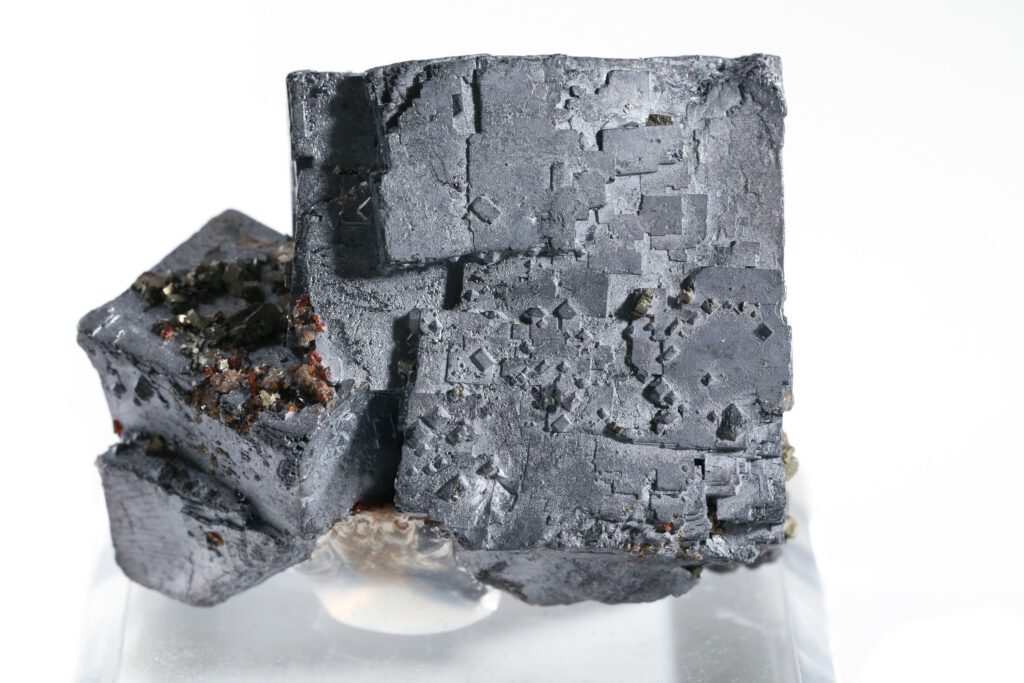
Galena is the primary natural mineral form of lead(II) sulfide (PbS), crystallizing in the isometric crystal system with a halite-type rock-salt crystal structure. As the world's most critical and abundant ore of lead—and a major historical source of byproduct silver—galena is celebrated for its high specific gravity (~7.6), splendent metallic luster, lead-gray streak, and perfect cubic cleavage along three perpendicular planes.
Basic Information Show Hide
Mineral ID
galena
Common Synonyms / Aliases
Lead glance, Blue lead, Plumbago (archaic), Galenite, Bleiglanz
Chemistry Show Hide
Chemical Formula
PbS
Elements
Pb, S
Minor Elements / Impurities
Ag, Sb, Bi, Cu, Fe, Zn, Cd, Se, Te, As
Empirical Formula
PbS
Molecular Weight (g/mol)
239.27
Solubility
Insoluble in water; soluble in hot hydrochloric acid with hydrogen sulfide evolution, and in dilute nitric acid.
Reaction to Acid
Moderate (Reacts with concentrated HCl liberating H₂S gas; vigorous effervescence and reaction in hot HNO₃).
Classification Show Hide
Mineral Type
Mineral Species
IMA Status
Grandfathered
IMA Symbol
Gn
Strunz Classification
02.CD.10
Dana Classification
02.08.01.01
Mineral Group
Galena Group
Crystal Structure Show Hide
Crystal System
Isometric (cubic)
Crystal Habit
Cubes, octahedra, cubo-octahedral combinations, tabular, massive, coarse-to-fine granular, and fibrous.
Crystal Class
m3m (hexoctahedral)
Space Group
Fm3̅m
Cell Parameter A (Angstrom)
5.936
Cell Parameter B (Angstrom)
5.936
Cell Parameter C (Angstrom)
5.936
Cell Angle Alpha (Degrees)
90
Cell Angle Beta (Degrees)
90
Cell Angle Gamma (Degrees)
90
Unit Cell Z
4
Crystal Twinning
Contact twins on {111} according to the Spinel Law (frequently producing flattened pseudo-hexagonal tabular twins); penetration twins on {111} and polysynthetic lamellar deformation twinning.
Common Crystal Faces
{100}, {111}, {110}, {211}
Physical Properties Show Hide
Primary Color
GrayBlack
Common Colors
Lead gray, silver gray, dark gray, steel gray; occasionally with iridescent tarnish
Streak
Lead gray to grayish black
Luster
Metallic on fresh cleavage surfaces; dull or earthy when weathered
Transparency / Diaphaneity
Opaque (even in the thinnest sections).
Hardness (Mohs)
2.5 - 2.75
Cleavage
Perfect
Cleavage Direction
Perfect cubic cleavage on {100}, {010}, and {001} (three directions at 90°)
Cleavage Angle / Parting Quality
Perfect cubic cleavage on {100}; no common parting is reported.
Fracture
Sub-conchoidal to uneven (difficult to produce due to rapid splitting along cubic cleavage planes).
Tenacity
Brittle; sectile in extremely fine-grained varieties.
Specific Gravity
7.40 - 7.60
Magnetism
Non-magnetic (diamagnetic; acts as a natural semiconductor and was used as the cat's-whisker crystal in early radio wave detectors).
Melting Point
1114 °C (2037 °F)
Thermal Stability
Thermally stable up to its melting point in inert conditions; roasts readily in air at 500 °C – 700 °C, oxidizing to lead(II) oxide (PbO, litharge/massicot) and sulfur dioxide (SO₂).
Optical Properties Show Hide
Refractive Index
3.91
Refractive Index Alpha
3.91
Refractive Index Beta
3.91
Refractive Index Gamma
3.91
Optical Axial Angle (2V)
0° (isotropic)
Optical Sign / Extinction
Isotropic; no extinction angle.
Birefringence
0.000
Dispersion
Not applicable (opaque in visible range)
Optical Character
Isotropic
Pleochroism
None
Pleochroism Details
Completely isotropic; highly reflective bright white with a faint grayish tint in reflected light microscopy; displays characteristic triangular cleavage pits on polished sections.
Optical Phenomena
Iridescence / tarnish
Fluorescence
Non-fluorescent
Luminescence / Phosphorescence / Thermoluminescence
Non-fluorescent under both shortwave (254 nm) and longwave (365 nm) ultraviolet radiation.
Absorption Spectrum
Exhibits high optical reflectance (~43–44% across the visible spectrum in reflected light microscopy) and sharp narrow-band electronic bandgap transitions (direct bandgap ≈ 0.4 eV at 300 K).
Occurrence and Formation Show Hide
Formation Process
Forms in hydrothermal vein systems, Mississippi Valley-Type carbonate-replacement deposits, sedimentary-exhalative deposits, volcanic massive sulfides, and contact-metamorphic skarns.
Geological Environment
Hydrothermal veins, limestone- and dolomite-hosted replacement beds, skarns, and volcanic massive-sulfide deposits.
Associated Minerals
Sphalerite, Pyrite, Chalcopyrite, Marcasite, Quartz, Calcite, Dolomite, Fluorite, Barite, Cerussite, Anglesite, silver sulfosalts
Type Locality
Freiberg, Mittelsachsen, Saxony, Germany
Major Producing Countries / Localities
ArgentinaAustraliaAustriaBoliviaBulgariaCanadaChileChinaCzechiaFranceGermanyIrelandItalyJapanKazakhstanMexicoMoroccoNamibiaPeruPolandRomaniaRussiaSouth AfricaSpainSwedenSwitzerlandUnited KingdomUnited States
Economic Deposit Type
Mississippi Valley-Type, SEDEX, epithermal/mesothermal vein, VMS, and skarn deposits
History and Naming Show Hide
Discovery Year
Ancient / Prehistoric (Described and named by Pliny the Elder in ~77 CE in Naturalis Historia).
Name Origin
Derived from the Latin word galena, an ancient term used to denote lead ore or the dross produced from lead smelting.
Type Specimen Repository
No separate type specimen recorded; known since antiquity.
Safety and Related Information Show Hide
Wearability
Display only
Health Hazards
Contains toxic lead (Pb). Poses heavy metal poisoning hazards if inhaled as dust or ingested. Chronic exposure leads to lead poisoning (plumbism), neurological impairment, kidney damage, and reproductive toxicity.
Handling Precautions
Always wash hands thoroughly after handling; never lick, ingest, or breathe generated mineral dust; use certified respirators and wet methods during lapidary cutting or educational sawing; store specimens out of reach of children and pets.
Varieties
Argentiferous Galena (silver-bearing galena, major silver source), Selenian Galena (selenium-bearing), Auriferous Galena (gold-bearing), U-Galena (radiogenic lead galena).
Polytypes
None
Related Minerals
Clausthalite (PbSe), Altaite (PbTe), Alabandite (MnS), Oldhamite (CaS), Sphalerite (ZnS), Anglesite (PbSO₄), Cerussite (PbCO₃).
Commercial and Gemology Show Hide
Common Treatments
No standard treatment; specimens may be cleaned or stabilized for display.
Enhancements
No established gem enhancement; polished surfaces may be waxed or coated for display.
Common Cuts
Very rarely faceted or cut into cabochons for specialized collector curiosities; primarily curated as natural crystal specimensaesthetic matrix clustersor polished decorative cubes.
Rarity / Market Grade
Extremely Common (as an industrial ore; exceptional aesthetic museum-grade crystal clusters associated with fluorite, calcite, or rhodochrosite are Rare to Museum-grade).