Names
Geversite
Intro
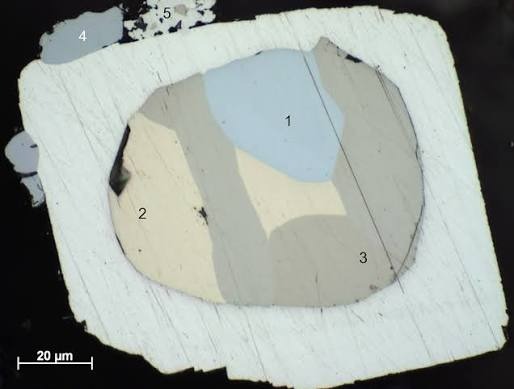
Geversite is a rare platinum-group mineral (PGM) with the chemical composition PtSb₂, crystallizing in the isometric pyrite structure type. First described from the Driekop Mine in the Bushveld Igneous Complex, South Africa, it forms microscopic metallic grains, euhedral cubes, and complex intergrowths typically hosted in ultramafic rocks, chromitites, and magmatic sulfide deposits.
Basic Information Show Hide
Mineral ID
geversite
Common Synonyms / Aliases
Platinum Diantimonide, Geversit, Геверсит
Chemistry Show Hide
Chemical Formula
PtSb₂
Elements
Pt, Sb
Minor Elements / Impurities
Bi, As, S, Fe, Ni, Cu
Empirical Formula
Pt₁.₀₀(Sb₁.₉₆Bi₀.₀₄)₂
Molecular Weight (g/mol)
438.59
Solubility
Insoluble in water and dilute acids; dissolves slowly in hot concentrated aqua regia.
Reaction to Acid
Resistant to standard room-temperature etch reagents (HCl, HNO₃, FeCl₃, KOH).
Classification Show Hide
Mineral Type
Mineral Species
IMA Status
Approved
IMA Symbol
Gev
Strunz Classification
02.EB.05a
Dana Classification
02.12.01.03
Mineral Group
Pyrite Group
Crystal Structure Show Hide
Crystal System
Isometric
Crystal Habit
Anhedral to subhedral microscopic grains, blebs, cubic crystals, and complex intergrowths.
Crystal Class
Diploidal (m3̄ or 2/m3̄)
Space Group
Pa3̄
Cell Parameter A (Angstrom)
6.428
Cell Parameter B (Angstrom)
6.428
Cell Parameter C (Angstrom)
6.428
Cell Angle Alpha (Degrees)
90
Cell Angle Beta (Degrees)
90
Cell Angle Gamma (Degrees)
90
Unit Cell Z
4
Crystal Twinning
None observed macroscopically; typical pyrite-law penetration twinning {110} possible on microscale.
Common Crystal Faces
{100}, {111}, {210}
Physical Properties Show Hide
Primary Color
WhiteGray
Common Colors
Bright metallic white, silver-gray, light cream-white with faint brownish or pinkish tint in reflected light.
Streak
Black to brownish-black
Luster
Metallic
Transparency / Diaphaneity
Opaque
Hardness (Mohs)
4.5 - 5.5
Cleavage
None
Cleavage Direction
None observed
Cleavage Angle / Parting Quality
Parting along {100} or {111} occasionally observed under polishing stress.
Fracture
Conchoidal to Uneven
Tenacity
Brittle
Specific Gravity
10.80 - 11.20
Magnetism
Non-magnetic
Melting Point
1226°C
Thermal Stability
Stable in high-temperature magmatic platinum-group alloy suites; decomposes at elevated temperatures under oxidizing sulfur-antimony fugacity conditions.
Optical Properties Show Hide
Dispersion
None (Reflectance dispersion varies slightly across 400–700 nm)
Optical Character
Isotropic
Pleochroism
Non Pleochroic
Pleochroism Details
Appears isotropic and non-bireflectant in reflected light microscopy; high reflectivity
Optical Phenomena
High metallic specular reflectance.
Fluorescence
Inert
Luminescence / Phosphorescence / Thermoluminescence
Non-luminescent
Absorption Spectrum
Not applicable (opaque metallic phase).
Occurrence and Formation Show Hide
Formation Process
Forms during late-stage magmatic crystallization and post-magmatic hydrothermal alteration of platinum-group elements in layered mafic-ultramafic intrusions, dunite pipes, and ophiolite complexes.
Geological Environment
Mafic to ultramafic layered igneous complexes, Bushveld-type chromitites, dunite pipes, and associated placer deposits.
Associated Minerals
Sperrylite, Stumpflite, Hollingworthite, Michenerite, Insizwaite, Sudburyite, Chalcopyrite, Pyrrhotite, Pentlandite, Chromite, Platinum-iron alloys
Type Locality
Driekop Platinum Mine, Tubatse, Sekhukhune District, Limpopo, South Africa
Major Producing Countries / Localities
AustraliaCanadaChinaFinlandIndiaRussiaSouth AfricaTanzaniaUnited StatesZimbabwe
Economic Deposit Type
Magmatic Ni-Cu-PGE sulfide deposits, PGE-bearing chromitites, and hortonolite-dunite pipes.
History and Naming Show Hide
Discovery Year
1961
Name Origin
Named in honor of Professor Traugott Wilhelm Gevers (1900–1991), a prominent South African geologist at the University of the Witwatersrand.
Type Specimen Repository
Geological Survey of South Africa, Pretoria; National Museum of Natural History (Smithsonian Institution), Washington, D.C., USA.
Safety and Related Information Show Hide
Wearability
Poor
Health Hazards
Contains heavy metal antimony (Sb). Inhalation of dust or ingestion during cutting/polishing can cause respiratory, gastrointestinal, or systemic toxicity.
Handling Precautions
Use protective gloves and proper particulate extraction/ventilation when handling crushed ores or preparing polished thin sections. Wash hands thoroughly after handling.
Varieties
Bismuthian Geversite
Polytypes
None
Related Minerals
Sperrylite (PtAs₂), Insizwaite (PtBi₂), Aurostibite (AuSb₂), Krut'aite (CuSe₂), Pyrite (FeS₂)
Commercial and Gemology Show Hide
Common Treatments
None
Enhancements
None
Common Cuts
None (Polished sections and micro-mounts for research only)
Rarity / Market Grade
Extremely Rare