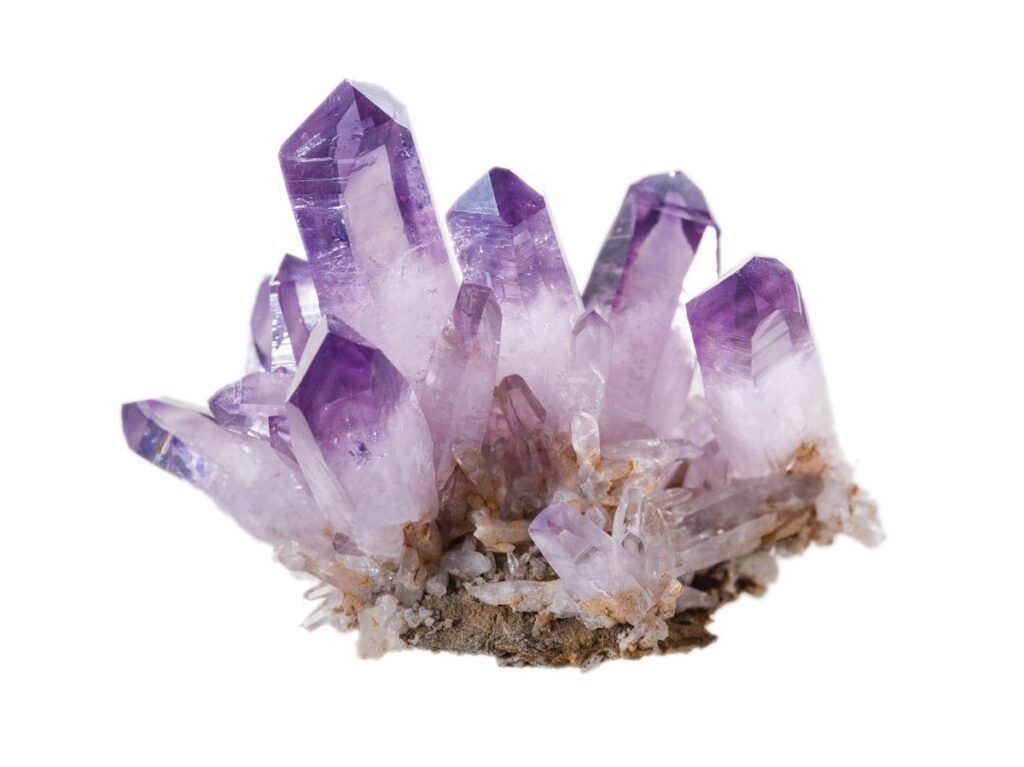
Names
Quartz
Intro
Quartz is the definitive low-temperature trigonal polymorph of silicon dioxide (SiO₂), stable up to 573 °C at ambient pressures. As the defining benchmark for Mohs hardness 7 and one of the most abundant rock-forming framework tectosilicates in the Earth's continental crust, quartz is renowned for its strong piezoelectricity, chemical durability, absence of cleavage, and extensive suite of colored macrocrystalline and microcrystalline (chalcedony) varieties.
Basic Information Show Hide
Mineral ID
quartz
Common Synonyms / Aliases
Alpha-quartz, Low-quartz, Rock crystal (macro-crystalline colorless), Silica, Quarz
Chemistry Show Hide
Chemical Formula
SiO₂
Elements
Silicon (Si), Oxygen (O)
Minor Elements / Impurities
Fe, Al, Ti, Mn, Li, Na, K, H₂O
Empirical Formula
SiO₂
Molecular Weight (g/mol)
60.08
Solubility
Insoluble in water and standard organic solvents; very slightly soluble in pure water under supercritical hydrothermal conditions; dissolved by aqueous hydrofluoric acid (HF) and hot concentrated alkali metal hydroxide solutions (KOH, NaOH).
Reaction to Acid
None (Completely inert to hydrochloric (HCl), nitric (HNO₃), and sulfuric (H₂SO₄) acids at ambient and boiling temperatures; reacts exclusively with hydrofluoric acid (HF)).
Classification Show Hide
Mineral Type
Mineral Species
IMA Status
Grandfathered
IMA Symbol
Qtz
Strunz Classification
04.DA.05
Dana Classification
75.01.03.01
Mineral Group
Quartz Group (Silicates / Oxides)
Crystal Structure Show Hide
Crystal System
Trigonal (low/alpha quartz); hexagonal symmetry for high/beta quartz above 573 °C
Crystal Habit
Prismatic six-sided crystals with pyramids, horizontal striations, drusy coatings, massive aggregates, microcrystalline chalcedony, and geode fillings.
Crystal Class
Trigonal trapezohedral, 32 (P3₁21 or P3₂21)
Space Group
P3₁21 or P3₂21
Cell Parameter A (Angstrom)
4.913
Cell Parameter B (Angstrom)
4.913
Cell Parameter C (Angstrom)
5.405
Cell Angle Alpha (Degrees)
90
Cell Angle Beta (Degrees)
90
Cell Angle Gamma (Degrees)
120
Unit Cell Z
3
Crystal Twinning
Exceptionally common; includes Dauphiné twins (penetration twin with c-axis as twin axis), Brazil twins (optical contact twin on {11-20}), Japan Law twins (contact twin on {11-22} at an angle of 84°33'), and Esterel Law twins.
Common Crystal Faces
{10-10} prism, {10-11} positive rhombohedron, {01-11} negative rhombohedron
Physical Properties Show Hide
Primary Color
ColorlessPurple (P)PinkYellow (Y)Green (G)WhiteGrayBrownBlack
Common Colors
Colorless, white, gray, purple, yellow, pink, brown, black, and green
Streak
White
Luster
Vitreous (glassy); greasy on fracture surfaces; waxy to dull in microcrystalline forms
Transparency / Diaphaneity
Transparent to translucent (opaque in massive, heavily included, or cryptocrystalline varieties).
Hardness (Mohs)
7
Cleavage
Poor
Cleavage Direction
Indistinct on {0111} and {1011}
Cleavage Angle / Parting Quality
No true cleavage; indistinct parting may occur on Brazil-law twin planes.
Fracture
Conchoidal to sub-conchoidal.
Tenacity
Brittle
Specific Gravity
2.65 - 2.66
Magnetism
Non-magnetic (diamagnetic).
Melting Point
1713 °C
Thermal Stability
Undergoes a reversible, displacive phase transition to high-temperature hexagonal beta-quartz (β-SiO₂) at 573 °C (1063 °F) at 1 atm, accompanied by structural volume expansion; converts to tridymite above 870 °C and cristobalite above 1470 °C.
Optical Properties Show Hide
Refractive Index
1.544 - 1.553
Refractive Index Alpha
1.544
Refractive Index Beta
1.544
Refractive Index Gamma
1.553
Optical Axial Angle (2V)
0° (uniaxial)
Optical Sign / Extinction
Positive (+)
Birefringence
0.009
Dispersion
0.013
Optical Character
Uniaxial+
Pleochroism
None to weak (in colored macrocrystalline varieties such as Amethyst, Citrine, and Smoky Quartz).
Pleochroism Details
Weak dichroism in dark amethyst (purple / reddish-purple) and smoky quartz (yellowish-brown / reddish-brown); none in pure colorless rock crystal.
Optical Phenomena
Asterism (6-rayed star caused by oriented rutile inclusions), chatoyancy (cat's-eye quartz, tiger's eye), iridescence (iris quartz / rainbow quartz due to thin-film fracture interference), optical circular polarization (rotates plane-polarized light along the c-axis).
Fluorescence
Inert to weakly fluorescent under UV radiation; diagnostic cathode-luminescence (CL) colors reveal growth zoning (blue, red, or greenish-yellow depending on [AlO₄] and structural defect centers).
Luminescence / Phosphorescence / Thermoluminescence
Generally non-fluorescent; some specific varieties or included specimens display weak green, yellow, or blue fluorescence under SW-UV (254 nm) or LW-UV (365 nm); strongly triboluminescent (emits flashes of light when crystals are struck or rubbed together in darkness).
Absorption Spectrum
Highly transparent across UV, visible, and near-IR regions; diagnostic vibrational infrared absorption bands at 1080 cm⁻¹, 798 cm⁻¹, 778 cm⁻¹ (Si-O-Si stretching doublet), and 460 cm⁻¹ (Si-O bending).
Occurrence and Formation Show Hide
Formation Process
Crystallizes in igneous magmas and pegmatites, hydrothermal veins, metamorphic quartzites, and sedimentary environments.
Geological Environment
Igneous, metamorphic, and sedimentary settings including quartz veins, geodes, pegmatites, and detrital sands.
Associated Minerals
Feldspar, Muscovite, Biotite, Tourmaline, Calcite, Fluorite, Pyrite, Hematite
Type Locality
No single type locality; quartz was recognized historically and is grandfathered
Major Producing Countries / Localities
AustraliaAustriaBrazilCanadaChinaFranceGermanyIndiaItalyJapanMadagascarMexicoNamibiaNorwayPakistanPeruRussiaSouth AfricaSpainSwitzerlandUnited KingdomUnited States
Economic Deposit Type
Hydrothermal veins, granite pegmatites, placer deposits, quartzites, and silica-sand beds
History and Naming Show Hide
Discovery Year
Ancient / Prehistoric (Documented in classical Greek mineral treatises by Theophrastus in ~300 BCE as κρύσταλλος (krýstallos)).
Name Origin
Derived from the German word Quarz, of Middle High German / Slavic origin (from Polish kwardy, meaning "hard").
Type Specimen Repository
None designated; grandfathered mineral
Safety and Related Information Show Hide
Wearability
Excellent
Health Hazards
Completely non-toxic and inert in solid hand specimen and jewelry forms; long-term occupational inhalation of respirable crystalline silica (RCS) dust generated during dry cutting, crushing, or mining operations presents severe health hazards (causes silicosis and classified as an IARC Group 1 human carcinogen).
Handling Precautions
Safe for ultrasonic, steam, and chemical cleaning; always enforce wet-cutting and wear certified N95/FFP3 particulate respirators when cutting, grinding, or polishing bulk quartz specimens.
Varieties
Rock Crystal, Amethyst, Citrine, Smoky Quartz, Rose Quartz, Prasiolite, Ametrine, Milky Quartz, Rutilated Quartz, Tourmalinated Quartz, Morion, Chalcedony (cryptocrystalline varieties: Agate, Jasper, Carnelian, Onyx, Chrysoprase).
Polytypes
None (Polymorphs include Beta-quartz, Tridymite, Cristobalite, Coesite, Stishovite, Moganite, Seifertite).
Related Minerals
Tridymite (SiO₂), Cristobalite (SiO₂), Coesite (SiO₂), Stishovite (SiO₂), Moganite (SiO₂), Opal (SiO₂·nH₂O), Feldspar group.
Commercial and Gemology Show Hide
Common Treatments
Colored and commercial quartz may be heat-treated, irradiated, dyed, coated, or fracture-filled; natural rock crystal is commonly untreated.
Enhancements
Irradiation can produce smoky quartz; heat can modify amethyst or citrine; coatings and dyeing are used for decorative material.
Common Cuts
Brilliant cutstep/emerald cutfantasy bespoke facetingCabochonsBeadsspherical spheresintricate lapidary carvingsoptical waveplatesand oscillator plates.
Rarity / Market Grade
Extremely Common (High-clarity inclusion-free giant crystals, aesthetic museum-grade clusters, and rare natural unheated color phases like natural ametrine or prasiolite are Rare to Museum-grade).