Names
Ruby
Intro
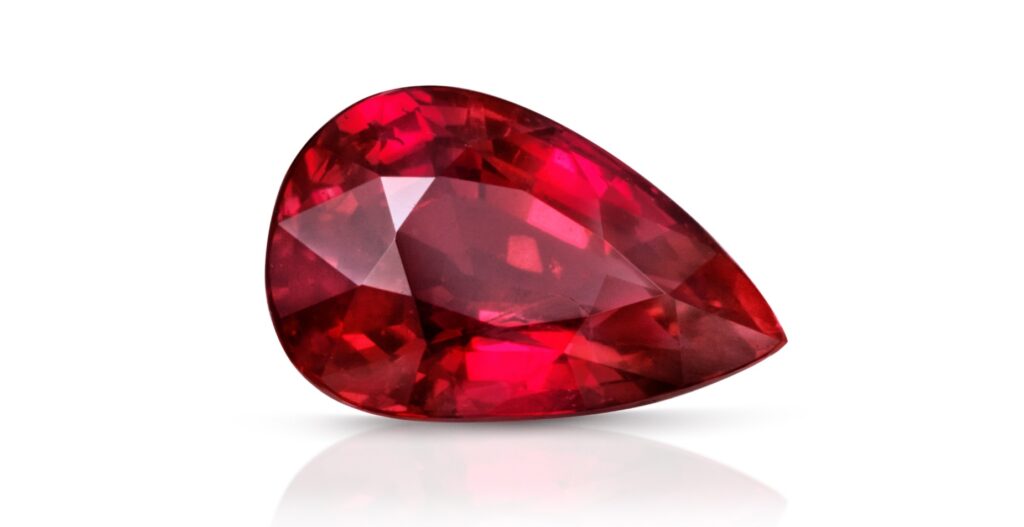
Ruby is the prestigious red, gem-quality variety of the mineral species corundum (aluminum oxide, Al₂O₃), colored predominantly by trace amounts of chromium (Cr³⁺ substituting for Al³⁺ in octahedral coordination). Renowned as one of the traditional cardinal gemstones, it exhibits exceptional Mohs hardness (9), high refractive indices, pronounced pleochroism, and vivid chromium-induced red fluorescence under longwave UV radiation.
Basic Information Show Hide
Mineral ID
ruby
Common Synonyms / Aliases
Red Corundum, Pigeon's Blood Ruby, Star Ruby, Oriental Ruby (archaic), Carbuncle (historical)
Chemistry Show Hide
Chemical Formula
Al₂O₃:Cr
Elements
Al, O; typically trace Cr, Fe, Ti, V
Minor Elements / Impurities
Cr, Fe, Ti, V, Mg, Si
Empirical Formula
Al₂O₃ with variable Cr³⁺ substitution
Molecular Weight (g/mol)
101.96
Solubility
Insoluble in water and resistant to most acids; attacked by hot concentrated alkalis and molten alkali compounds.
Reaction to Acid
None (Completely inert to room-temperature hydrochloric (HCl), nitric (HNO₃), and sulfuric (H₂SO₄) acids).
Classification Show Hide
Mineral Type
Mineral Variety
IMA Status
Grandfathered
IMA Symbol
Crn
Strunz Classification
04.CB.05
Dana Classification
04.03.01.01
Mineral Group
Corundum Group (Oxides)
Crystal Structure Show Hide
Crystal System
Trigonal (rhombohedral)
Crystal Habit
Hexagonal-barrel and tabular crystals, steep rhombohedra, prismatic forms, granular and massive aggregates.
Crystal Class
3̅m (rhombohedral / scalenohedral)
Space Group
R3̅c
Cell Parameter A (Angstrom)
4.759
Cell Parameter B (Angstrom)
4.759
Cell Parameter C (Angstrom)
12.993
Cell Angle Alpha (Degrees)
90
Cell Angle Beta (Degrees)
90
Cell Angle Gamma (Degrees)
120
Unit Cell Z
6
Crystal Twinning
Pervasive polysynthetic/lamellar twinning on {10-11} (rhombohedral) producing distinct striations and parting planes; simple contact twins on basal pinacoid {0001} or prism faces {10-10}.
Common Crystal Faces
{0001}, {10-11}, {11-20}
Physical Properties Show Hide
Primary Color
reddish Purple (rP)Red-Purple or Purple-Red (RP/PR)PinkRed (R)orangy Red (oR)
Common Colors
Pure vivid red ("Pigeon's Blood"), purplish-red, carmine, pinkish-red, deep crimson, brownish-red (when iron content is elevated), and orangey-red.
Streak
White
Luster
Vitreous to adamantine
Transparency / Diaphaneity
Transparent
Hardness (Mohs)
9
Cleavage
None
Cleavage Direction
None (Displays pseudo-cleavage parting)
Cleavage Angle / Parting Quality
Highly pronounced basal parting parallel to {0001} and rhombohedral parting parallel to {10-11} due to lamellar polysynthetic twinning.
Fracture
Conchoidal to unevensplintery.
Tenacity
Brittle; extremely tough in massive granular formations due to high structural density.
Specific Gravity
3.97 - 4.05
Magnetism
Non-magnetic (diamagnetic; very weakly paramagnetic if rich in iron impurities).
Melting Point
2044 °C (3711 °F)
Thermal Stability
Exceptionally high thermal stability; endures extreme geological metamorphic temperatures without structural breakdown.
Optical Properties Show Hide
Refractive Index
1.762 - 1.770
Refractive Index Alpha
1.762
Refractive Index Beta
1.770
Refractive Index Gamma
1.770
Optical Axial Angle (2V)
0° (uniaxial)
Optical Sign / Extinction
Negative (-)
Birefringence
0.008
Dispersion
0.018
Optical Character
Uniaxial-
Pleochroism
Strong
Pleochroism Details
Dichroic: ω (omega / ordinary ray) = vivid purplish-red to deep crimson-red; ε (epsilon / extraordinary ray) = pale orangey-red to yellowish-red.
Optical Phenomena
Asterism (6-rayed star caused by oriented micro-inclusions of rutile silk needles intersecting at 60° parallel to {0001}); rarely displays chatoyancy (cat's-eye effect).
Fluorescence
Strong diagnostic red under LW-UV (365 nm); weak to moderate red under SW-UV (254 nm); exhibits strong red laser-induced emission (R-lines at 692.8 nm and 694.3 nm).
Luminescence / Phosphorescence / Thermoluminescence
Intense bright red to crimson-red under longwave UV (365 nm); moderate to weak red under shortwave UV (254 nm) and X-rays (quenched by increasing trace iron (Fe²⁺/Fe³⁺) concentration).
Absorption Spectrum
Highly diagnostic absorption spectrum with strong broad bands centered at ~410 nm and ~550 nm, complete violet absorption below 400 nm, sharp chromium absorption doublet lines at 692.8 nm & 694.3 nm (seen as dark absorption lines or bright fluorescent emission lines), and weak lines at 475 nm, 476 nm, and 468 nm.
Occurrence and Formation Show Hide
Formation Process
Originates primarily in high-grade regional and contact metamorphic settings (aluminous marbles, amphibolites, granulite-facies rocks, and skarns) where aluminum-rich protoliths undergo desilication in silica-poor, chromium-bearing metamorphic regimes. Also occurs in mantle-derived xenoliths and alkali basalts, accumulating commercially in secondary alluvial and colluvial placer deposits.
Geological Environment
Marble-hosted deposits, mafic-ultramafic metamorphic belts, desilicated pegmatites/plumasites, alkali basalt corundum xenocryst suites, and secondary alluvial gravel placers (gem gravels / "illam").
Associated Minerals
Calcite, Dolomite, Spinel, Phlogopite, Rutile, Zircon, Margarite, Pargasite, Apatite, Sphene (Titanite), Tourmaline, Graphite.
Type Locality
Historical ancient gemstone; primary archetypal geological benchmark locality is the Mogok Stone Tract, Pyin-Oo-Lwin District, Mandalay Region, Myanmar (Burma).
Major Producing Countries / Localities
AfghanistanAustraliaCambodiaChinaIndiaKenyaMadagascarMozambiqueMyanmarNepalNorth MacedoniaPakistanRussiaSri LankaTajikistanTanzaniaThailandUnited StatesVietnam
Economic Deposit Type
Marble-hosted Metamorphic Deposit / Metamorphic-Metasomatic Belt Deposit / Secondary Alluvial Placer Gem Deposit.
History and Naming Show Hide
Discovery Year
Ancient / Prehistoric (Recorded in Sanskrit and Roman lapidary treatises since antiquity).
Name Origin
Derived from the Latin word ruber, meaning "red".
Type Specimen Repository
None preserved (Prehistoric historical gemstone recognition).
Safety and Related Information Show Hide
Wearability
Excellent
Health Hazards
Completely non-toxic and chemically inert in solid crystalline form; standard PPE and wet-cutting protocols apply during lapidary faceting and grinding to prevent inhalation of fine abrasive dust.
Handling Precautions
Safe for ultrasonic and steam cleaning if natural and unheated or standard heat-treated; avoid ultrasonic, steam, or acidic cleaning solutions for lead-glass filled or fracture-healed stones.
Varieties
Star Ruby (asteriated), Pigeon's Blood Ruby (trade color grade), Trapiche Ruby (sectoral growth wheels), Chrome Corundum.
Polytypes
None
Related Minerals
Sapphire (Corundum species color varieties), Hematite (Fe₂O₃), Ilmenite (FeTiO₃), Eskolaite (Cr₂O₃), Karelianite (V₂O₃), Spinel (MgAl₂O₄), Chrysoberyl (BeAl₂O₄).
Commercial and Gemology Show Hide
Common Treatments
High-temperature heat treatment (to dissolve rutile silk and enrich color), lead glass fracture filling (flux/composite clarity enhancement), beryllium diffusion (lattice color enhancement), flux-assisted healing of fractures, surface oiling/resins.
Enhancements
Heat Treatment (standard commercial practice), Fracture Filling, Lattice Diffusion.
Common Cuts
Oval brilliant/mixed cutcushion cutround brilliantemerald/step cutpear cutcabochon (standard for asteriated star rubies and lower-clarity material)Beadscarvings.
Rarity / Market Grade
Rare (High-grade unheated natural stones above 3–5 carats with vivid Pigeon's Blood saturation and high clarity are Museum-grade to Investment-grade).