Names
Khaidarkanite
Intro
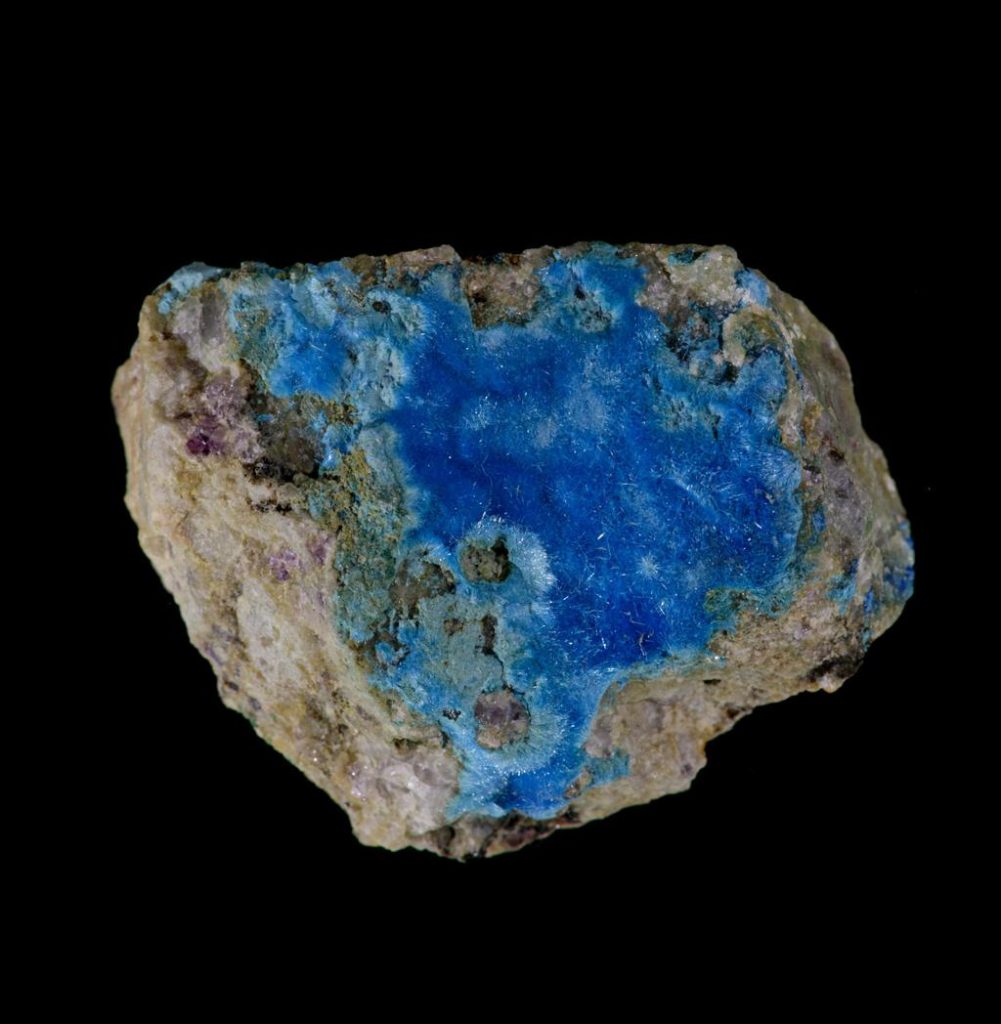
An extremely rare copper-aluminum hydroxyl-fluoride hydrate mineral, typically occurring as light blue to bright sky-blue acicular crystals or divergent radial aggregates, first discovered in the oxidized zone of the Khaidarkan Sb-Hg deposit in Kyrgyzstan.
View article
Basic Information Show Hide
Mineral ID
khaidarkanite
Common Synonyms / Aliases
IMA1998-013
Chemistry Show Hide
Chemical Formula
Cu₄Al₃(OH)₁₄F₃·2H₂O
Elements
Cu, Al, H, O, F, (Na)
Minor Elements / Impurities
Na, SO₄, SiO₄
Empirical Formula
Na₀.₃₄Cu₄Al₃(OH)₁₄F₃·2H₂O
Molecular Weight (g/mol)
674.07
Solubility
Slightly soluble in acids
Reaction to Acid
Slow reaction with dilute HCl or HNO₃
Classification Show Hide
Mineral Type
Mineral Species
IMA Status
Approved
IMA Symbol
Khd
Strunz Classification
03.DA.45
Dana Classification
10.06.13.01
Mineral Group
Hydroxyhalide group / Cyanotrichite-related structural relatives
Crystal Structure Show Hide
Crystal System
Monoclinic
Crystal Habit
Acicular, tabular, divergent radial aggregates
Crystal Class
2/m - Prismatic
Space Group
C2/m
Cell Parameter A (Angstrom)
12.346
Cell Parameter B (Angstrom)
2.907
Cell Parameter C (Angstrom)
10.369
Cell Angle Alpha (Degrees)
90
Cell Angle Beta (Degrees)
97.90
Cell Angle Gamma (Degrees)
90
Unit Cell Z
1
Common Crystal Faces
{100}, {001}
Physical Properties Show Hide
Primary Color
very strongly bluish Green (vstbG)Blue (B)
Common Colors
Sky blue, bright blue, cyan, light blue
Streak
Pale blue to white
Luster
Silky to vitreous
Transparency / Diaphaneity
Translucent to transparent
Hardness (Mohs)
2.5
Cleavage
Good
Cleavage Direction
{001}
Cleavage / Parting Description
Good on {001} parallel to fiber length
Fracture
Splintery to uneven
Tenacity
Brittle
Specific Gravity
2.85 - 2.9
Magnetism
Non-magnetic
Melting Point
Decomposes prior to melting
Thermal Stability
Dehydrates and dehydroxylates upon heating above 180°C
Optical Properties Show Hide
Refractive Index
1.588 - 1.625
Refractive Index Alpha
1.588
Refractive Index Beta
1.615
Refractive Index Gamma
1.625
Optical Axial Angle (2V)
60° - 70°
Optical Sign / Extinction
Negative
Birefringence
0.037
Dispersion
Moderate, r > v
Optical Character
Biaxial-
Pleochroism
Visible
Pleochroism Details
X = light blue to pale green-blue, Y = sky blue, Z = deep sky blue
Optical Phenomena
Silky chatoyant sheen on fibrous aggregates
Fluorescence
Inert under SW and LW ultraviolet light
Luminescence / Phosphorescence / Thermoluminescence
Non-fluorescent
Absorption Spectrum
Broad Cu²⁺ absorption in the near-infrared and red region
Occurrence and Formation Show Hide
Formation Process
Secondary supergene mineral formed by the low-temperature oxidation and leaching of copper-bearing polymetallic, mercury-antimony ores in fluorine-bearing hydrothermal zones.
Geological Environment
Weathered oxidation zone (gossan) of fluorite-bearing Sb-Hg and polymetallic vein deposits.
Associated Minerals
Fluorite, malachite, azurite, cinnabar, stibnite, quartz, calcite, chrysocolla
Type Locality
Khaidarkan (Chaidarkan) Sb-Hg deposit, Fergana Valley, Batken Region, Kyrgyzstan
Major Producing Countries / Localities
AustriaGermanyKyrgyzstanUnited Kingdom
Economic Deposit Type
Hydrothermal antimony-mercury deposit (oxidation zone)
History and Naming Show Hide
Discovery Year
1998
Name Origin
Named after its type locality, the Khaidarkan (Chaidarkan) antimony-mercury deposit in Kyrgyzstan.
Type Specimen Repository
Fersman Mineralogical Museum, Russian Academy of Sciences, Moscow, Russia (Catalog No. 2977/1)
Safety and Related Information Show Hide
Wearability
Display only
Health Hazards
Contains copper and fluorine; toxic if ingested or inhaled as dust.
Handling Precautions
Handle with care to preserve fragile crystal tufts; wash hands thoroughly after handling; avoid inhaling mineral dust.
Related Minerals
Cyanotrichite, camerolaite, carbonate-cyanotrichite
Commercial and Gemology Show Hide
Common Treatments
None
Enhancements
None
Common Cuts
None (too soft and fibrous; kept as matrix specimen)
Rarity / Market Grade
Extremely rare collector mineral