Names
Edscottite
Intro
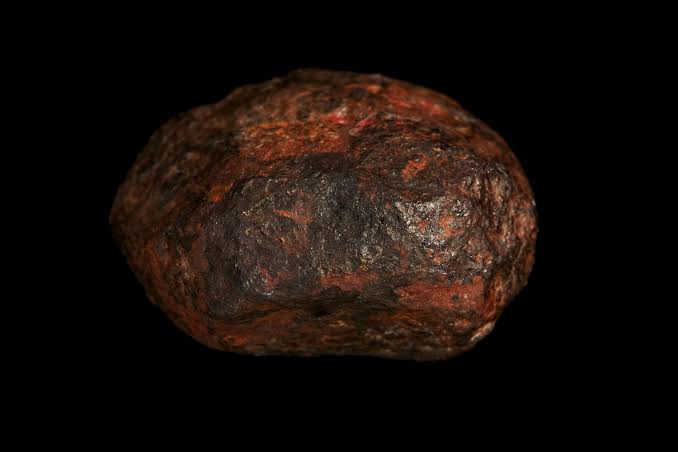
Edscottite is an ultra-rare iron carbide mineral (Fe5C2) discovered inside the Wedderburn iron meteorite, formed as a phase during the slow cooling of an ancient planetesimal core.
View article
Basic Information Show Hide
Mineral ID
edscottite
Common Synonyms / Aliases
Iron carbide, theta-Fe5C2
Chemistry Show Hide
Chemical Formula
Fe5C2
Elements
Fe, C
Minor Elements / Impurities
Ni, Co
Empirical Formula
Fe5C2
Molecular Weight (g/mol)
303.250000000001
Solubility
Insoluble in water
Reaction to Acid
Dissolves slowly in dilute mineral acids
Classification Show Hide
Mineral Type
Mineral Species
IMA Status
Approved
IMA Symbol
Eds
Strunz Classification
01.BA.30
Dana Classification
01.01.08.03
Mineral Group
Native Elements and Carbides
Crystal Structure Show Hide
Crystal System
Monoclinic
Crystal Habit
Lath-like microcrystals, microscopic inclusions
Crystal Class
Monoclinic Prismatic (2/m)
Space Group
C 2/c
Cell Parameter A (Angstrom)
11.562
Cell Parameter B (Angstrom)
4.571
Cell Parameter C (Angstrom)
5.058
Cell Angle Alpha (Degrees)
90
Cell Angle Beta (Degrees)
97.54
Cell Angle Gamma (Degrees)
90
Unit Cell Z
4
Crystal Twinning
None observed
Common Crystal Faces
Indetermined due to microscopic grain size
Physical Properties Show Hide
Primary Color
GrayBlack
Common Colors
Steel Gray, Opaque Black, Silver-Gray
Streak
Black
Luster
Metallic
Transparency / Diaphaneity
Opaque
Hardness (Mohs)
5.5 - 6
Cleavage
None
Cleavage Direction
N/A
Cleavage Angle / Parting Quality
None
Fracture
Irregular / Uneven
Tenacity
Brittle
Specific Gravity
7.6 - 7.65
Magnetism
Strongly Magnetic
Melting Point
>1150 °C
Thermal Stability
Decomposes into iron and graphite at high temperatures outside its stability field
Optical Properties Show Hide
Dispersion
Not reported
Optical Character
Isotropic
Pleochroism
Non Pleochroic
Pleochroism Details
Not reported
Optical Phenomena
High metallic reflectance under reflected light microscopy
Fluorescence
Non-fluorescent
Luminescence / Phosphorescence / Thermoluminescence
Non-fluorescent
Absorption Spectrum
N/A
Occurrence and Formation Show Hide
Formation Process
Crystallized during the supersaturation and segregation of carbon from nickel-rich iron melt during the slow cooling of a planetary core.
Geological Environment
Meteoritic iron core fragment (extraterrestrial origin)
Associated Minerals
Kamacite, Taenite, Cohenite, Schreibersite, Graphite, Troilite
Type Locality
Wedderburn meteorite, Victoria, Australia
Major Producing Countries / Localities
Australia
Economic Deposit Type
Meteoritic inclusion
History and Naming Show Hide
Discovery Year
2018
Name Origin
Named after Edward R. D. Scott, a cosmochemist at the University of Hawaiʻi who made pioneering contributions to the research of meteorites.
Type Specimen Repository
Museums Victoria, Melbourne, Australia
Safety and Related Information Show Hide
Wearability
Poor
Health Hazards
None under normal handling
Handling Precautions
Store in desiccated environments to prevent atmospheric oxidation of associated iron alloys.
Varieties
None
Polytypes
None
Related Minerals
Cohenite, Haxonite, Guobeiite
Commercial and Gemology Show Hide
Common Treatments
None
Enhancements
None
Common Cuts
None
Rarity / Market Grade
Extremely Rare