Names
Gerstleyite
Intro
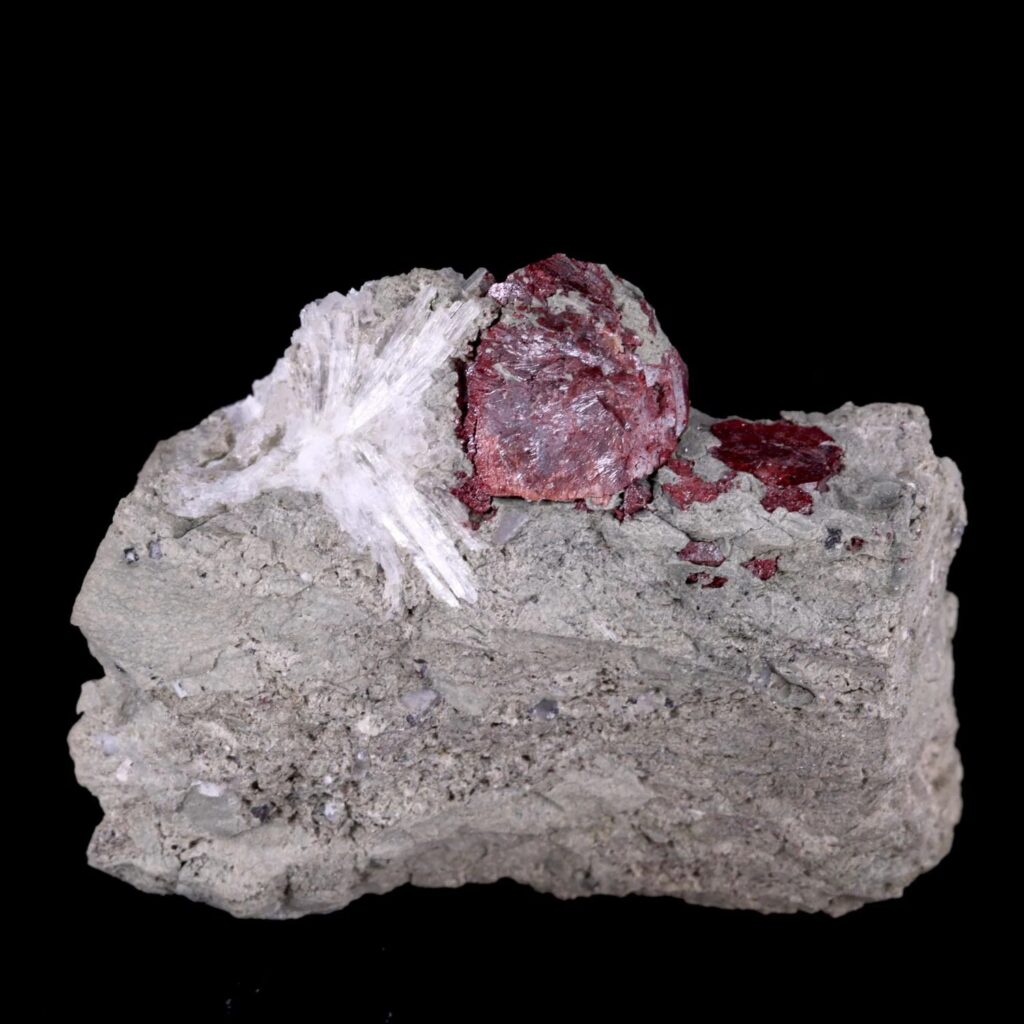
Gerstleyite is an extremely rare hydrated sodium antimony arsenic sulfosalt mineral, notable as one of the first discovered alkali-bearing sulfosalts. It typically occurs as cinnabar-red to blackish-red fibrous or platy aggregates in lacustrine borate deposits.
View article
Basic Information Show Hide
Mineral ID
gerstleyite
Common Synonyms / Aliases
IMA1956-s.sp.
Chemistry Show Hide
Chemical Formula
Na₂(Sb,As)₈S₁₃·2H₂O
Elements
Na, Sb, As, S, H, O
Minor Elements / Impurities
Fe, Ca, Cl
Empirical Formula
Na₂Sb₇AsS₁₃·2H₂O
Molecular Weight (g/mol)
1426.04
Solubility
Insoluble in water; decomposes in strong acids or alkalis
Reaction to Acid
Decomposes easily in strong acids
Classification Show Hide
Mineral Type
Mineral Species
IMA Status
Approved
IMA Symbol
Gst
Strunz Classification
02.HE.05
Dana Classification
03.08.08.01
Mineral Group
Sulfosalts
Crystal Structure Show Hide
Crystal System
Monoclinic
Crystal Habit
Fibrous, Platy, Spherical aggregates
Crystal Class
Domatic - m (m)
Space Group
Cm
Cell Parameter A (Angstrom)
9.911
Cell Parameter B (Angstrom)
23.050
Cell Parameter C (Angstrom)
7.097
Cell Angle Alpha (Degrees)
90.00
Cell Angle Beta (Degrees)
127.85
Cell Angle Gamma (Degrees)
90.00
Unit Cell Z
2
Crystal Twinning
None reported
Common Crystal Faces
{010}, {100}, {001}
Physical Properties Show Hide
Primary Color
Red (R)orangy Red (oR)Red-Orange or Orange-Red (RO/OR)reddish Orange (rO)Black
Common Colors
Vermilion, Cinnabar-red, Black, Dark reddish-orange
Streak
Vermilion / Orange-red
Luster
Adamantine
Transparency / Diaphaneity
Translucent to Subopaque
Hardness (Mohs)
2.5
Cleavage
Perfect
Cleavage Direction
Perfect
Cleavage Angle / Parting Quality
{010} Perfect, {100} Perfect, {001} Indistinct
Fracture
Perfect on {010} and {100}indistinct on {001}
Tenacity
Flexible
Specific Gravity
3.62 - 3.70
Magnetism
Non-magnetic
Melting Point
Low
Thermal Stability
Dehydrates and alters easily under high thermal or low moisture conditions
Optical Properties Show Hide
Refractive Index
2.02 - 2.25
Refractive Index Alpha
2.02
Refractive Index Beta
2.13
Refractive Index Gamma
2.25
Optical Axial Angle (2V)
Large
Optical Sign / Extinction
Negative (-)
Birefringence
0.230
Dispersion
Strong
Optical Character
Biaxial-
Pleochroism
Strong
Pleochroism Details
X = Salmon red, Y = Deep blood red, Z = Deep blood red
Optical Phenomena
Strong internal reddish reflections
Fluorescence
Non-fluorescent
Luminescence / Phosphorescence / Thermoluminescence
Non-luminescent
Absorption Spectrum
Strong absorption in UV to blue-green bands, red wavelength transmission
Occurrence and Formation Show Hide
Formation Process
Formed late stage in low-temperature hydrothermal alkaline environments or sedimentary lacustrine borate beds.
Geological Environment
Sedimentary borate deposits
Associated Minerals
Stibnite, Realgar, Orpiment, Probertite, Ulexite, Kernite, Borax, Clay minerals
Type Locality
Baker Mine, Boron, Kramer District, Kern Co., California, USA
Major Producing Countries / Localities
United States
Economic Deposit Type
Hydrothermal / Lacustrine evaporite borate deposit
History and Naming Show Hide
Discovery Year
1956
Name Origin
Named after James M. Gerstley (1907–2007), former president of the Pacific Coast Borax Company.
Type Specimen Repository
National Museum of Natural History (Smithsonian Institution), Washington, D.C., USA
Safety and Related Information Show Hide
Wearability
Display only
Health Hazards
Contains Arsenic (As) and Antimony (Sb). Highly toxic if ingested or inhaled.
Handling Precautions
Wash hands thoroughly after handling. Avoid dust inhalation. Keep away from acidic, humid environments and store in a sealed container.
Varieties
None
Polytypes
None
Related Minerals
Stibnite, Metastibnite, Realgar, Orpiment, Livingstonite
Commercial and Gemology Show Hide
Common Treatments
None
Enhancements
None
Common Cuts
None (Collector raw specimens)
Rarity / Market Grade
Extremely Rare