Names
Krotite
Intro
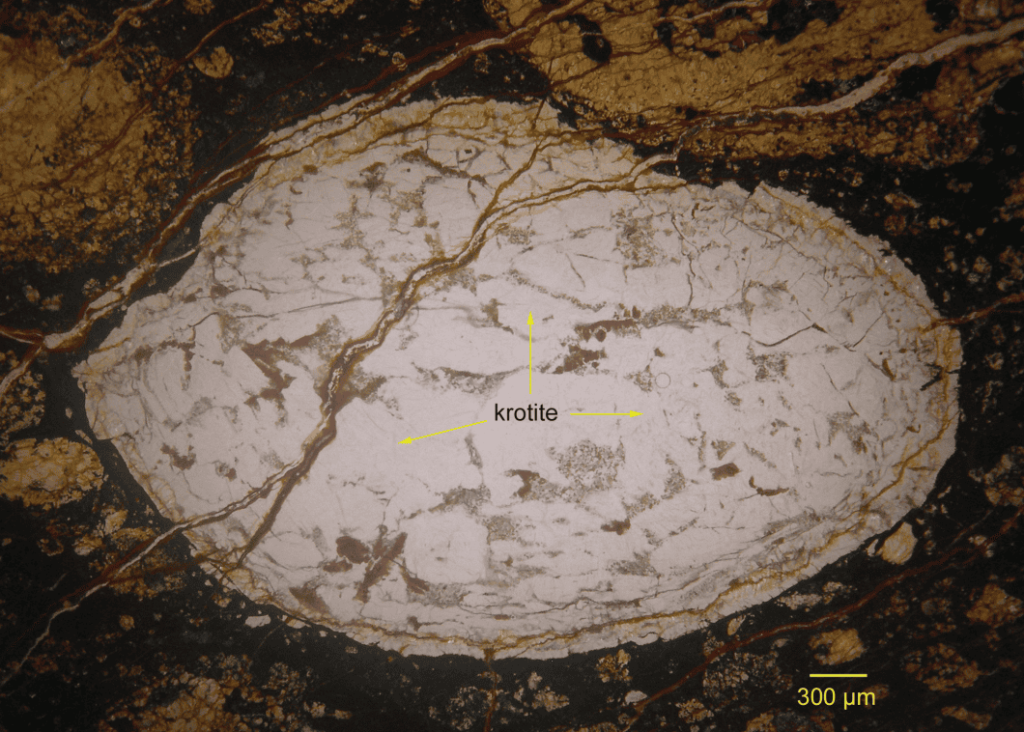
Krotite is a low-pressure, high-temperature calcium aluminate oxide mineral (CaAl₂O₄) discovered within refractory inclusions of primitive chondritic meteorites, serving as one of the earliest solid materials formed in the solar nebula.
View article
Basic Information Show Hide
Mineral ID
krotite
Common Synonyms / Aliases
Monocalcium aluminate, CaAl₂O₄
Chemistry Show Hide
Chemical Formula
CaAl₂O₄
Elements
Ca, Al, O
Minor Elements / Impurities
Fe, Mg, Ti, Si, Sr
Empirical Formula
Ca₁.₀₀Al₂.₀₀O₄.₀₀
Molecular Weight (g/mol)
158.04
Solubility
Very low in water; dissolves slowly in strong inorganic acids
Reaction to Acid
Slowly soluble in concentrated hydrochloric acid (HCl)
Classification Show Hide
Mineral Type
Mineral Species
IMA Status
Approved
IMA Symbol
Krt
Strunz Classification
04.AB.55
Dana Classification
04.02.06.01
Mineral Group
Oxide mineral
Crystal Structure Show Hide
Crystal System
Monoclinic
Crystal Habit
Microscopic subhedral to anhedral grains, irregular intergrowths
Crystal Class
Monoclinic Prismatic (2/m)
Space Group
P 2₁/n
Cell Parameter A (Angstrom)
8.700
Cell Parameter B (Angstrom)
8.092
Cell Parameter C (Angstrom)
15.217
Cell Angle Alpha (Degrees)
90
Cell Angle Beta (Degrees)
90.18
Cell Angle Gamma (Degrees)
90
Unit Cell Z
12
Crystal Twinning
Polysynthetic twinning observed along {001} planes
Common Crystal Faces
Indetermined due to sub-micron grain scale
Physical Properties Show Hide
Primary Color
ColorlessWhite
Common Colors
Colorless, White, Very Pale Gray
Streak
White
Luster
Vitreous
Transparency / Diaphaneity
Transparent to Translucent
Hardness (Mohs)
6.5 - 7
Cleavage
None
Cleavage Direction
Not reported
Cleavage Angle / Parting Quality
Not reported
Fracture
Not reported
Tenacity
Brittle
Specific Gravity
2.94 - 2.98
Magnetism
Non-magnetic
Melting Point
1605 °C
Thermal Stability
Exceptionally high thermal stability under low-oxygen refractory environments
Optical Properties Show Hide
Refractive Index
1.608 - 1.626
Refractive Index Alpha
1.608
Refractive Index Beta
1.618
Refractive Index Gamma
1.626
Optical Axial Angle (2V)
70° – 80°
Optical Sign / Extinction
-
Birefringence
0.018
Dispersion
Moderate
Optical Character
Biaxial-
Pleochroism
Non Pleochroic
Pleochroism Details
N/A
Optical Phenomena
High relief under petrographic microscopy
Fluorescence
Non-fluorescent under SW-UV and LW-UV
Luminescence / Phosphorescence / Thermoluminescence
Non-fluorescent
Absorption Spectrum
Not reported
Occurrence and Formation Show Hide
Formation Process
Formed as a primary high-temperature condensate (>1500 K) from the cooling solar nebula at low pressure (~10⁻³ bar).
Geological Environment
Calcium-aluminum-rich inclusion (CAI) in primitive carbonaceous chondrites
Associated Minerals
Perovskite, Melilite, Spinel, Hibonite, Davisite, Grossite
Type Locality
NWA 1934 carbonaceous chondrite meteorite, Northwest Africa (Morocco)
Major Producing Countries / Localities
Morocco
Economic Deposit Type
Refractory meteoritic inclusion
History and Naming Show Hide
Discovery Year
2010
Name Origin
Named after Alexander N. Krot, a renowned cosmochemist at the University of Hawaiʻi, for his major contributions to the understanding of early solar system processes.
Type Specimen Repository
National Museum of Natural History, Smithsonian Institution, Washington D.C., USA
Safety and Related Information Show Hide
Wearability
Poor
Health Hazards
None under ordinary conditions
Handling Precautions
Handle with standard laboratory care; protect thin-sections from physical abrasion.
Varieties
None reported
Polytypes
Monoclinic CaAl₂O₄ polymorph
Related Minerals
Grossite, Hibonite, Mayenite, Dmitryivanovite
Commercial and Gemology Show Hide
Common Treatments
None
Enhancements
None
Common Cuts
Not suitable for jewelry use; scientific microsections only.
Rarity / Market Grade
Extremely rare