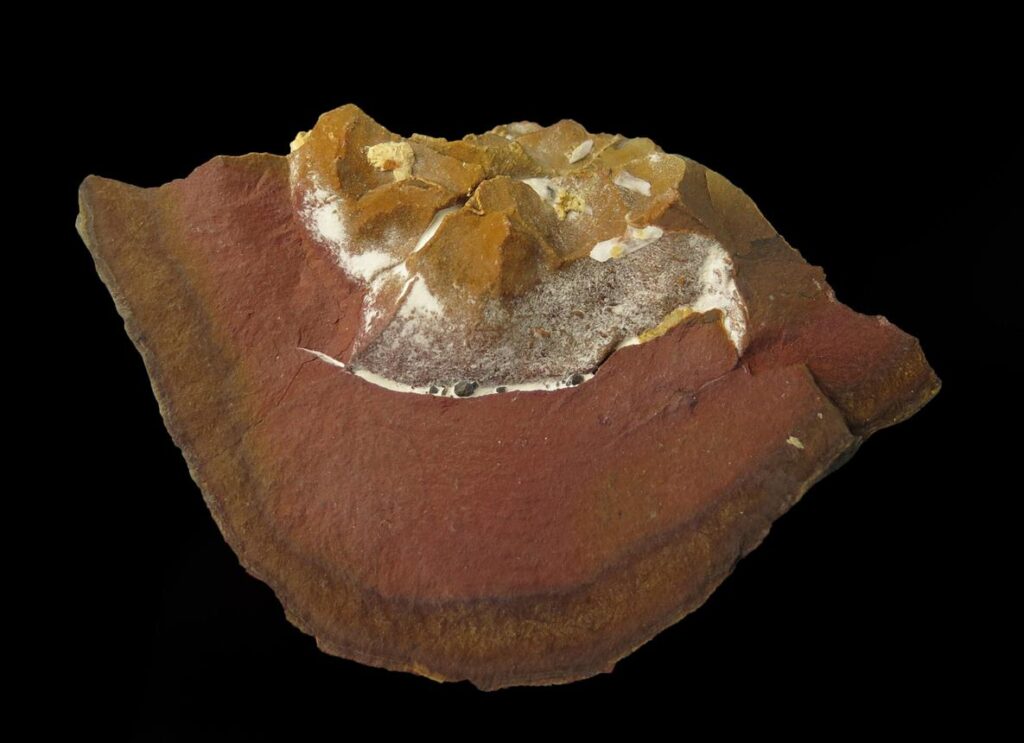
Names
Nacrite
Intro
Nacrite is a kaolin-group clay mineral and a polymorph of kaolinite with the formula Al₂Si₂O₅(OH)₄. It occurs as white, pearly, tabular crystals or fine scaly aggregates, commonly in hydrothermal alteration assemblages.
View article
Basic Information Show Hide
Mineral ID
nacrite
Common Synonyms / Aliases
No verified current mineralogical synonym; historical uses of the name for unrelated pearly minerals are obsolete.
Chemistry Show Hide
Chemical Formula
Al₂Si₂O₅(OH)₄
Elements
Aluminum (Al), Silicon (Si), Oxygen (O), Hydrogen (H)
Minor Elements / Impurities
Trace Ti and Fe reported in some analyzed specimens; likely from associated mineral inclusions.
Empirical Formula
Al₂Si₂O₅(OH)₄
Molecular Weight (g/mol)
258.16
Solubility
Insoluble in water; no quantitative solubility value reported for nacrite.
Reaction to Acid
No carbonate-like effervescence with dilute HCl; nacrite remained after acid treatment used to dissolve associated calcite.
Classification Show Hide
Mineral Type
Mineral Species
IMA Status
Grandfathered
IMA Symbol
Ncr
Strunz Classification
09.ED.05
Dana Classification
71.01.01.03
Mineral Group
Kaolinite–serpentine group (kaolin subgroup)
Crystal Structure Show Hide
Crystal System
Monoclinic
Crystal Habit
Irregular pseudohexagonal plates up to 8 mm and aggregates of plates; commonly massive.
Crystal Class
Domatic (m)
Space Group
Cc
Cell Parameter A (Angstrom)
8.909 Å
Cell Parameter B (Angstrom)
5.146 Å
Cell Parameter C (Angstrom)
15.697 Å
Cell Angle Alpha (Degrees)
90°
Cell Angle Beta (Degrees)
113.70°
Cell Angle Gamma (Degrees)
90°
Unit Cell Z
4
Crystal Twinning
Fan-shaped or bunch-like twinned aggregates observed in thin section; twin law not specified.
Common Crystal Faces
{001}
Physical Properties Show Hide
Primary Color
ColorlessYellow (Y)Green (G)WhiteBrown
Common Colors
Usually white; colorless to pale yellow-brown, with light green material reported from Hirvivaara, Finland.
Streak
White
Luster
Pearly
Transparency / Diaphaneity
Transparent in thin crystals
Hardness (Mohs)
2 - 2.5
Cleavage
Perfect
Cleavage Direction
Perfect on {001}
Cleavage / Parting Description
Perfect basal cleavage on {001}.
Fracture
Not reliably reported in the cited mineralogical descriptions; perfect {001} basal cleavage is the characteristic breakage plane.
Tenacity
Flexible but inelastic
Specific Gravity
2.5 - 2.7
Magnetism
Not determined in the cited mineralogical descriptions.
Melting Point
No single melting point reported; the mineral dehydroxylates before melting.
Thermal Stability
Dehydroxylates on heating. In a published test, coarse flakes lost most water at 500–600 °C, while ground powder lost most at 400–500 °C; results depend on sample and heating conditions.
Optical Properties Show Hide
Refractive Index
1.557 - 1.566
Refractive Index Alpha
1.557
Refractive Index Beta
1.562
Refractive Index Gamma
1.563
Optical Axial Angle (2V)
40°–90° (reported range)
Optical Sign / Extinction
Biaxial; both positive and negative signs have been reported. α = 1.557–1.560, β = 1.562–1.563, γ = 1.563–1.566.
Birefringence
0.006
Dispersion
Weak; r > v
Optical Character
Biaxial-
Pleochroism
None observed in thin section.
Pleochroism Details
Hirvivaara specimens were colorless and non-pleochroic in thin section.
Optical Phenomena
No special optical effect documented beyond pearly luster.
Fluorescence
Not reported in the cited mineralogical descriptions.
Luminescence / Phosphorescence / Thermoluminescence
Not reported in the cited mineralogical descriptions.
Absorption Spectrum
Room-temperature IR OH-stretching bands near 3705, 3655, 3634 and 3622 cm⁻¹ (Otoge mine sample, Japan).
Occurrence and Formation Show Hide
Formation Process
Hydrothermal origin.
Geological Environment
Hydrothermal alteration assemblages and kaolin-rich rocks.
Associated Minerals
Kaolinite, dickite, mica, quartz
Type Locality
Brand near Freiberg, Saxony, Germany (historical type locality).
Major Producing Countries / Localities
CanadaFinlandFranceGermanyJapanMexicoTunisiaUnited KingdomUnited States
Economic Deposit Type
Hydrothermal quartz–galena veins; pegmatitic feldspar alteration at some localities.
History and Naming Show Hide
Discovery Year
1807
Name Origin
From French nacre, meaning mother-of-pearl, in reference to its pearly luster.
Type Specimen Repository
Original type specimen repository not identified in the cited historical descriptions.
Safety and Related Information Show Hide
Wearability
Display only
Health Hazards
No nacrite-specific toxicology assessment identified; respirable kaolin-group mineral dust should not be inhaled.
Handling Precautions
Avoid generating airborne dust when grinding or cleaning specimens; handle thin platy crystals gently.
Varieties
No formally named varieties documented in the cited references.
Polytypes
Nacrite is a kaolin-group stacking polymorph alongside kaolinite and dickite.
Related Minerals
Kaolinite, dickite, halloysite
Commercial and Gemology Show Hide
Common Treatments
No routine gem treatment documented.
Enhancements
No commercial enhancement documented.
Common Cuts
No standard gem cuts documented; specimens are described as thin plates or masses.
Rarity / Market Grade
Probably widespread, but confident identification requires analytical characterization because it resembles other kaolin minerals.