
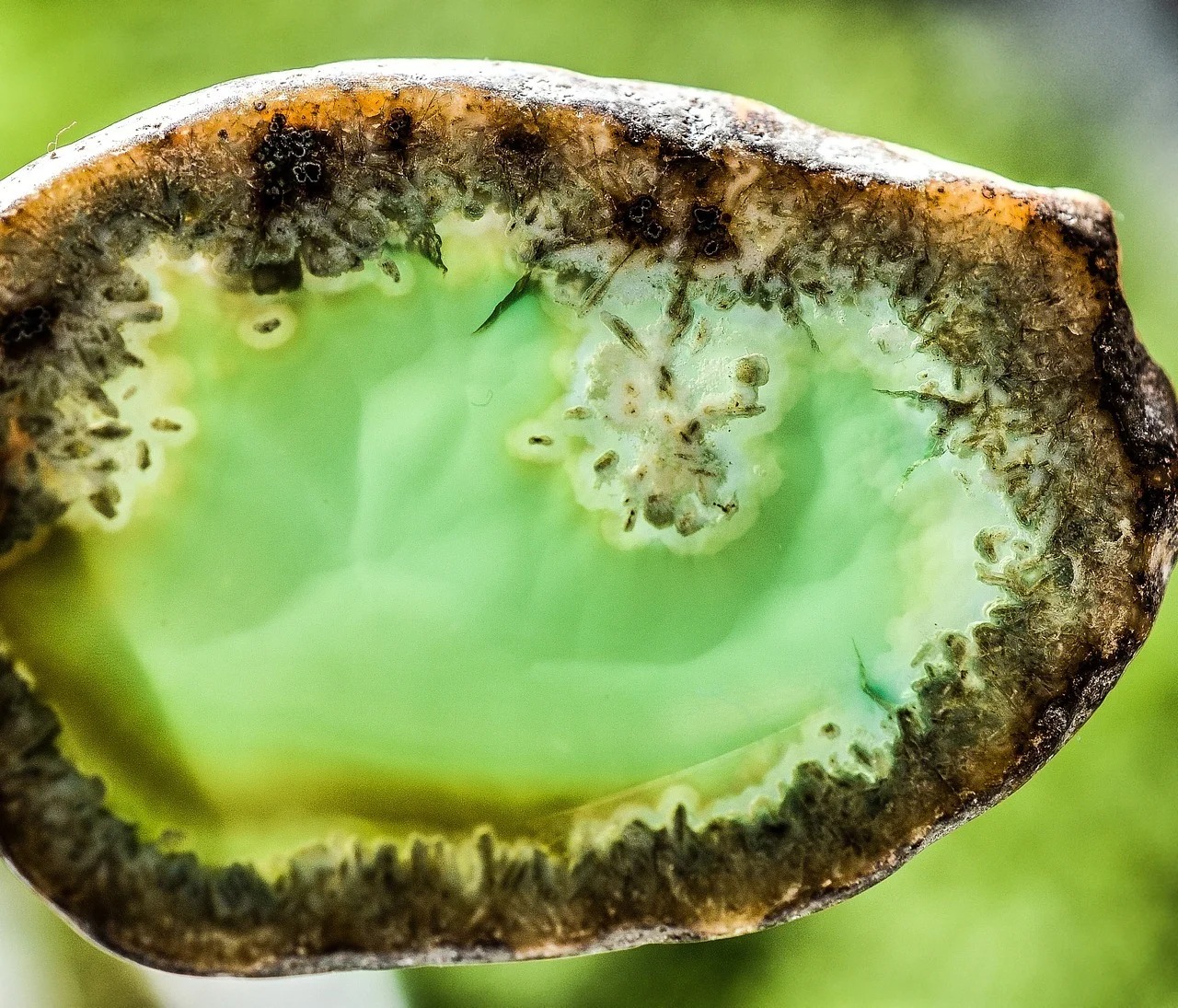
Kernowite is a hydrated copper–iron arsenate mineral with the ideal chemical formula Cu₂Fe(AsO₄)(OH)₄·4H₂O. It is an arsenate mineral and the ferric iron-dominant analogue of liroconite, Cu₂Al(AsO₄)(OH)₄·4H₂O. In the liroconite–kernowite series, Fe³⁺ substitutes for Al³⁺ at a structural site without fundamentally changing the overall framework. Kernowite is defined where ferric iron is the dominant occupant of that site; material with aluminium dominance remains liroconite, even where its colour is strongly green.
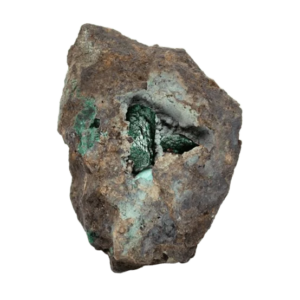
The mineral is known from old specimens probably collected at the Wheal Gorland mine near St Day, Cornwall, England. It occurs as a secondary mineral in the oxidized portion of a copper-bearing ore assemblage. Kernowite is generally green, whereas aluminium-dominant liroconite is typically blue to blue-green. Colour can suggest an increased iron content, but it cannot establish mineral identity because many green specimens historically labelled as liroconite remain aluminium-dominant when analysed.
History and Discovery of Kernowite
Kernowite was approved as a new mineral species by the International Mineralogical Association in 2020 under proposal number IMA 2020-053. Its formal mineral description was published in 2021. The type material is not a recently collected specimen; instead, it is a historical specimen probably mined around 1800 at Wheal Gorland. Before its re-examination, the material had been labelled as liroconite and had passed through several historical mineral collections, including those of the Cornish collector Philip Rashleigh and Sir Arthur Russell.
The mineral was named after Kernow, the Cornish-language name for Cornwall. The choice reflects the type locality rather than a particular person. Kernowite was identified after mineralogical examination showed that ferric iron, rather than aluminium, dominates the relevant octahedrally coordinated site in material that had previously been grouped with liroconite.
Its recognition illustrates a compositional distinction within a known mineral series. Earlier observations had established that greener liroconite specimens commonly contain more iron than blue examples. However, iron enrichment alone does not justify a separate species. Kernowite is restricted to material in which Fe³⁺ exceeds Al³⁺ at the relevant structural site. This species definition follows the dominant-constituent rule used in modern mineral nomenclature.
Formation and Geological Occurrence of Kernowite
Kernowite occurs as a secondary mineral in cavities within quartz-rich gossan. Gossan is an oxidized, weathered material developed above or around sulfide-bearing ore. In the type material, the cavities contain poorly differentiated microcrystalline grey sulfides and poorly crystalline arsenic-bearing phases, including pharmacosiderite and minerals of the olivenite group. This association is consistent with mineral formation during oxidation and alteration of a primary copper–arsenic sulfide assemblage.
The formation of Kernowite requires the availability of copper, ferric iron, arsenic, oxygen, hydroxyl-bearing fluids, and water. During weathering, oxidation of primary sulfides can release Cu²⁺ and Fe³⁺ into acidic to locally neutralized solutions. Arsenic may be released from arsenic-bearing sulfides or arsenides and transported as arsenate species under oxidizing conditions. Where these components interact in open spaces, such as fractures and cavities in gossan, hydrated copper–iron arsenates may precipitate.
The mineral’s hydration state indicates formation in a near-surface or low-temperature aqueous environment rather than under high-temperature magmatic conditions. Its occurrence with pharmacosiderite and olivenite-group minerals also reflects local changes in pH, redox conditions, dissolved-metal concentrations, and water activity. Such conditions may vary over small distances within the same oxidized ore zone, allowing several copper and iron arsenate minerals to develop together.
Crystal Structure of Kernowite
Kernowite crystallizes in the monoclinic crystal system. Its structure was determined by single-crystal X-ray diffraction in space group I2/a, a non-standard setting of the conventional space group C2/c. The structure is closely related to that of liroconite, consistent with the substitution of Fe³⁺ for Al³⁺ rather than a complete reconstruction of the mineral framework.
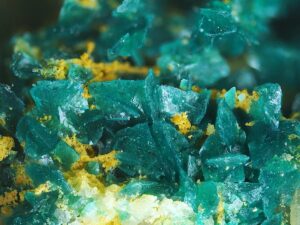
The structure consists of linked arsenate tetrahedra, hydroxyl-bearing metal coordination polyhedra, and water molecules. Copper occupies sites affected by the Jahn–Teller distortion characteristic of Cu²⁺ compounds, producing elongated copper–oxygen coordination environments. Ferric iron occupies an octahedrally coordinated site that is occupied primarily by aluminium in liroconite. The replacement of Al³⁺ by the larger Fe³⁺ cation produces measurable structural differences while retaining the same basic structural type.
Water molecules are structurally important in Kernowite. The ideal formula contains four molecules of water per formula unit, in addition to four hydroxyl groups. Hydrogen bonding between water molecules, hydroxyl groups, and oxygen atoms of arsenate tetrahedra contributes to the stability of the hydrated structure. Loss or modification of structural water may affect the mineral during heating, dehydration, or prolonged alteration.
Physical and Chemical Properties of Kernowite
Kernowite is usually described as green to emerald green. Its colour is associated with the presence of Cu²⁺ and Fe³⁺, although the precise shade depends on grain thickness, crystal orientation, inclusions, surface condition, and the relative proportions of iron and aluminium. It may occur as small crystals or crystal aggregates lining cavities in quartz-gossan material. Because the confirmed material comes from old specimens and is closely intergrown with other secondary phases, many conventional physical measurements are limited.
The ideal formula, Cu₂Fe(AsO₄)(OH)₄·4H₂O, contains copper, ferric iron, arsenate, hydroxyl groups, and molecular water. Electron-microprobe analysis of type material, supplemented by Raman spectroscopy, gave an empirical composition close to Cu₁.₈₈(Fe₀.₇₉Al₀.₀₉)Σ₀.₈₈(As₁.₁₂O₄)(OH)₄·3.65H₂O. This analysis shows that the type material is not chemically ideal: it contains minor aluminium and has small deviations in copper, iron, arsenic, and water contents. Such deviations are typical of secondary hydrated minerals and do not alter the species assignment when Fe³⁺ remains dominant over Al³⁺.
Kernowite should be treated as a hydrated mineral that may be sensitive to alteration. Surface dehydration, weathering, microfracturing, and mixtures with adjacent arsenate phases can complicate analytical results. Its optical appearance and approximate chemistry are useful preliminary indicators, but definitive identification requires quantitative analysis and structural confirmation.
Types and Varieties of Kernowite
Kernowite has no officially recognized varieties. The following terms describe compositional or geological relationships rather than separate varieties:
- Iron-dominant Kernowite: Material in the liroconite–kernowite series in which Fe³⁺ is dominant over Al³⁺ at the relevant structural site.
- Aluminium-bearing Kernowite: Kernowite may contain minor Al³⁺, as shown by the type-material analysis. It remains Kernowite as long as Fe³⁺ remains dominant.
- Liroconite–Kernowite intermediate material: Samples with variable Fe³⁺ and Al³⁺ contents occur within the solid-solution series. Their mineral name depends on the dominant cation, not on colour.
- Green liroconite: Green colour alone does not prove Kernowite. Many green samples remain Al³⁺-dominant and should be identified as liroconite after chemical analysis.
Where Is Kernowite Found?
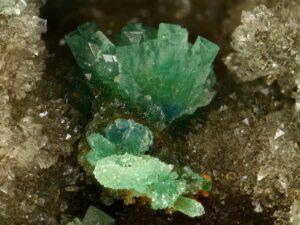
The confirmed type locality is Wheal Gorland, near St Day in Cornwall, England. Wheal Gorland was part of the historically important copper-mining district around St Day and was worked principally for copper ores. The type specimen is associated with old mine material, probably collected around 1800, and was later preserved in museum collections.
The mineral is reported from cavities in quartz-gossan rather than from fresh unaltered sulfide ore. Its immediate association includes poorly crystalline arsenic phases, pharmacosiderite, olivenite-group minerals, and undifferentiated grey sulfide material. This setting is characteristic of an oxidized copper–arsenic mineral assemblage.
Kernowite should not presently be treated as a widespread mineral with many confirmed localities. Its formal definition is recent, and many historical green specimens from Cornwall or other oxidized copper deposits may not have been examined using modern quantitative and crystallographic methods. Material described historically as iron-rich liroconite requires re-analysis before it can be assigned to Kernowite.
How to Identify Kernowite
Visual examination can provide an initial indication because Kernowite is commonly green and occurs in an oxidized copper–arsenic assemblage. However, visual identification is unreliable. Copper arsenates, copper phosphates, hydrated iron arsenates, and green liroconite can occur in the same setting and may resemble one another in hand specimen or under a microscope.
Electron-microprobe analysis is the primary method for determining whether Fe³⁺ or Al³⁺ dominates the relevant site. The analysis should measure copper, iron, aluminium, arsenic, and other possible substituting elements, while water and hydroxyl contents must be inferred from stoichiometry and supplemented where possible by spectroscopic methods. Raman spectroscopy is useful for confirming the presence of arsenate groups, hydroxyl groups, and structural water, especially when crystals are too small for conventional bulk methods.
Single-crystal X-ray diffraction provides the most direct confirmation of the structure where an appropriate crystal can be isolated. Powder X-ray diffraction, electron diffraction, and electron backscatter diffraction may also assist with identification, although interpretation can be difficult when grains are small, poorly crystalline, hydrated, or intergrown with other secondary phases. A reliable identification of Kernowite should therefore combine occurrence, chemical composition, Raman data, and crystallographic evidence.
The principal mineral requiring distinction is liroconite, Cu₂Al(AsO₄)(OH)₄·4H₂O. Kernowite and liroconite have the same overall structural type, similar hydration, and closely related chemical formulas. The decisive criterion is Fe³⁺ dominance in Kernowite versus Al³⁺ dominance in liroconite. Other associated arsenates, including pharmacosiderite and olivenite-group minerals, differ in crystal structure, cation ratios, hydration, and optical properties.
Applications and Uses of Kernowite
Kernowite has no established industrial, gemstone, ornamental, or ore-processing application. It occurs in limited quantities as a secondary mineral and is not mined separately. Its high arsenic content also makes it unsuitable for ordinary handling without appropriate mineral-specimen precautions.
Its use is primarily mineralogical and analytical. Kernowite provides a defined ferric iron end-member for the liroconite–kernowite series and allows historical Cornish copper-arsenate specimens to be classified more precisely. The mineral may also be used in studies of secondary arsenate formation in oxidized copper deposits, particularly where iron–aluminium substitution affects mineral stability and colour.